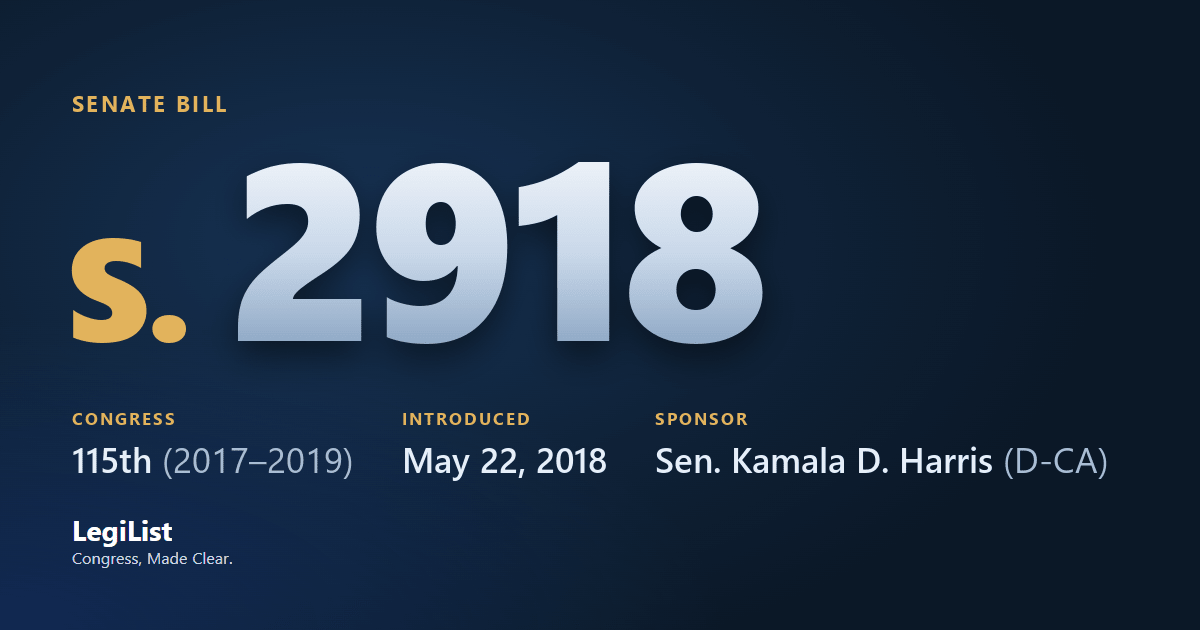
Do No Harm Act
Latest action · May 22, 2018 Read twice and referred to the Committee on the Judiciary.
Progress
Where this bill reached, and when. A stage with no date was not reached; one that failed a vote and later carried shows the date it carried.
- IntroducedMay 22, 2018
- Passed SenateNot reached
- Passed HouseNot reached
- To the PresidentNot reached
- Became lawNot reached
Summary
Do No Harm Act
This bill makes the Religious Freedom Restoration Act of 1993 (RFRA) inapplicable to federal laws (or implementations of laws) that:
- protect against discrimination or the promotion of equal opportunity, including the Civil Rights Act of 1964, the Americans with Disabilities Act, the Family Medical Leave Act, Executive Order 11246 (concerning equal employment opportunity), the Violence Against Women Act, and the Department of Housing and Urban Development's (HUD's) rules entitled "Equal Access to Housing in HUD Programs Regardless of Sexual Orientation or Gender Identity";
- require employers to provide wages, other compensation, or benefits, including leave;
- protect collective activity in the workplace;
- protect against child labor, abuse, or exploitation; or
- provide for access to, information about, referrals for, provision of, or coverage for, any health care item or service.
Under current law, RFRA prohibits the government from substantially burdening a person's exercise of religion even if the burden results from a rule of general applicability, except in furtherance of a compelling governmental interest when using the least restrictive means.
The bill makes RFRA inapplicable to: (1) terms requiring goods, services, functions, or activities to be performed or provided to beneficiaries of government contracts, grants, cooperative agreements, or awards; or (2) denials of a person's full and equal enjoyment of a government-provided good, service, benefit, facility, privilege, advantage, or accommodation.
To assert a RFRA claim or defense in a judicial proceeding, the government must be a party to the proceeding.
Cosponsors 31
Members who signed on, in the order they did. Signatures ran from May 22, 2018 to Dec 19, 2018; 12 are original cosponsors, there from the day it was introduced.
| Seat | Cosponsor | Signed on | |
|---|---|---|---|
| I-VT | Bernard Sanders | Original | May 22, 2018 |
| D-CA | Dianne Feinstein | Original | May 22, 2018 |
| D-MA | Edward J. Markey | Original | May 22, 2018 |
| D-MA | Elizabeth Warren | Original | May 22, 2018 |
| D-OR | Jeff Merkley | Original | May 22, 2018 |
| D-NY | Kirsten E. Gillibrand | Original | May 22, 2018 |
| D-HI | Mazie K. Hirono | Original | May 22, 2018 |
| D-VT | Patrick J. Leahy | Original | May 22, 2018 |
| D-IL | Richard J. Durbin | Original | May 22, 2018 |
| D-OR | Ron Wyden | Original | May 22, 2018 |
| D-RI | Sheldon Whitehouse | Original | May 22, 2018 |
| D-MN | Tina Smith | Original | May 22, 2018 |
| D-NV | Catherine Cortez Masto | Sep 12, 2018 | |
| D-NH | Jeanne Shaheen | Sep 12, 2018 | |
| D-WA | Patty Murray | Sep 12, 2018 |
Committees 1
Where it was sent and what each committee and subcommittee did with it, in order.
| Chamber | Committee | What it did |
|---|---|---|
| Senate | Judiciary Committee | Referred May 22, 2018 |
Actions 2
Everything that happened, newest first.
- May 22, 2018Introduced in Senate
- May 22, 2018Read twice and referred to the Committee on the Judiciary.
Related bills 2
Companion bills and other measures the record links to this one.
| Bill | Title | Relationship | Latest action |
|---|---|---|---|
| S 593 | Do No Harm Act | Reintroduced Bill | Feb 28, 2019 |
| HR 3222 | Do No Harm Act | Related bill | Aug 3, 2017 |
Titles 2
Every title it has carried, official and short, at each stage.
- Official Title as Introduced
- A bill to amend the Religious Freedom Restoration Act of 1993 to protect civil rights and otherwise prevent meaningful harm to third parties, and for other purposes.
- Short Titles as Introduced
- Do No Harm Act
Subjects
Assigned by the Library of Congress. Policy area: Civil Rights and Liberties, Minority Issues.
- Civil actions and liability
- Civil Rights and Liberties, Minority Issues
- Crimes against women
- Disability and health-based discrimination
- Employee leave
- Employment discrimination and employee rights
- First Amendment rights
- Government liability
- Health care coverage and access
- Housing discrimination
- Labor-management relations
- Religion
- Sex, gender, sexual orientation discrimination
- Wages and earnings
- Youth employment and child labor
Text 1
Each version as it was printed, newest first.
- May 22, 2018Introduced in Senate
Support LegiList
This page is free, carries no paywall, and is built and maintained by one person. If the record here is useful to you, a few dollars keeps it going.
Everything here is as published by Congress: the summary is the Congressional Research Service's, the action wording is the clerks', and the subjects are the Library of Congress's. How far it got is read from the actions themselves, taking the most recent one of each kind, so a bill that failed a vote and later passed is shown as having passed. Records come from this bill on Congress.gov and govinfo.gov; cost estimates are the Congressional Budget Office's, and the hearings are the printed hearings GovInfo publishes, which can appear months after the hearing.