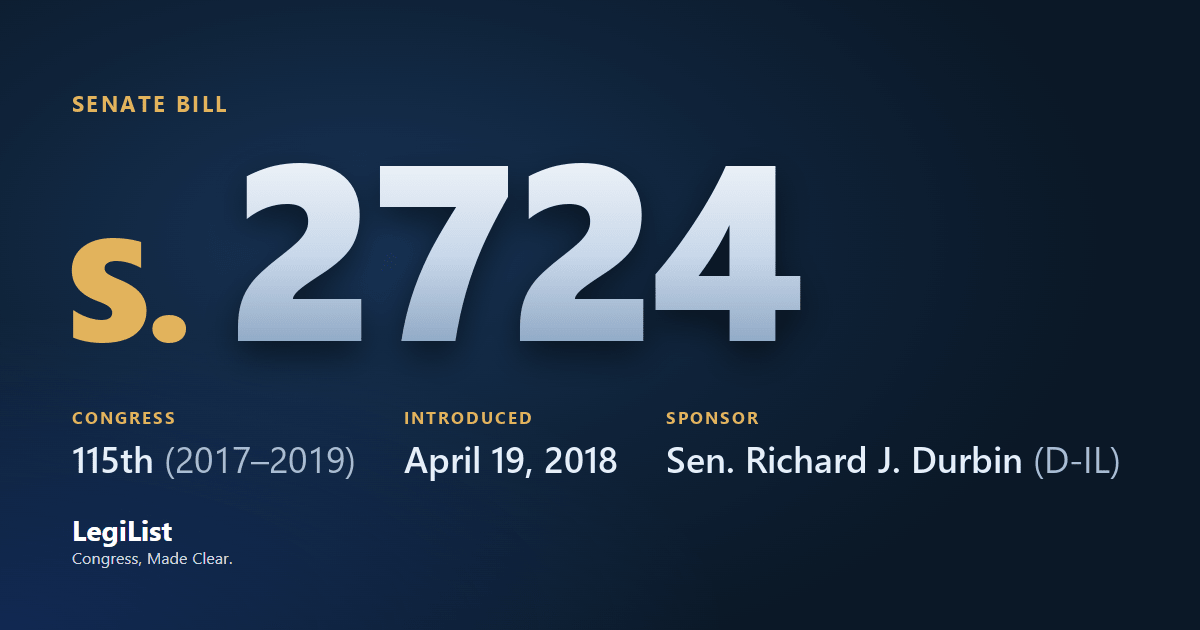
Solitary Confinement Reform Act
Latest action · Apr 19, 2018 Read twice and referred to the Committee on the Judiciary. (text of measure as introduced: CR S2324-2329)
Progress
Where this bill reached, and when. A stage with no date was not reached; one that failed a vote and later carried shows the date it carried.
- IntroducedApr 19, 2018
- Passed SenateNot reached
- Passed HouseNot reached
- To the PresidentNot reached
- Became lawNot reached
Summary
Solitary Confinement Reform Act
This bill amends the federal criminal code to establish standards for the use of solitary confinement at federal prisons.
It limits the use of solitary confinement to situations that meet certain criteria, including that the confinement is limited to the briefest term and the least restrictive conditions practicable. It also prohibits, with limited exceptions, solitary confinement of inmates who are younger than 18 years of age, disabled, pregnant, or recently pregnant.
The bill requires the Bureau of Prisons (BOP) to establish a transitional process for inmates in solitary confinement, requires inmates in solitary confinement to receive comprehensive mental health evaluations, and requires BOP employees to complete training on mental illness and the psychological effects of solitary confinement.
It establishes, within the BOP, an Office of the Civil Rights Ombudsman. The office must be headed by a Civil Rights Ombudsman appointed by the Attorney General.
The BOP must annually assess and report on the use of solitary confinement.
The Department of Justice's Bureau of Justice Assistance must establish and administer a solitary confinement resource center.
Cosponsors 6
Members who signed on, in the order they did. Signatures ran from Apr 19, 2018 to Nov 13, 2018; 4 are original cosponsors, there from the day it was introduced.
| Seat | Cosponsor | Signed on | |
|---|---|---|---|
| D-DE | Christopher A. Coons | Original | Apr 19, 2018 |
| D-NJ | Cory A. Booker | Original | Apr 19, 2018 |
| D-MA | Elizabeth Warren | Original | Apr 19, 2018 |
| D-VT | Patrick J. Leahy | Original | Apr 19, 2018 |
| D-CA | Kamala D. Harris | May 21, 2018 | |
| D-HI | Brian Schatz | Nov 13, 2018 |
Committees 1
Where it was sent and what each committee and subcommittee did with it, in order.
| Chamber | Committee | What it did |
|---|---|---|
| Senate | Judiciary Committee | Referred Apr 19, 2018 |
Actions 2
Everything that happened, newest first.
- Apr 19, 2018Introduced in Senate
- Apr 19, 2018Read twice and referred to the Committee on the Judiciary. (text of measure as introduced: CR S2324-2329)
In the Congressional Record 1
Days the Record’s own index lists this bill, newest first, with the pages and the members it names. Pages starting H are the House, S the Senate, E Extensions of Remarks.
| Where | In the Record | Members | Date |
|---|---|---|---|
| Senate | Text printed S2324 | Richard J. Durbin D-IL (text) | Apr 19, 2018 |
Related bills 2
Companion bills and other measures the record links to this one.
| Bill | Title | Relationship | Latest action |
|---|---|---|---|
| S 719 | Solitary Confinement Reform Act | Reintroduced Bill | Mar 7, 2019 |
| S 3432 | Solitary Confinement Reform Act | Reintroduction of | Sep 28, 2016 |
Titles 2
Every title it has carried, official and short, at each stage.
- Official Title as Introduced
- A bill to reform the use of solitary confinement and other forms of restrictive housing in the Bureau of Prisons, and for other purposes.
- Short Titles as Introduced
- Solitary Confinement Reform Act
Subjects
Assigned by the Library of Congress. Policy area: Crime and Law Enforcement.
- Administrative law and regulatory procedures
- Administrative remedies
- Assault and harassment offenses
- Child safety and welfare
- Congressional oversight
- Correctional facilities and imprisonment
- Crime and Law Enforcement
- Criminal justice information and records
- Department of Justice
- Disability and paralysis
- Executive agency funding and structure
- Government information and archives
- Government studies and investigations
- Health personnel
- HIV/AIDS
- Intergovernmental relations
- Juvenile crime and gang violence
- Medical tests and diagnostic methods
- Mental health
- Sex, gender, sexual orientation discrimination
- State and local government operations
- Women's health
Text 1
Each version as it was printed, newest first.
- Apr 19, 2018Introduced in Senate
Everything here is as published by Congress: the summary is the Congressional Research Service's, the action wording is the clerks', and the subjects are the Library of Congress's. How far it got is read from the actions themselves, taking the most recent one of each kind, so a bill that failed a vote and later passed is shown as having passed. Records come from this bill on Congress.gov and govinfo.gov; cost estimates are the Congressional Budget Office's, and the hearings are the printed hearings GovInfo publishes, which can appear months after the hearing.