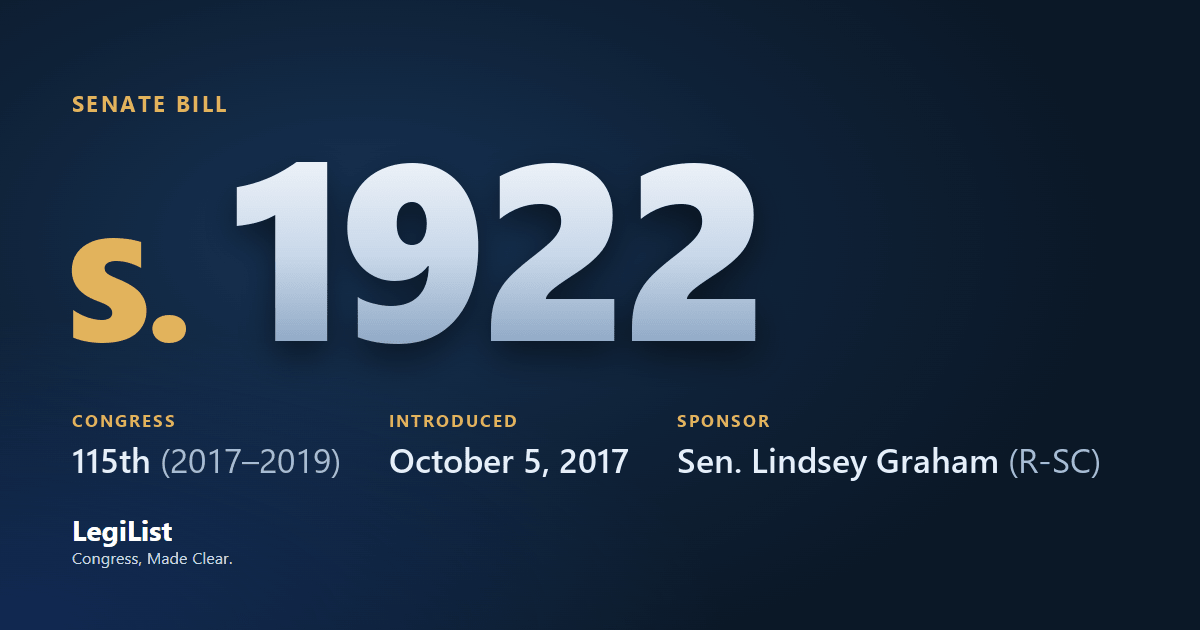
Pain-Capable Unborn Child Protection Act
Latest action · Oct 5, 2017 Read twice and referred to the Committee on the Judiciary.
Progress
Where this bill reached, and when. A stage with no date was not reached; one that failed a vote and later carried shows the date it carried.
- IntroducedOct 5, 2017
- Passed SenateNot reached
- Passed HouseNot reached
- To the PresidentNot reached
- Became lawNot reached
Summary
Pain-Capable Unborn Child Protection Act
This bill amends the federal criminal code to make it a crime for any person to perform or attempt to perform an abortion if the probable post-fertilization age of the fetus is 20 weeks or more.
A violator is subject to criminal penalties—a fine, up to five years in prison, or both.
The bill provides exceptions for an abortion: (1) that is necessary to save the life of the pregnant woman, or (2) when the pregnancy is the result of rape or incest. A physician who performs or attempts to perform an abortion under an exception must comply with specified requirements.
A woman who undergoes a prohibited abortion may not be prosecuted for violating or conspiring to violate the provisions of this bill.
Cosponsors 48
Members who signed on, in the order they did. Signatures ran from Oct 5, 2017 to Nov 15, 2018; 45 are original cosponsors, there from the day it was introduced.
| Seat | Cosponsor | Signed on | |
|---|---|---|---|
| R-NE | Ben Sasse | Original | Oct 5, 2017 |
| R-LA | Bill Cassidy | Original | Oct 5, 2017 |
| R-TN | Bob Corker | Original | Oct 5, 2017 |
| R-IA | Chuck Grassley | Original | Oct 5, 2017 |
| R-AK | Dan Sullivan | Original | Oct 5, 2017 |
| R-GA | David Perdue | Original | Oct 5, 2017 |
| R-NE | Deb Fischer | Original | Oct 5, 2017 |
| R-ID | James E. Risch | Original | Oct 5, 2017 |
| R-OK | James Lankford | Original | Oct 5, 2017 |
| R-OK | James M. Inhofe | Original | Oct 5, 2017 |
| R-AZ | Jeff Flake | Original | Oct 5, 2017 |
| R-KS | Jerry Moran | Original | Oct 5, 2017 |
| R-WY | John Barrasso | Original | Oct 5, 2017 |
| R-AR | John Boozman | Original | Oct 5, 2017 |
| R-TX | John Cornyn | Original | Oct 5, 2017 |
Committees 1
Where it was sent and what each committee and subcommittee did with it, in order.
| Chamber | Committee | What it did |
|---|---|---|
| Senate | Judiciary Committee | Referred Oct 5, 2017 |
Actions 2
Everything that happened, newest first.
- Oct 5, 2017Introduced in Senate
- Oct 5, 2017Read twice and referred to the Committee on the Judiciary.
Research
What has been written about this bill: committee reports, cost estimates, the sponsor’s authority statement, printed hearings and the Congressional Research Service’s work.
CRS reports 1
Congressional Research Service work that CRS links to this bill or the law it became, newest first.
Cite it 1
Products on other subjects that cite it, usually among other measures.
| Product | Title | Kind | Published |
|---|---|---|---|
| R45161 | Abortion At or Over 20 Weeks’ Gestation: Frequently Asked Questions | Report | Apr 30, 2018 |
Related bills 4
Companion bills and other measures the record links to this one.
| Bill | Title | Relationship | Latest action |
|---|---|---|---|
| HR 36 | Pain-Capable Unborn Child Protection Act | Related bill | Oct 4, 2017 |
| S 160 | Pain-Capable Unborn Child Protection Act | Reintroduced Bill | Apr 9, 2019 |
| S 1553 | Pain-Capable Unborn Child Protection Act | Reintroduction of | Mar 15, 2016 |
| S 2311 | Pain-Capable Unborn Child Protection Act | Identical bill | Jan 29, 2018 |
Titles 2
Every title it has carried, official and short, at each stage.
- Official Title as Introduced
- A bill to amend title 18, United States Code, to protect pain-capable unborn children, and for other purposes.
- Short Titles as Introduced
- Pain-Capable Unborn Child Protection Act
Subjects
Assigned by the Library of Congress. Policy area: Crime and Law Enforcement.
- Abortion
- Assault and harassment offenses
- Civil actions and liability
- Crime and Law Enforcement
- Crime victims
- Crimes against children
- Crimes against women
- Criminal investigation, prosecution, interrogation
- Government information and archives
- Health information and medical records
- Health personnel
- Medical ethics
- Medical tests and diagnostic methods
- Sex offenses
- Women's health
Text 1
Each version as it was printed, newest first.
- Oct 5, 2017Introduced in Senate
Support LegiList
This page is free, carries no paywall, and is built and maintained by one person. If the record here is useful to you, a few dollars keeps it going.
Everything here is as published by Congress: the summary is the Congressional Research Service's, the action wording is the clerks', and the subjects are the Library of Congress's. How far it got is read from the actions themselves, taking the most recent one of each kind, so a bill that failed a vote and later passed is shown as having passed. Records come from this bill on Congress.gov and govinfo.gov; cost estimates are the Congressional Budget Office's, and the hearings are the printed hearings GovInfo publishes, which can appear months after the hearing.