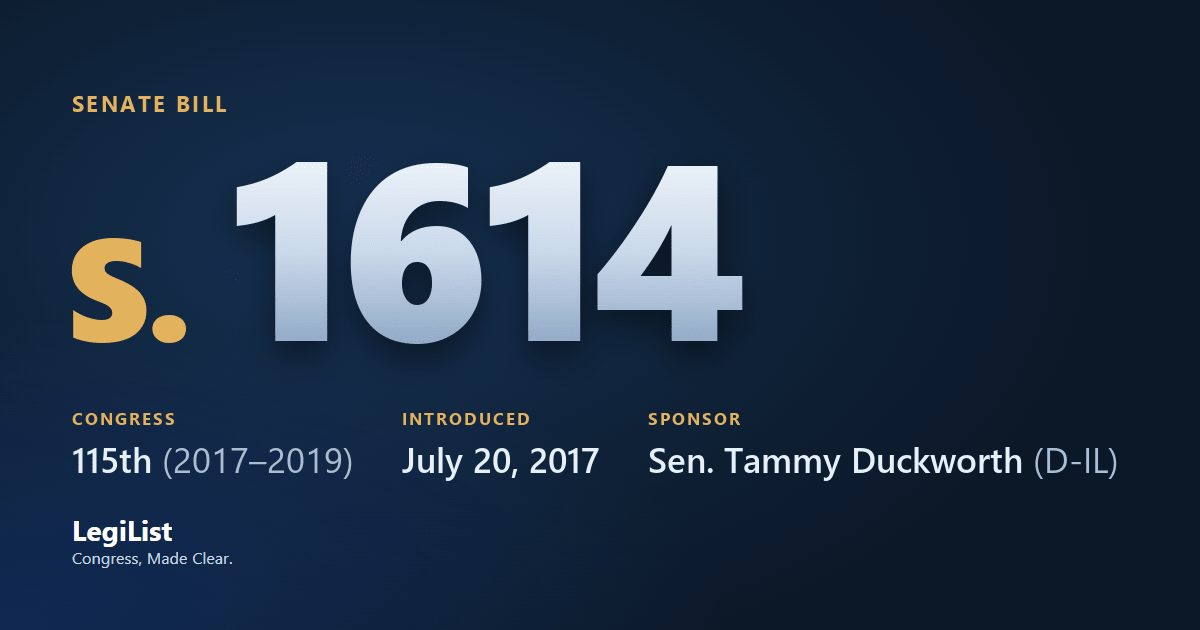
Video Visitation and Inmate Calling in Prisons Act of 2017
Latest action · Jul 20, 2017 Read twice and referred to the Committee on the Judiciary.
Progress
Where this bill reached, and when. A stage with no date was not reached; one that failed a vote and later carried shows the date it carried.
- IntroducedJul 20, 2017
- Passed SenateNot reached
- Passed HouseNot reached
- To the PresidentNot reached
- Became lawNot reached
Summary
Video Visitation and Inmate Calling in Prisons Act of 2017
This bill requires the Federal Communications Commission to promulgate regulations for video visitation services that allow inmates to make video calls to individuals outside a correctional facility, and amend its regulations on inmate calling services as necessary to ensure that all charges and practices are just and reasonable.
The regulations must include:
- video visitation cannot replace in-person visits;
- caps on rates charged by service providers;
- a prohibition against charging flat rates;
- a prohibition against a provider requiring a correctional facility to restrict in-person visitation as a condition to providing a calling or video visitation service;
- a requirement for a provider to submit an annual report about interstate, intrastate, and international inmate calling services;
- a prohibition against the provider offering bundled services that include non-communications services; and
- video quality standards.
The federal criminal code is amended to require the Bureau of Prisons to ensure that:
- video visitation does not supplant in-person visitation;
- privacy is maximized in the video areas and equipment;
- no persons other than corrections officers have authority over the terms of a prisoner's imprisonment, including visitation schedules or the ability to move within a correctional facility; and
- service providers provide a list of each video visitation and each fee charged to visitors and prisoners, offer free visits based on good behavior if authorized by the correctional facility, and submit quarterly compliance reports.
Cosponsors
Members who signed on, in the order they did.
Committees 1
Where it was sent and what each committee and subcommittee did with it, in order.
| Chamber | Committee | What it did |
|---|---|---|
| Senate | Judiciary Committee | Referred Jul 20, 2017 |
Actions 2
Everything that happened, newest first.
- Jul 20, 2017Introduced in Senate
- Jul 20, 2017Read twice and referred to the Committee on the Judiciary.
Research
What has been written about this bill: committee reports, cost estimates, the sponsor’s authority statement, printed hearings and the Congressional Research Service’s work.
CRS reports 1
Congressional Research Service work that CRS links to this bill or the law it became, newest first.
Cite it 1
Products on other subjects that cite it, usually among other measures.
| Product | Title | Kind | Published |
|---|---|---|---|
| R46486 | Telegraphs, Steamships, and Virtual Currency: An Analysis of Money Transmitter Regulation Archived | Report | Aug 20, 2020 |
Titles 2
Every title it has carried, official and short, at each stage.
- Official Title as Introduced
- A bill to provide for the regulation of video visitation services and inmate calling services by the Federal Communications Commission generally, to establish criteria for the provision of video visitation services by the Bureau of Prisons, and for other purposes.
- Short Titles as Introduced
- Video Visitation and Inmate Calling in Prisons Act of 2017
Subjects
Assigned by the Library of Congress. Policy area: Science, Technology, Communications.
- Administrative law and regulatory procedures
- Consumer affairs
- Contracts and agency
- Correctional facilities and imprisonment
- Federal Communications Commission (FCC)
- Government information and archives
- Internet and video services
- Internet, web applications, social media
- Right of privacy
- Science, Technology, Communications
- Telecommunication rates and fees
- Telephone and wireless communication
Text 1
Each version as it was printed, newest first.
- Jul 20, 2017Introduced in Senate
Support LegiList
This page is free, carries no paywall, and is built and maintained by one person. If the record here is useful to you, a few dollars keeps it going.
Everything here is as published by Congress: the summary is the Congressional Research Service's, the action wording is the clerks', and the subjects are the Library of Congress's. How far it got is read from the actions themselves, taking the most recent one of each kind, so a bill that failed a vote and later passed is shown as having passed. Records come from this bill on Congress.gov and govinfo.gov; cost estimates are the Congressional Budget Office's, and the hearings are the printed hearings GovInfo publishes, which can appear months after the hearing.