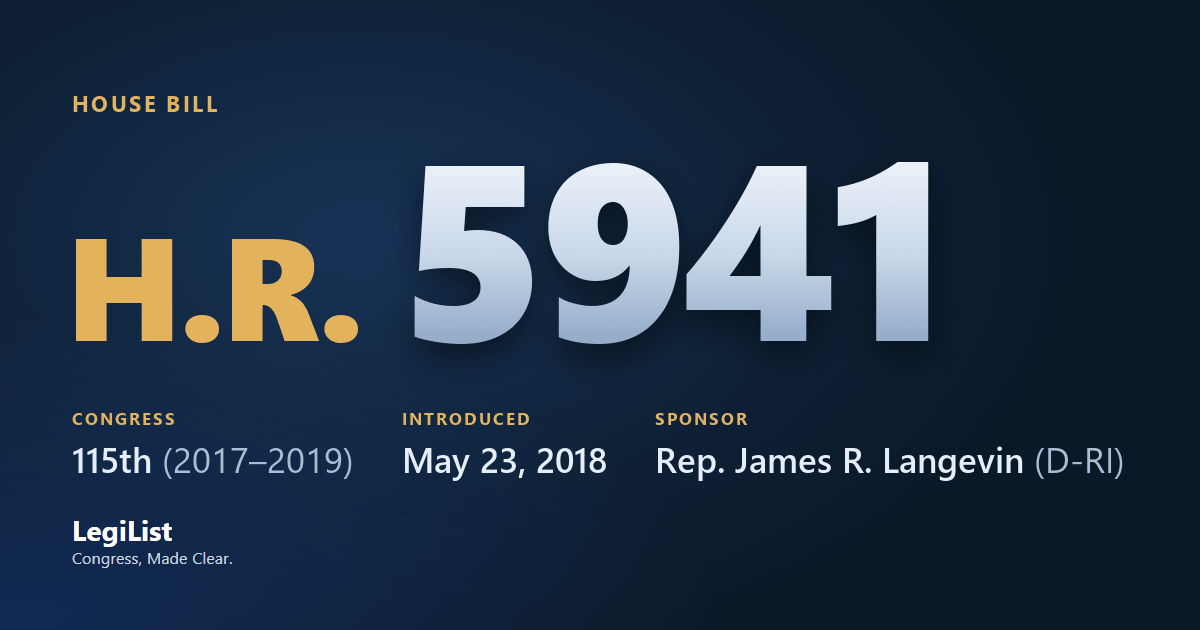
Child Gun Access Prevention Act
Latest action · Jun 5, 2018 Referred to the Subcommittee on Crime, Terrorism, Homeland Security, and Investigations.
Progress
Where this bill reached, and when. A stage with no date was not reached; one that failed a vote and later carried shows the date it carried.
- IntroducedMay 23, 2018
- Passed HouseNot reached
- Passed SenateNot reached
- To the PresidentNot reached
- Became lawNot reached
Summary
Child Gun Access Prevention Act
This bill authorizes the Department of Justice to award state grants to implement child access prevention laws. A child access prevention law prohibits an adult from leaving an unsecured firearm in a manner that is known to be, or reasonably should be known to be, accessible to a child.
Additionally, the Centers for Disease Control and Prevention must study and report to Congress: (1) on child injuries and deaths resulting from firearms, and (2) on safe storage practices for firearms.
Finally, the bill amends the federal criminal code to require a licensed firearms dealer to provide gun safety information, including safe storage practices, to a firearm purchaser.
Cosponsors 8
Members who signed on, in the order they did. Signatures ran from May 23, 2018 to Sep 26, 2018; 3 are original cosponsors, there from the day it was introduced.
| Seat | Cosponsor | Signed on | |
|---|---|---|---|
| D-DC | Eleanor Holmes Norton | Original | May 23, 2018 |
| D-IL | Mike Quigley | Original | May 23, 2018 |
| D-AZ | Raúl M. Grijalva | Original | May 23, 2018 |
| D-FL | Debbie Wasserman Schultz | Jun 5, 2018 | |
| D-WI | Gwen Moore | Jun 5, 2018 | |
| D-OR | Earl Blumenauer | Jun 6, 2018 | |
| D-IL | Janice D. Schakowsky | Jun 6, 2018 | |
| D-CA | Mark DeSaulnier | Sep 26, 2018 |
Committees 2
Where it was sent and what each committee and subcommittee did with it, in order.
| Chamber | Committee | What it did |
|---|---|---|
| House | Judiciary Committee | Referred May 23, 2018 |
| Crime and Federal Government Surveillance Subcommittee | Referred Jun 5, 2018 | |
| House | Energy and Commerce Committee | Referred May 23, 2018 |
Actions 4
Everything that happened, newest first.
- Jun 5, 2018Sponsor introductory remarks on measure. (CR H4762)
- Jun 5, 2018Referred to the Subcommittee on Crime, Terrorism, Homeland Security, and Investigations.
- May 23, 2018Introduced in House
- May 23, 2018Referred to the Committee on the Judiciary, and in addition to the Committee on Energy and Commerce, for a period to be subsequently determined by the Speaker, in each case for consideration of such provisions as fall within the jurisdiction of the committee concerned.
In the Congressional Record 1
Days the Record’s own index lists this bill, newest first, with the pages and the members it names. Pages starting H are the House, S the Senate, E Extensions of Remarks.
| Where | In the Record | Members | Date |
|---|---|---|---|
| House | Debate and remarks H4762 | James R. Langevin D-RI | Jun 5, 2018 |
Research
What has been written about this bill: committee reports, cost estimates, the sponsor’s authority statement, printed hearings and the Congressional Research Service’s work.
Constitutional authority
The sponsor’s statement, as printed in the Congressional Record, vol. 164, no. 85, May 23, 2018, page H4694.
Titles 2
Every title it has carried, official and short, at each stage.
- Official Title as Introduced
- To prevent child injuries and deaths by firearms.
- Short Titles as Introduced
- Child Gun Access Prevention Act
Subjects
Assigned by the Library of Congress. Policy area: Crime and Law Enforcement.
- Child safety and welfare
- Congressional oversight
- Consumer affairs
- Crime and Law Enforcement
- Criminal investigation, prosecution, interrogation
- Firearms and explosives
- Government information and archives
- Government studies and investigations
- Health information and medical records
- Health promotion and preventive care
- Law enforcement administration and funding
- Medical research
- Product safety and quality
- Retail and wholesale trades
- State and local government operations
Text 1
Each version as it was printed, newest first.
- May 23, 2018Introduced in House
Support LegiList
This page is free, carries no paywall, and is built and maintained by one person. If the record here is useful to you, a few dollars keeps it going.
Everything here is as published by Congress: the summary is the Congressional Research Service's, the action wording is the clerks', and the subjects are the Library of Congress's. How far it got is read from the actions themselves, taking the most recent one of each kind, so a bill that failed a vote and later passed is shown as having passed. Records come from this bill on Congress.gov and govinfo.gov; cost estimates are the Congressional Budget Office's, and the hearings are the printed hearings GovInfo publishes, which can appear months after the hearing.