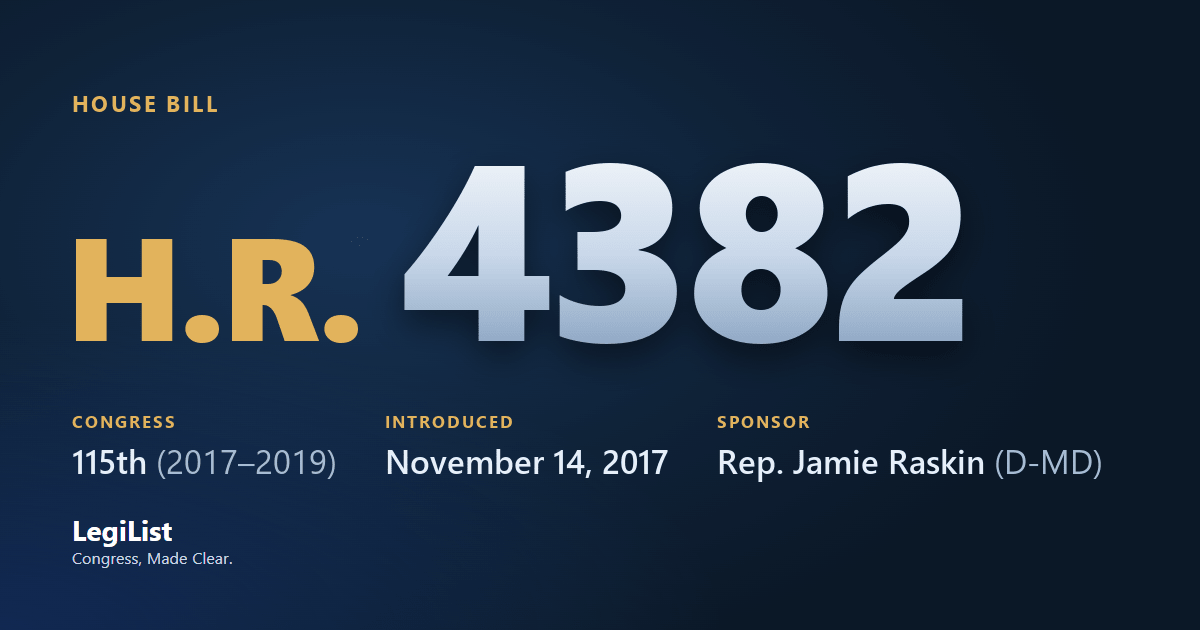
Free Flow of Information Act of 2017
Latest action · Dec 13, 2017 Referred to the Subcommittee on Crime, Terrorism, Homeland Security, and Investigations.
Progress
Where this bill reached, and when. A stage with no date was not reached; one that failed a vote and later carried shows the date it carried.
- IntroducedNov 14, 2017
- Passed HouseNot reached
- Passed SenateNot reached
- To the PresidentNot reached
- Became lawNot reached
Summary
Free Flow of Information Act of 2017
This bill establishes conditions under which a journalist may be compelled to produce documents or provide testimony in a matter arising under federal law.
Cosponsors 12
Members who signed on, in the order they did. Signatures ran from Nov 14, 2017 to Jul 25, 2018; 1 is an original cosponsor, there from the day it was introduced.
| Seat | Cosponsor | Signed on | |
|---|---|---|---|
| R-OH | Jim Jordan | Original | Nov 14, 2017 |
| D-FL | Darren Soto | Dec 12, 2017 | |
| D-DC | Eleanor Holmes Norton | Dec 12, 2017 | |
| D-NY | Grace Meng | Dec 12, 2017 | |
| R-WV | Alexander X. Mooney | Dec 22, 2017 | |
| D-KY | John A. Yarmuth | Dec 22, 2017 | |
| D-FL | Debbie Wasserman Schultz | Jun 20, 2018 | |
| R-NC | Mark Meadows | Jun 20, 2018 | |
| R-VA | Scott Taylor | Jun 20, 2018 | |
| R-ID | Michael K. Simpson | Jun 22, 2018 | |
| D-TX | Sheila Jackson Lee | Jun 22, 2018 | |
| D-PA | Robert A. Brady | Jul 25, 2018 |
Committees 1
Where it was sent and what each committee and subcommittee did with it, in order.
| Chamber | Committee | What it did |
|---|---|---|
| House | Judiciary Committee | Referred Nov 14, 2017 |
| Crime and Federal Government Surveillance Subcommittee | Referred Dec 13, 2017 |
Actions 3
Everything that happened, newest first.
- Dec 13, 2017Referred to the Subcommittee on Crime, Terrorism, Homeland Security, and Investigations.
- Nov 14, 2017Introduced in House
- Nov 14, 2017Referred to the House Committee on the Judiciary.
In the Congressional Record 1
Days the Record’s own index lists this bill, newest first, with the pages and the members it names. Pages starting H are the House, S the Senate, E Extensions of Remarks.
| Where | In the Record | Members | Date |
|---|---|---|---|
| House | Lists H9254H.R. 4382–4394 | — | Nov 14, 2017 |
Research
What has been written about this bill: committee reports, cost estimates, the sponsor’s authority statement, printed hearings and the Congressional Research Service’s work.
Constitutional authority
The sponsor’s statement, as printed in the Congressional Record, vol. 163, no. 186, November 14, 2017, page H9254.
Printed hearings 1
Hearings whose printed record names this bill, newest first: hearings on it, and wider hearings where it came up.
| Number | Hearing | Committee | Held |
|---|---|---|---|
| Serial No. 115-98 | SHIELDING SOURCES: SAFEGUARDING THE PUBLIC'S RIGHT TO KNOW61 pages | Oversight and Government Reform Committee | Jul 24, 2018 |
Titles 2
Every title it has carried, official and short, at each stage.
- Official Title as Introduced
- To maintain the free flow of information to the public by providing conditions for the federally compelled disclosure of information by certain persons connected with the news media.
- Short Titles as Introduced
- Free Flow of Information Act of 2017
Subjects
Assigned by the Library of Congress. Policy area: Law.
- Business records
- Criminal investigation, prosecution, interrogation
- Criminal procedure and sentencing
- Evidence and witnesses
- First Amendment rights
- Health information and medical records
- Internet and video services
- Internet, web applications, social media
- Judicial procedure and administration
- Law
- News media and reporting
- Right of privacy
- Telephone and wireless communication
- Terrorism
- Trade secrets and economic espionage
Text 1
Each version as it was printed, newest first.
- Nov 14, 2017Introduced in House
Everything here is as published by Congress: the summary is the Congressional Research Service's, the action wording is the clerks', and the subjects are the Library of Congress's. How far it got is read from the actions themselves, taking the most recent one of each kind, so a bill that failed a vote and later passed is shown as having passed. Records come from this bill on Congress.gov and govinfo.gov; cost estimates are the Congressional Budget Office's, and the hearings are the printed hearings GovInfo publishes, which can appear months after the hearing.