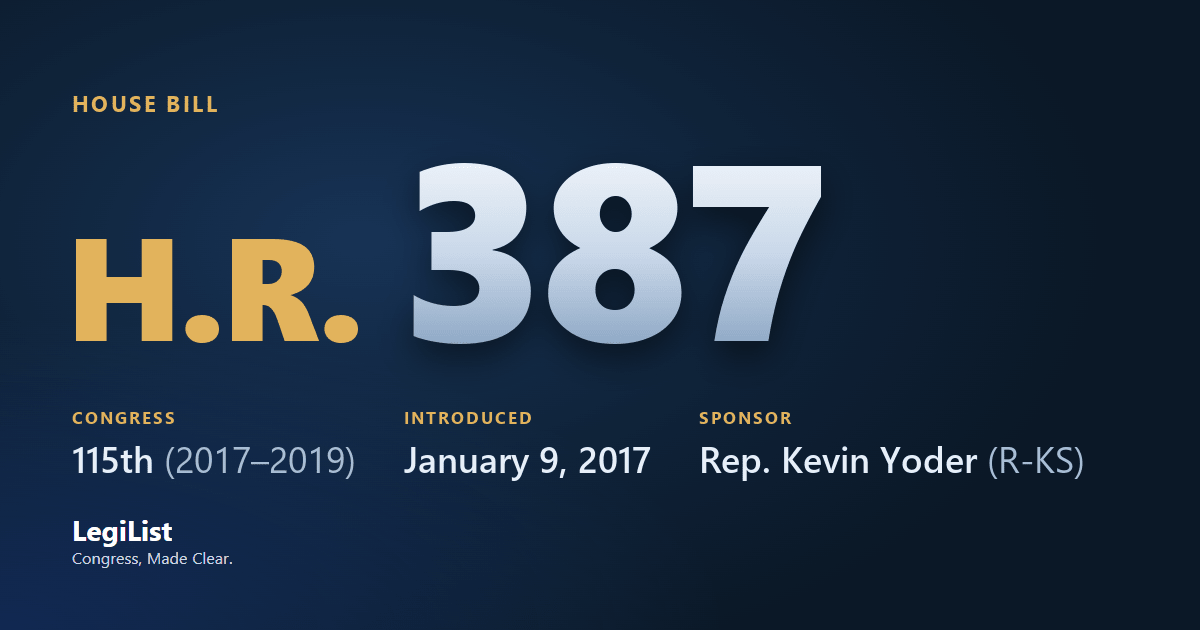
Email Privacy Act
Latest action · Feb 7, 2017 Received in the Senate and Read twice and referred to the Committee on the Judiciary.
Progress
Where this bill reached, and when. A stage with no date was not reached; one that failed a vote and later carried shows the date it carried.
- IntroducedJan 9, 2017
- Passed HouseFeb 6, 2017
- Passed SenateNot reached
- To the PresidentNot reached
- Became lawNot reached
Summary
Email Privacy Act
(Sec. 2) This bill amends the federal criminal code to revise provisions that limit an electronic communication service (ECS) or remote communication service (RCS) provider from voluntarily disclosing the contents of a wire or electronic communication that is in electronic storage.
(Sec. 3) The bill also revises the standards for the government to compel an ECS or RCS provider to disclose contents of a wire or electronic communication or noncontent records or information pertaining to a subscriber or customer.
The government must obtain a warrant to compel the disclosure of contents of a communication that is in electronic storage, or otherwise stored, held, or maintained by an ECS or RCS provider.
An ECS or RCS provider may notify a subscriber or customer of the receipt of a warrant, court order, subpoena, or request, unless the government obtains an order for delayed notification.
(Sec. 4) The bill revises the process for obtaining a delayed notification order and lengthens the maximum duration of a delayed notification order.
(Sec. 5) The bill does not preclude the government from acquiring, pursuant to other legal authorities: (1) contents of a wire or electronic communication, or (2) noncontent records or information related to a subscriber or customer.
Cosponsors 138
Members who signed on, in the order they did. Signatures ran from Jan 9, 2017 to Feb 6, 2017; 9 are original cosponsors, there from the day it was introduced.
| Seat | Cosponsor | Signed on | |
|---|---|---|---|
| R-VA | Bob Goodlatte | Original | Jan 9, 2017 |
| R-GA | Doug Collins | Original | Jan 9, 2017 |
| D-CO | Jared Polis | Original | Jan 9, 2017 |
| D-NY | Jerrold Nadler | Original | Jan 9, 2017 |
| D-MI | John Conyers, Jr. | Original | Jan 9, 2017 |
| D-CA | Judy Chu | Original | Jan 9, 2017 |
| D-WA | Suzan K. DelBene | Original | Jan 9, 2017 |
| R-TX | Ted Poe | Original | Jan 9, 2017 |
| R-TX | Will Hurd | Original | Jan 9, 2017 |
| D-FL | Alcee L. Hastings | Jan 24, 2017 | |
| D-NH | Ann M. Kuster | Jan 24, 2017 | |
| R-MO | Ann Wagner | Jan 24, 2017 | |
| D-CA | Anna G. Eshoo | Jan 24, 2017 | |
| R-AS | Aumua Amata Coleman Radewagen | Jan 24, 2017 | |
| R-VA | Barbara Comstock | Jan 24, 2017 |
Committees 2
Where it was sent and what each committee and subcommittee did with it, in order.
| Chamber | Committee | What it did |
|---|---|---|
| House | Judiciary Committee | Referred Jan 9, 2017 |
| Crime and Federal Government Surveillance Subcommittee | Referred Jan 10, 2017 | |
| Senate | Judiciary Committee | Referred Feb 7, 2017 |
Actions 9
Everything that happened, newest first.
- Feb 7, 2017Received in the Senate and Read twice and referred to the Committee on the Judiciary.
- Feb 6, 2017Mr. Yoder moved to suspend the rules and pass the bill.
- Feb 6, 2017Considered under suspension of the rules. (consideration: CR H988-992)
- Feb 6, 2017DEBATE - The House proceeded with forty minutes of debate on H.R. 387.
- Feb 6, 2017Passed/agreed to in House: On motion to suspend the rules and pass the bill Agreed to by voice vote. (text: CR H988-989)
In the Congressional Record 3
Days the Record’s own index lists this bill, newest first, with the pages and the members it names. Pages starting H are the House, S the Senate, E Extensions of Remarks.
| Where | In the Record | Members | Date |
|---|---|---|---|
| House | Debate and remarks H8434 | Ken Buck R-CO, Ted Poe R-TX | Nov 2, 2017 |
| Extensions | Debate and remarks E186 | Henry C. "Hank" Johnson, Jr. D-GA | Feb 14, 2017 |
| House | Debate and remarks H988–H992Text printed H988 | Bob Goodlatte R-VA, Eric Swalwell D-CA, Jared Polis D-CO, Jerrold Nadler D-NY, John Conyers, Jr. D-MI, Kevin Yoder R-KS, Tom Emmer R-MN | Feb 6, 2017 |
Research
What has been written about this bill: committee reports, cost estimates, the sponsor’s authority statement, printed hearings and the Congressional Research Service’s work.
Constitutional authority
The sponsor’s statement, as printed in the Congressional Record, vol. 163, no. 5, January 9, 2017, page H236.
Printed hearings 1
Hearings whose printed record names this bill, newest first: hearings on it, and wider hearings where it came up.
| Number | Hearing | Committee | Held |
|---|---|---|---|
| S. Hrg. 115-62 | UNMANNED AIRCRAFT SYSTEMS: INNOVATION, INTEGRATION, SUCCESSES,. AND CHALLENGES94 pages | Commerce, Science, and Transportation Committee | Mar 15, 2017 |
Related bills 2
Companion bills and other measures the record links to this one.
| Bill | Title | Relationship | Latest action |
|---|---|---|---|
| S 1654 | Email Privacy Act | Identical bill | Jul 27, 2017 |
| HR 6147 | Interior, Environment, Financial Services and General Government, Agriculture, Rural Development, Food and Drug Administration, and Transportation, Housing and Urban Development Appropriations Act, 2019 | Related bill | Sep 7, 2018 |
Titles 3
Every title it has carried, official and short, at each stage.
- Official Title as Introduced
- To amend title 18, United States Code, to update the privacy protections for electronic communications information that is stored by third-party service providers in order to protect consumer privacy interests while meeting law enforcement needs, and for other purposes.
- Short Titles as Introduced
- Email Privacy Act
- Short Titles as Passed House
- Email Privacy Act
Subjects
Assigned by the Library of Congress. Policy area: Crime and Law Enforcement.
Text 3
Each version as it was printed, newest first.
- Feb 7, 2017Referred in Senate
- Feb 6, 2017Engrossed in House
- Jan 9, 2017Introduced in House
Everything here is as published by Congress: the summary is the Congressional Research Service's, the action wording is the clerks', and the subjects are the Library of Congress's. How far it got is read from the actions themselves, taking the most recent one of each kind, so a bill that failed a vote and later passed is shown as having passed. Records come from this bill on Congress.gov and govinfo.gov; cost estimates are the Congressional Budget Office's, and the hearings are the printed hearings GovInfo publishes, which can appear months after the hearing.