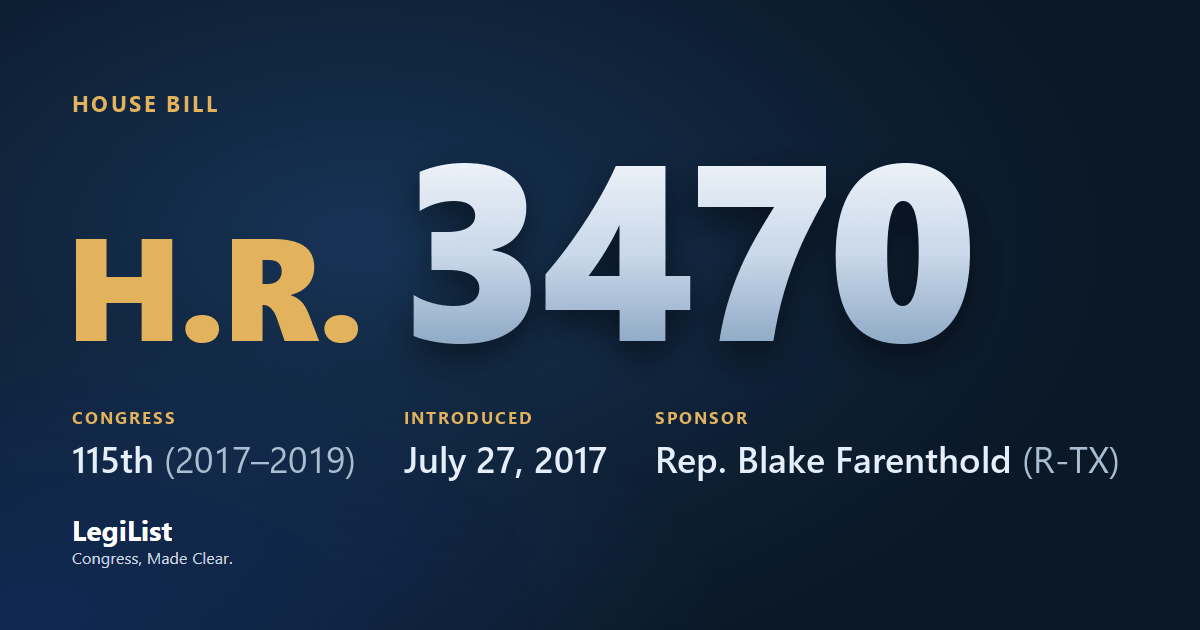
GPS Act
Latest action · Sep 6, 2017 Referred to the Subcommittee on Crime, Terrorism, Homeland Security, and Investigations.
Progress
Where this bill reached, and when. A stage with no date was not reached; one that failed a vote and later carried shows the date it carried.
- IntroducedJul 27, 2017
- Passed HouseNot reached
- Passed SenateNot reached
- To the PresidentNot reached
- Became lawNot reached
Summary
Geolocational Privacy and Surveillance Act or the GPS Act
This bill makes it unlawful to intentionally intercept the geolocation information of another person; intentionally disclose or use geolocation information knowing or having reason to know that it was obtained in violation of this bill; or intentionally disclose geolocation information knowing or having reason to know it was obtained as part of a criminal investigation with the intent to improperly obstruct with a duly authorized criminal investigation.
There are several exceptions to this prohibition against intercepting geolocation information: (1) information obtained in the normal course of business, (2) information obtained while conducting foreign intelligence surveillance, (3) consent, (4) information readily available to the public, (5) theft or fraud involving the device, (6) issuance of a warrant, and (7) emergency circumstances.
Geolocation information shall not be used as evidence in a legal proceeding when disclosure of such information would be in violation of this bill.
The bill creates a civil cause of action for any person whose geolocation information is intercepted, disclosed, or intentionally used in violation of this bill.
The bill makes it a criminal offense to knowingly and intentionally obtain, or attempt to obtain, global positioning system (GPS) records from a geolocation information service through fraud or by other means. It also makes it unlawful to intentionally and knowingly sell or transfer GPS records without the consent of the customer.
Cosponsors
Members who signed on, in the order they did.
Committees 2
Where it was sent and what each committee and subcommittee did with it, in order.
| Chamber | Committee | What it did |
|---|---|---|
| House | Judiciary Committee | Referred Jul 27, 2017 |
| Crime and Federal Government Surveillance Subcommittee | Referred Sep 6, 2017 | |
| House | Intelligence (Permanent Select) Committee | Referred Jul 27, 2017 |
Actions 3
Everything that happened, newest first.
- Sep 6, 2017Referred to the Subcommittee on Crime, Terrorism, Homeland Security, and Investigations.
- Jul 27, 2017Introduced in House
- Jul 27, 2017Referred to the Committee on the Judiciary, and in addition to the Committee on Intelligence (Permanent Select), for a period to be subsequently determined by the Speaker, in each case for consideration of such provisions as fall within the jurisdiction of the committee concerned.
Research
What has been written about this bill: committee reports, cost estimates, the sponsor’s authority statement, printed hearings and the Congressional Research Service’s work.
Constitutional authority
The sponsor’s statement, as printed in the Congressional Record, vol. 163, no. 127, July 27, 2017, page H6518.
Related bills 2
Companion bills and other measures the record links to this one.
Titles 3
Every title it has carried, official and short, at each stage.
- Official Title as Introduced
- To amend title 18, United States Code, to specify the circumstances in which a person may acquire geolocation information, and for other purposes.
- Short Titles as Introduced
- GPS Act
- Geolocational Privacy and Surveillance Act
Subjects
Assigned by the Library of Congress. Policy area: Crime and Law Enforcement.
- Civil actions and liability
- Computers and information technology
- Crime and Law Enforcement
- Criminal investigation, prosecution, interrogation
- Criminal justice information and records
- Criminal procedure and sentencing
- Evidence and witnesses
- Fraud offenses and financial crimes
- Geography and mapping
- Higher education
- Poverty and welfare assistance
- Right of privacy
- Student aid and college costs
- Telephone and wireless communication
Text 1
Each version as it was printed, newest first.
- Jul 27, 2017Introduced in House
Everything here is as published by Congress: the summary is the Congressional Research Service's, the action wording is the clerks', and the subjects are the Library of Congress's. How far it got is read from the actions themselves, taking the most recent one of each kind, so a bill that failed a vote and later passed is shown as having passed. Records come from this bill on Congress.gov and govinfo.gov; cost estimates are the Congressional Budget Office's, and the hearings are the printed hearings GovInfo publishes, which can appear months after the hearing.