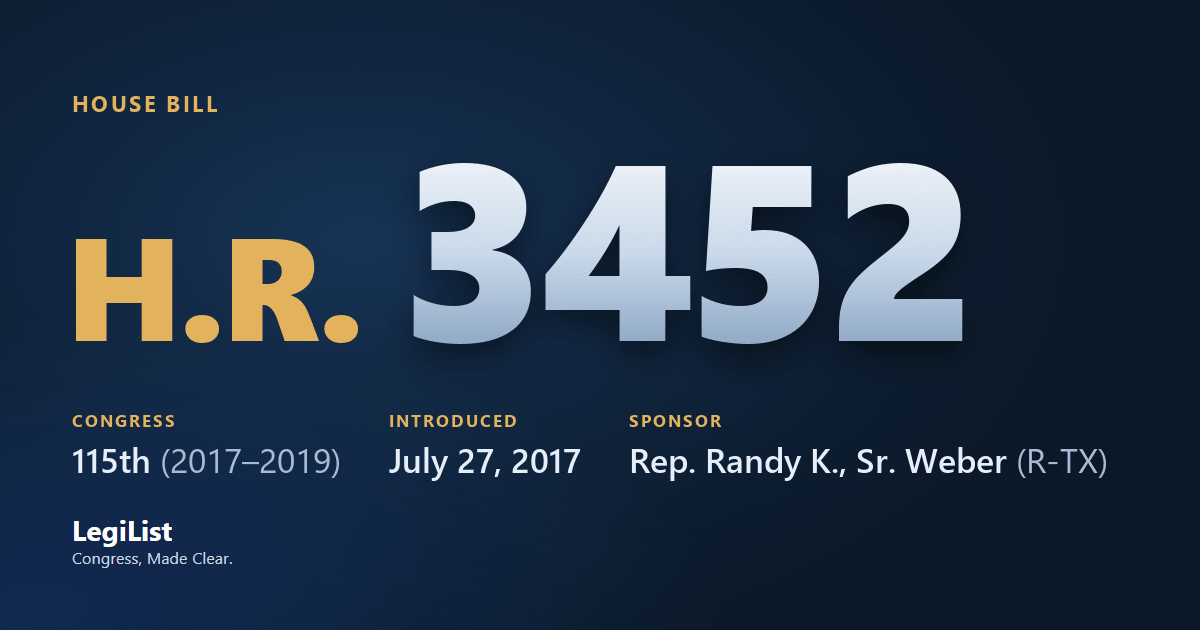
Relief for Recovering Communities Act
Latest action · Jul 28, 2017 Referred to the Subcommittee on Highways and Transit.
Progress
Where this bill reached, and when. A stage with no date was not reached; one that failed a vote and later carried shows the date it carried.
- IntroducedJul 27, 2017
- Passed HouseNot reached
- Passed SenateNot reached
- To the PresidentNot reached
- Became lawNot reached
Summary
Relief for Recovering Communities Act
This bill requires the Department of Transportation to treat an area as an "urbanized area" following a major disaster under the Robert T. Stafford Disaster Relief and Emergency Assistance Act until the second decennial census conducted after such disaster if:
- the population of the area fell below 50,000 as a result of such disaster;
- the area was defined and designated as such by the Department of Commerce in the decennial census immediately preceding such disaster, beginning with the 2000 decennial census; and
- the area was not so defined and designated in the decennial census immediately following such disaster.
An area treated as an urbanized area shall be assigned the population and square miles of the urban cluster with respect to the area designated by Commerce in the most recent decennial census. This designation as an urbanized area permits an application for federal transit funding based upon population levels in the area prior to the major disaster.
Cosponsors 8
Members who signed on, in the order they did. Signatures ran from Jul 28, 2017 to Oct 11, 2017.
| Seat | Cosponsor | Signed on | |
|---|---|---|---|
| R-TX | John Abney Culberson | Jul 28, 2017 | |
| R-TX | Pete Sessions | Jul 28, 2017 | |
| R-TX | Blake Farenthold | Aug 25, 2017 | |
| R-TX | Brian Babin | Sep 18, 2017 | |
| D-TX | Gene Green | Sep 18, 2017 | |
| R-NC | David Rouzer | Oct 3, 2017 | |
| D-TX | Henry Cuellar | Oct 10, 2017 | |
| R-TX | Kay Granger | Oct 11, 2017 |
Committees 1
Where it was sent and what each committee and subcommittee did with it, in order.
| Chamber | Committee | What it did |
|---|---|---|
| House | Transportation and Infrastructure Committee | Referred Jul 27, 2017 |
| Economic Development, Public Buildings, and Emergency Management Subcommittee | Referred Jul 28, 2017 | |
| Highways and Transit Subcommittee | Referred Jul 28, 2017 |
Actions 4
Everything that happened, newest first.
- Jul 28, 2017Referred to the Subcommittee on Economic Development, Public Buildings and Emergency Management.
- Jul 28, 2017Referred to the Subcommittee on Highways and Transit.
- Jul 27, 2017Introduced in House
- Jul 27, 2017Referred to the House Committee on Transportation and Infrastructure.
Research
What has been written about this bill: committee reports, cost estimates, the sponsor’s authority statement, printed hearings and the Congressional Research Service’s work.
Constitutional authority
The sponsor’s statement, as printed in the Congressional Record, vol. 163, no. 127, July 27, 2017, page H6518.
Related bills 1
Companion bills and other measures the record links to this one.
| Bill | Title | Relationship | Latest action |
|---|---|---|---|
| S 1664 | Relief for Recovering Communities Act | Related bill | Jul 27, 2017 |
Titles 2
Every title it has carried, official and short, at each stage.
- Official Title as Introduced
- To amend section 5307 of title 49, United States Code, with respect to the treatment of a community as an urbanized area following a major disaster.
- Short Titles as Introduced
- Relief for Recovering Communities Act
Subjects
Assigned by the Library of Congress. Policy area: Transportation and Public Works.
Text 1
Each version as it was printed, newest first.
- Jul 27, 2017Introduced in House
Everything here is as published by Congress: the summary is the Congressional Research Service's, the action wording is the clerks', and the subjects are the Library of Congress's. How far it got is read from the actions themselves, taking the most recent one of each kind, so a bill that failed a vote and later passed is shown as having passed. Records come from this bill on Congress.gov and govinfo.gov; cost estimates are the Congressional Budget Office's, and the hearings are the printed hearings GovInfo publishes, which can appear months after the hearing.