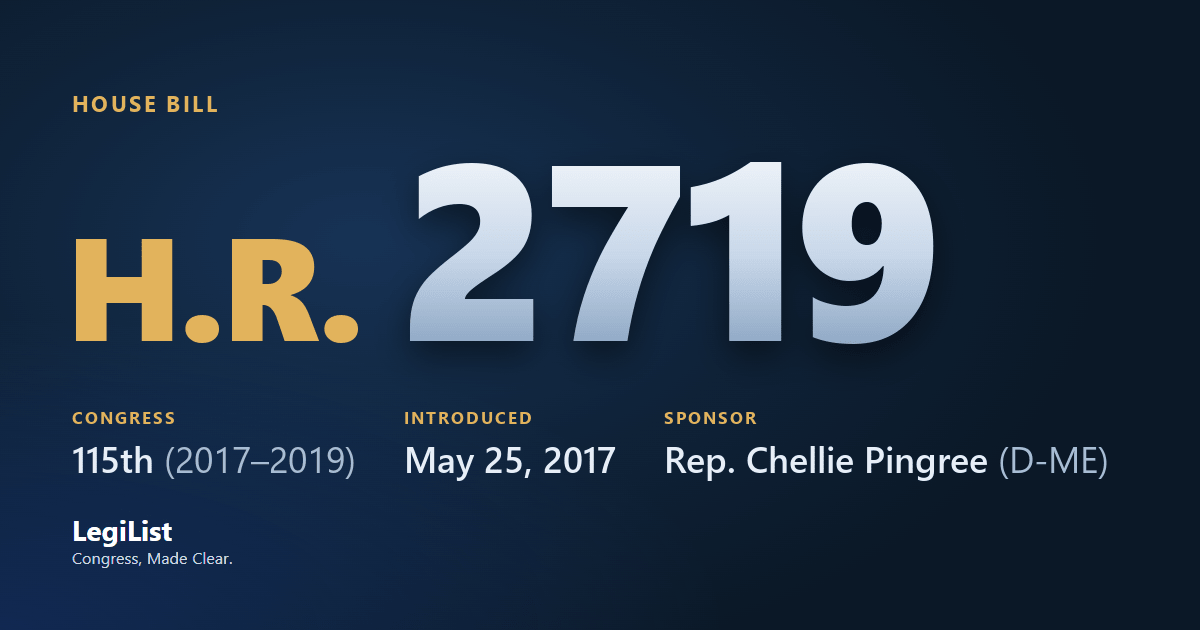
Coastal Communities Ocean Acidification Act of 2017
Latest action · May 22, 2018 Referred to the Subcommittee on Environment.
Progress
Where this bill reached, and when. A stage with no date was not reached; one that failed a vote and later carried shows the date it carried.
- IntroducedMay 25, 2017
- Passed HouseNot reached
- Passed SenateNot reached
- To the PresidentNot reached
- Became lawNot reached
Summary
Coastal Communities Ocean Acidification Act of 2017
This bill amends the Federal Ocean Acidification Research and Monitoring Act of 2009 to require the National Oceanic and Atmospheric Administration (NOAA) to conduct and update at least once every seven years an ocean acidification coastal community vulnerability assessment with a corresponding public report. The assessment must identify: (1) U.S. coastal communities that are most dependent on coastal and ocean resources that may be impacted by ocean acidification; (2) the nature of those communities' social and economic vulnerabilities; (3) impacts from changes in ocean and coastal marine resources that are not managed by the federal government; and (4) key knowledge gaps where research could be devoted to better understand the possible ocean acidification impacts, risks, threats, and possible adaptation strategies for the communities.
In carrying out the ocean acidification coastal community vulnerability assessment, NOAA must collaborate with state and local government entities that are conducting or have completed vulnerability assessments, strategic research planning, or other similar activities related to ocean acidification and its impacts on coastal communities.
NOAA's ocean acidification program is expanded to include an ongoing mechanism that allows affected industry members, coastal stakeholders, non-federal resource managers, and outside scientific experts not employed by the federal government to provide input on research, data, and monitoring necessary to support on-the-ground management, decision making, and adaptation related to ocean acidification and its impacts.
The strategic plan for ocean acidification research and monitoring developed by the Joint Subcommittee on Ocean Science and Technology of the National Science and Technology Council must make recommendations for research to address the key knowledge gaps identified in the community vulnerability assessment report.
Cosponsors 25
Members who signed on, in the order they did. Signatures ran from May 25, 2017 to Dec 21, 2018, with 6 there on the day it was introduced.
| Seat | Cosponsor | Signed on | |
|---|---|---|---|
| R-FL | Carlos Curbelo | Original | May 25, 2017 |
| D-CA | Jared Huffman | Original | May 25, 2017 |
| D-CA | Mike Thompson | Original | May 25, 2017 |
| R-NY | Peter T. King | Original | May 25, 2017 |
| D-OR | Suzanne Bonamici | Original | May 25, 2017 |
| R-FL | Vern Buchanan | Original | May 25, 2017 |
| D-FL | Charlie Crist | Jul 25, 2017 | |
| D-FL | Debbie Wasserman Schultz | Jul 25, 2017 | |
| D-WA | Denny Heck | Jul 25, 2017 | |
| D-VA | Donald S. Beyer, Jr. | Jul 25, 2017 | |
| D-MA | Seth Moulton | Jul 25, 2017 | |
| D-FL | Theodore E. Deutch | Jul 25, 2017 | |
| D-CA | Alan S. Lowenthal | Sep 26, 2017 | |
| D-CT | Rosa L. DeLauro | Sep 26, 2017 | |
| D-MN | Betty McCollum | Nov 9, 2017 |
Actions 3
Everything that happened, newest first.
- May 22, 2018Referred to the Subcommittee on Environment.
- May 25, 2017Introduced in House
- May 25, 2017Referred to the House Committee on Science, Space, and Technology.
Related bills 1
Companion bills and other measures the record links to this one.
| Bill | Title | Relationship | Latest action |
|---|---|---|---|
| S 2229 | Coastal Communities Ocean Acidification Act of 2017 | Related bill | Dec 14, 2017 |
Subjects
Assigned by the Library of Congress. Policy area: Public Lands and Natural Resources.
- Air quality
- Aquatic ecology
- Climate change and greenhouse gases
- Economic performance and conditions
- Environmental assessment, monitoring, research
- Government information and archives
- Government studies and investigations
- Marine and coastal resources, fisheries
- Marine pollution
- Public Lands and Natural Resources
Text 1
Each version as it was printed, newest first.
- May 25, 2017Introduced in House
Everything here is as published by Congress: the summary is the Congressional Research Service's, the action wording is the clerks', and the subjects are the Library of Congress's. How far it got is read from the actions themselves, taking the most recent one of each kind, so a bill that failed a vote and later passed is shown as having passed. Records come from this bill on Congress.gov and govinfo.gov.