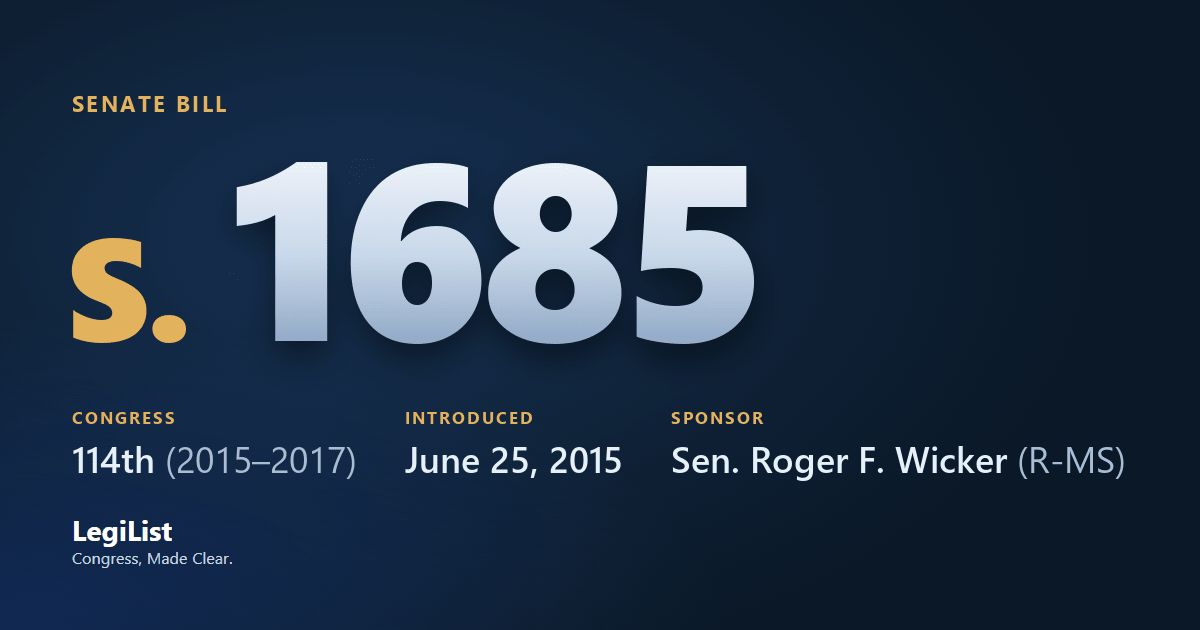
Amateur Radio Parity Act of 2015
Latest action · Dec 9, 2016 By Senator Thune from Committee on Commerce, Science, and Transportation filed written report. Report No. 114-400. Additional views filed.
Progress
Where this bill reached, and when. A stage with no date was not reached; one that failed a vote and later carried shows the date it carried.
- IntroducedJun 25, 2015
- Passed SenateNot reached
- Passed HouseNot reached
- To the PresidentNot reached
- Became lawNot reached
Summary
(This measure has not been amended since it was introduced. The summary has been expanded because action occurred on the measure.)
Amateur Radio Parity Act of 2015
(Sec. 3) This bill directs the Federal Communications Commission to amend regulations concerning the height and dimensions of station antenna structures to prohibit a private land use restriction from applying to amateur service communications if the restriction precludes such communications, fails to accommodate such communications, or does not constitute the minimum practicable restriction to accomplish the legitimate purpose of the private entity seeking to enforce the restriction.
Cosponsors 4
Members who signed on, in the order they did. Signatures ran from Jun 25, 2015 to May 9, 2016; 1 is an original cosponsor, there from the day it was introduced.
| Seat | Cosponsor | Signed on | |
|---|---|---|---|
| D-CT | Richard Blumenthal | Original | Jun 25, 2015 |
| D-MN | Al Franken | Nov 5, 2015 | |
| R-KS | Jerry Moran | Nov 17, 2015 | |
| D-DE | Christopher A. Coons | May 9, 2016 |
Committees 1
Where it was sent and what each committee and subcommittee did with it, in order.
| Chamber | Committee | What it did |
|---|---|---|
| Senate | Commerce, Science, and Transportation Committee | Referred Jun 25, 2015Markup Nov 18, 2015Reported Dec 6, 2016 |
Actions 6
Everything that happened, newest first.
- Dec 9, 2016By Senator Thune from Committee on Commerce, Science, and Transportation filed written report. Report No. 114-400. Additional views filed.
- Dec 6, 2016Committee on Commerce, Science, and Transportation. Reported by Senator Thune without amendment. Without written report.
- Dec 6, 2016Placed on Senate Legislative Calendar under General Orders. Calendar No. 700.
- Nov 18, 2015Committee on Commerce, Science, and Transportation. Ordered to be reported without amendment favorably.
- Jun 25, 2015Introduced in Senate
- Jun 25, 2015Read twice and referred to the Committee on Commerce, Science, and Transportation.
Research
What has been written about this bill: committee reports, cost estimates, the sponsor’s authority statement, printed hearings and the Congressional Research Service’s work.
Committee report
Congressional Budget Office cost estimate
- Feb 9, 2016S. 1685, Amateur Radio Parity Act of 2015As ordered reported by the Senate Committee on Commerce, Science, and Transportation on November 18, 2015
Related bills 2
Companion bills and other measures the record links to this one.
| Bill | Title | Relationship | Latest action |
|---|---|---|---|
| S 253 | Federal Communications Commission Consolidated Reporting Act of 2015 | Related bill | Sep 28, 2016 |
| HR 1301 | Amateur Radio Parity Act of 2016 | Identical bill | Sep 13, 2016 |
Titles 3
Every title it has carried, official and short, at each stage.
- Official Title as Introduced
- A bill to direct the Federal Communications Commission to extend to private land use restrictions its rule relating to reasonable accommodation of amateur service communications.
- Short Titles as Introduced
- Amateur Radio Parity Act of 2015
- Short Titles as Reported to Senate
- Amateur Radio Parity Act of 2015
Subjects
Assigned by the Library of Congress. Policy area: Science, Technology, Communications.
Text 2
Each version as it was printed, newest first.
- Dec 6, 2016Reported to Senate
- Jun 25, 2015Introduced in Senate
Everything here is as published by Congress: the summary is the Congressional Research Service's, the action wording is the clerks', and the subjects are the Library of Congress's. How far it got is read from the actions themselves, taking the most recent one of each kind, so a bill that failed a vote and later passed is shown as having passed. Records come from this bill on Congress.gov and govinfo.gov; cost estimates are the Congressional Budget Office's, and the hearings are the printed hearings GovInfo publishes, which can appear months after the hearing.