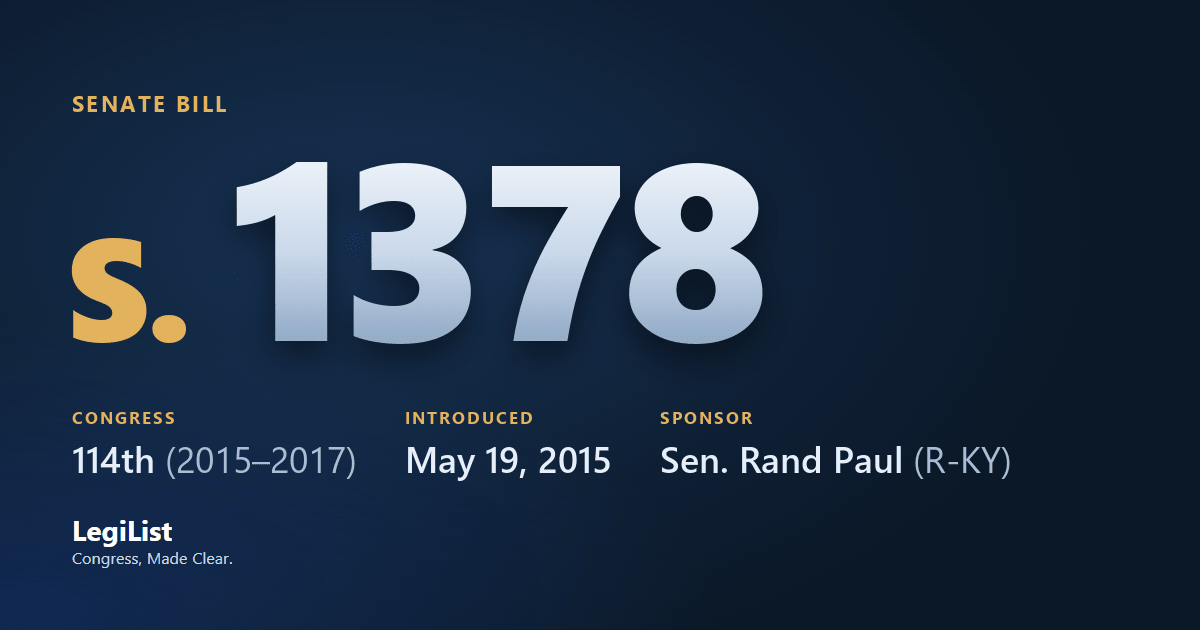
Bonuses for Cost-Cutters Act of 2016
Latest action · Dec 20, 2016 By Senator Johnson from Committee on Homeland Security and Governmental Affairs filed written report under authority of the order of the Senate of 12/10/2016. Report No. 114-406. Additional views filed.
Progress
Where this bill reached, and when. A stage with no date was not reached; one that failed a vote and later carried shows the date it carried.
- IntroducedMay 19, 2015
- Passed SenateNot reached
- Passed HouseNot reached
- To the PresidentNot reached
- Became lawNot reached
Summary
Bonuses for Cost-Cutters Act of 2016
(Sec. 2) This bill expands the cash awards program for disclosures by federal employees of fraud, waste, or mismanagement that result in cost savings to the employee's agency to include identification of surplus salaries and expenses funds that: (1) an agency employee identifies as unnecessary, (2) the inspector general and the chief financial officer of the agency determine are not required for the purpose for which the amounts were made available, and (3) the rescission of which would not be detrimental to the full execution of the purposes for which the amounts were made available.
Any savings resulting from such identifications must be deposited in the Treasury and used to reduce a budget deficit or the federal debt. But agencies may retain up to 10% of such savings for the purpose of paying cash awards to employees who identify surplus salaries and expenses funds.
Each fiscal year, agencies must submit reports to the Department of the Treasury regarding: (1) the total savings achieved through disclosures of possible fraud, waste, or mismanagement and identifications of surplus salaries and expenses funds by an employee; and (2) each disclosure that has merit and the number and amount of cash awards by the agency. This information must also be included in agency budget requests submitted to the Office of Management and Budget.
Treasury must report annually to Congress on federal cost saving and awards based on agency reports about such employee disclosures. The Office of Personnel Management must certify annually whether each agency's cash award program complies with this bill.
Every three years, the Government Accountability Office must report on the operation of the program and any recommendations for legislative improvements.
The amendments in this bill regarding the expansion of the cash awards program and the use of cost savings from such employee identifications shall sunset six years after enactment of this bill.
The bill prohibits the payment of awards to: (1) federal officers who serve in a position at level I of the Executive Schedule; (2) the head of an agency; or (3) a commissioner, board member, or other voting member of an independent establishment.
Cosponsors 15
Members who signed on, in the order they did. Signatures ran from May 19, 2015 to Jul 14, 2016; 4 are original cosponsors, there from the day it was introduced.
| Seat | Cosponsor | Signed on | |
|---|---|---|---|
| R-CO | Cory Gardner | Original | May 19, 2015 |
| D-VA | Mark R. Warner | Original | May 19, 2015 |
| R-WY | Michael B. Enzi | Original | May 19, 2015 |
| R-PA | Patrick J. Toomey | Original | May 19, 2015 |
| D-CO | Michael F. Bennet | May 22, 2015 | |
| R-MT | Steve Daines | May 22, 2015 | |
| R-OH | Rob Portman | Jun 8, 2015 | |
| R-TX | John Cornyn | Oct 8, 2015 | |
| R-IA | Joni Ernst | Feb 10, 2016 | |
| R-NH | Kelly Ayotte | Feb 10, 2016 | |
| R-OK | James Lankford | Mar 14, 2016 | |
| D-MO | Claire McCaskill | May 19, 2016 | |
| R-WI | Ron Johnson | May 19, 2016 | |
| R-UT | Mike Lee | Jun 8, 2016 | |
| R-GA | David Perdue | Jul 14, 2016 |
Committees 1
Where it was sent and what each committee and subcommittee did with it, in order.
| Chamber | Committee | What it did |
|---|---|---|
| Senate | Homeland Security and Governmental Affairs Committee | Referred May 19, 2015Markup May 25, 2016Reported Dec 9, 2016 |
Actions 6
Everything that happened, newest first.
- Dec 20, 2016By Senator Johnson from Committee on Homeland Security and Governmental Affairs filed written report under authority of the order of the Senate of 12/10/2016. Report No. 114-406. Additional views filed.
- Dec 9, 2016Committee on Homeland Security and Governmental Affairs. Reported by Senator Johnson with an amendment in the nature of a substitute. Without written report.
- Dec 9, 2016Placed on Senate Legislative Calendar under General Orders. Calendar No. 720.
- May 25, 2016Committee on Homeland Security and Governmental Affairs. Ordered to be reported with an amendment in the nature of a substitute favorably.
- May 19, 2015Introduced in Senate
Research
What has been written about this bill: committee reports, cost estimates, the sponsor’s authority statement, printed hearings and the Congressional Research Service’s work.
Committee report
Congressional Budget Office cost estimate
- Aug 3, 2016S. 1378, Bonuses for Cost-Cutters Act of 2016As ordered reported by the Senate Committee on Homeland Security and Governmental Affairs on May 25, 2016
Related bills 1
Companion bills and other measures the record links to this one.
| Bill | Title | Relationship | Latest action |
|---|---|---|---|
| HR 2532 | Bonuses for Cost-Cutters Act of 2016 | Related bill | Nov 14, 2016 |
Titles 3
Every title it has carried, official and short, at each stage.
- Official Title as Introduced
- A bill to strengthen employee cost savings suggestions programs within the Federal Government.
- Short Titles as Introduced
- Bonuses for Cost-Cutters Act of 2015
- Short Titles as Reported to Senate
- Bonuses for Cost-Cutters Act of 2016
Subjects
Assigned by the Library of Congress. Policy area: Government Operations and Politics.
Text 2
Each version as it was printed, newest first.
- Dec 9, 2016Reported to Senate
- May 19, 2015Introduced in Senate
Support LegiList
This page is free, carries no paywall, and is built and maintained by one person. If the record here is useful to you, a few dollars keeps it going.
Everything here is as published by Congress: the summary is the Congressional Research Service's, the action wording is the clerks', and the subjects are the Library of Congress's. How far it got is read from the actions themselves, taking the most recent one of each kind, so a bill that failed a vote and later passed is shown as having passed. Records come from this bill on Congress.gov and govinfo.gov; cost estimates are the Congressional Budget Office's, and the hearings are the printed hearings GovInfo publishes, which can appear months after the hearing.