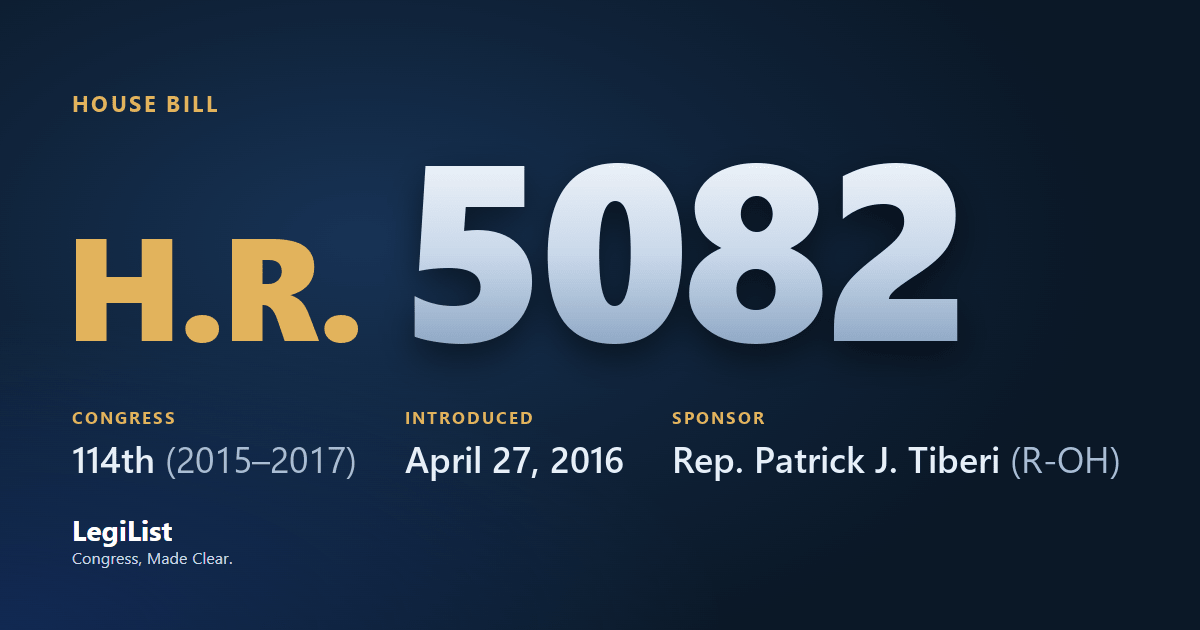
Investing in Opportunity Act
Latest action · Apr 27, 2016 Referred to the House Committee on Ways and Means.
Progress
Where this bill reached, and when. A stage with no date was not reached; one that failed a vote and later carried shows the date it carried.
- IntroducedApr 27, 2016
- Passed HouseNot reached
- Passed SenateNot reached
- To the PresidentNot reached
- Became lawNot reached
Summary
Investing in Opportunity Act
This bill amends the Internal Revenue Code to authorize the designation of opportunity zones in low-income communities and to provide tax incentives for investments in the zones, including deferring the recognition of capital gains that are reinvested in the zones.
Governors may submit nominations for a limited number of opportunity zones to the Department of the Treasury for certification and designation. Governors must give particular consideration to areas that:
- are currently the focus of mutually reinforcing state, local, or private economic development initiatives to attract investment and foster startup activity;
- have demonstrated success in geographically targeted development programs such as promise zones, the new markets tax credit, empowerment zones, and renewal communities; and
- have recently experienced significant layoffs due to business closures or relocations.
Treasury must designate zones if a governor fails to submit nominations within a specified period of time.
The bill defines opportunity funds as any investment vehicle organized as a corporation or a partnership to invest in opportunity zones that holds at least 90% of its assets in opportunity zone assets.
Taxpayers may temporarily defer the recognition of capital gains that are invested in opportunity zones or opportunity funds. Investments that are held for at least five years are eligible for capital gains tax reductions or exemptions, depending on how long the investment is held.
Treasury must report to Congress on the opportunity zone incentives enacted in this bill, including an assessment of opportunity fund investments at the national and state levels.
Cosponsors 61
Members who signed on, in the order they did. Signatures ran from Apr 27, 2016 to Dec 12, 2016; 21 are original cosponsors, there from the day it was introduced.
| Seat | Cosponsor | Signed on | |
|---|---|---|---|
| R-FL | Carlos Curbelo | Original | Apr 27, 2016 |
| R-LA | Charles W. Boustany, Jr. | Original | Apr 27, 2016 |
| R-OH | David P. Joyce | Original | Apr 27, 2016 |
| D-WA | Derek Kilmer | Original | Apr 27, 2016 |
| R-CA | Devin Nunes | Original | Apr 27, 2016 |
| D-OR | Earl Blumenauer | Original | Apr 27, 2016 |
| R-MI | Fred Upton | Original | Apr 27, 2016 |
| D-CO | Jared Polis | Original | Apr 27, 2016 |
| R-MO | Jason Smith | Original | Apr 27, 2016 |
| D-CT | John B. Larson | Original | Apr 27, 2016 |
| R-KS | Kevin Yoder | Original | Apr 27, 2016 |
| D-CA | Norma J. Torres | Original | Apr 27, 2016 |
| R-PA | Patrick Meehan | Original | Apr 27, 2016 |
| R-IL | Peter J. Roskam | Original | Apr 27, 2016 |
| D-WA | Rick Larsen | Original | Apr 27, 2016 |
| R-IL | Robert J. Dold | Original | Apr 27, 2016 |
| D-WI | Ron Kind | Original | Apr 27, 2016 |
| D-WA | Suzan K. DelBene | Original | Apr 27, 2016 |
| D-AL | Terri A. Sewell | Original | Apr 27, 2016 |
| R-IN | Todd Young | Original | Apr 27, 2016 |
| R-NY | Tom Reed | Original | Apr 27, 2016 |
| R-OH | James B. Renacci | May 10, 2016 | |
| D-MD | John K. Delaney | May 10, 2016 | |
| D-CA | Pete Aguilar | May 10, 2016 | |
| R-OH | Steve Stivers | May 10, 2016 | |
| R-OH | Steve Chabot | May 11, 2016 | |
| R-TX | Kenny Marchant | May 18, 2016 | |
| R-NJ | Leonard Lance | May 18, 2016 | |
| R-KS | Lynn Jenkins | May 18, 2016 | |
| D-MA | Seth Moulton | May 18, 2016 | |
| R-WV | Evan H. Jenkins | May 23, 2016 | |
| R-NC | Renee L. Ellmers | May 25, 2016 | |
| R-KY | Andy Barr | Jun 8, 2016 | |
| R-NY | Peter T. King | Jun 8, 2016 | |
| R-WI | Sean P. Duffy | Jun 8, 2016 | |
| D-CA | Sam Farr | Jun 10, 2016 | |
| R-NC | Patrick T. McHenry | Jun 16, 2016 | |
| D-CA | Grace F. Napolitano | Jun 21, 2016 | |
| R-MO | Billy Long | Jun 22, 2016 | |
| R-OH | Brad R. Wenstrup | Jul 6, 2016 | |
| R-MN | Erik Paulsen | Jul 6, 2016 | |
| R-WI | F. James Sensenbrenner, Jr. | Jul 6, 2016 | |
| D-TX | Ruben Hinojosa | Jul 6, 2016 | |
| R-AL | Bradley Byrne | Jul 7, 2016 | |
| R-OH | Bill Johnson | Jul 14, 2016 | |
| I-AZ | Kyrsten Sinema | Jul 14, 2016 | |
| R-IL | Rodney Davis | Jul 14, 2016 | |
| R-NC | David Rouzer | Sep 14, 2016 | |
| D-MO | Emanuel Cleaver | Sep 21, 2016 | |
| R-NC | George Holding | Sep 21, 2016 | |
| R-PA | Tom Marino | Sep 21, 2016 | |
| D-TN | Jim Cooper | Sep 26, 2016 | |
| R-PA | Scott Perry | Sep 26, 2016 | |
| D-CA | Ted Lieu | Sep 26, 2016 | |
| R-FL | Thomas J. Rooney | Sep 27, 2016 | |
| R-SD | Kristi L. Noem | Sep 28, 2016 | |
| R-NC | Mark Walker | Nov 29, 2016 | |
| R-WA | David G. Reichert | Dec 2, 2016 | |
| D-MA | Richard E. Neal | Dec 2, 2016 | |
| D-CA | Eric Swalwell | Dec 8, 2016 | |
| D-IL | Bobby L. Rush | Dec 12, 2016 |
Committees 1
Where it was sent and what each committee and subcommittee did with it, in order.
| Chamber | Committee | What it did |
|---|---|---|
| House | Ways and Means Committee | Referred Apr 27, 2016 |
Actions 2
Everything that happened, newest first.
- Apr 27, 2016Introduced in House
- Apr 27, 2016Referred to the House Committee on Ways and Means.
Research
What has been written about this bill: committee reports, cost estimates, the sponsor’s authority statement, printed hearings and the Congressional Research Service’s work.
Constitutional authority
The sponsor’s statement, as printed in the Congressional Record, vol. 162, no. 65, April 27, 2016, page H2067.
Related bills 1
Companion bills and other measures the record links to this one.
| Bill | Title | Relationship | Latest action |
|---|---|---|---|
| S 2868 | Investing in Opportunity Act | Identical bill | Jun 29, 2016 |
Titles 2
Every title it has carried, official and short, at each stage.
- Official Title as Introduced
- To amend the Internal Revenue Code of 1986 to provide for the deferral of inclusion in gross income for capital gains reinvested in economically distressed zones.
- Short Titles as Introduced
- Investing in Opportunity Act
Subjects
Assigned by the Library of Congress. Policy area: Taxation.
Text 1
Each version as it was printed, newest first.
- Apr 27, 2016Introduced in House
Support LegiList
This page is free, carries no paywall, and is built and maintained by one person. If the record here is useful to you, a few dollars keeps it going.
Everything here is as published by Congress: the summary is the Congressional Research Service's, the action wording is the clerks', and the subjects are the Library of Congress's. How far it got is read from the actions themselves, taking the most recent one of each kind, so a bill that failed a vote and later passed is shown as having passed. Records come from this bill on Congress.gov and govinfo.gov; cost estimates are the Congressional Budget Office's, and the hearings are the printed hearings GovInfo publishes, which can appear months after the hearing.