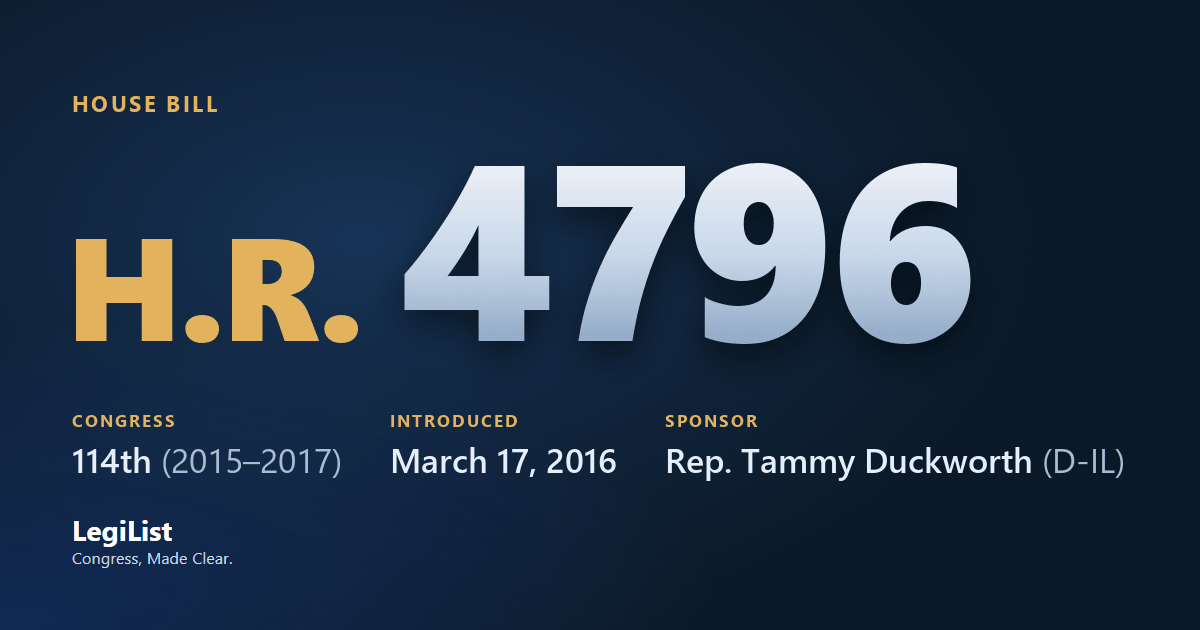
Military Parental Leave Modernization Act
Latest action · Mar 23, 2016 Referred to the Subcommittee on Military Personnel.
Progress
Where this bill reached, and when. A stage with no date was not reached; one that failed a vote and later carried shows the date it carried.
- IntroducedMar 17, 2016
- Passed HouseNot reached
- Passed SenateNot reached
- To the PresidentNot reached
- Became lawNot reached
Summary
Military Parental Leave Modernization Act
This bill revises military parental leave requirements to state that:
- a member of the armed forces, regardless of gender or marital status, shall be authorized to take at least 84 days of parental leave in connection with the birth of a child, a qualifying adoption of a child, or the placement of a child in foster care with the service member; and
- in the case of a dual military family, both service members shall be authorized to take parental leave. (The Department concerned shall permit the transfer of such leave between the two service members to accommodate individual family circumstances.)
Such parental leave shall be in addition to other leave.
Convalescent or other leave taken before childbirth by a pregnant service member shall not reduce the number parental leave days.
Cosponsors 23
Members who signed on, in the order they did. Signatures ran from Mar 22, 2016 to Dec 7, 2016.
| Seat | Cosponsor | Signed on | |
|---|---|---|---|
| D-DC | Eleanor Holmes Norton | Mar 22, 2016 | |
| D-TX | Beto O'Rourke | Apr 12, 2016 | |
| D-MA | James P. McGovern | Apr 12, 2016 | |
| D-HI | Mark Takai | Apr 12, 2016 | |
| D-AZ | Raúl M. Grijalva | Apr 12, 2016 | |
| D-WI | Gwen Moore | Apr 18, 2016 | |
| D-CA | Lois Capps | Apr 18, 2016 | |
| D-MD | Donna F. Edwards | Apr 26, 2016 | |
| D-CA | Linda T. Sánchez | Apr 26, 2016 | |
| D-CT | Rosa L. DeLauro | Apr 26, 2016 | |
| D-VA | Donald S. Beyer, Jr. | Apr 27, 2016 | |
| D-CA | John Garamendi | Apr 29, 2016 | |
| D-CA | Michael M. Honda | Apr 29, 2016 | |
| D-CA | Barbara Lee | May 25, 2016 | |
| D-MN | Richard M. Nolan | May 25, 2016 | |
| D-KY | John A. Yarmuth | May 26, 2016 | |
| D-OH | Tim Ryan | Jun 3, 2016 | |
| D-NE | Brad Ashford | Jun 7, 2016 | |
| D-VA | Gerald E. Connolly | Jun 7, 2016 | |
| D-NY | Carolyn B. Maloney | Sep 6, 2016 | |
| D-CA | Zoe Lofgren | Sep 6, 2016 | |
| D-ME | Chellie Pingree | Sep 21, 2016 | |
| D-CA | Alan S. Lowenthal | Dec 7, 2016 |
Committees 1
Where it was sent and what each committee and subcommittee did with it, in order.
| Chamber | Committee | What it did |
|---|---|---|
| House | Armed Services Committee | Referred Mar 17, 2016 |
| Military Personnel Subcommittee | Referred Mar 23, 2016 |
Actions 3
Everything that happened, newest first.
- Mar 23, 2016Referred to the Subcommittee on Military Personnel.
- Mar 17, 2016Introduced in House
- Mar 17, 2016Referred to the House Committee on Armed Services.
Research
What has been written about this bill: committee reports, cost estimates, the sponsor’s authority statement, printed hearings and the Congressional Research Service’s work.
Constitutional authority
The sponsor’s statement, as printed in the Congressional Record, vol. 162, no. 43, March 17, 2016, page H1463.
Titles 2
Every title it has carried, official and short, at each stage.
- Official Title as Introduced
- To amend title 10, United States Code, to specify a minimum number of days of parental leave available for a member of the Armed Forces in connection with the birth of a child of the member or in connection with the adoption or foster care of a child by the member.
- Short Titles as Introduced
- Military Parental Leave Modernization Act
Subjects
Assigned by the Library of Congress. Policy area: Armed Forces and National Security.
Text 1
Each version as it was printed, newest first.
- Mar 17, 2016Introduced in House
Everything here is as published by Congress: the summary is the Congressional Research Service's, the action wording is the clerks', and the subjects are the Library of Congress's. How far it got is read from the actions themselves, taking the most recent one of each kind, so a bill that failed a vote and later passed is shown as having passed. Records come from this bill on Congress.gov and govinfo.gov; cost estimates are the Congressional Budget Office's, and the hearings are the printed hearings GovInfo publishes, which can appear months after the hearing.