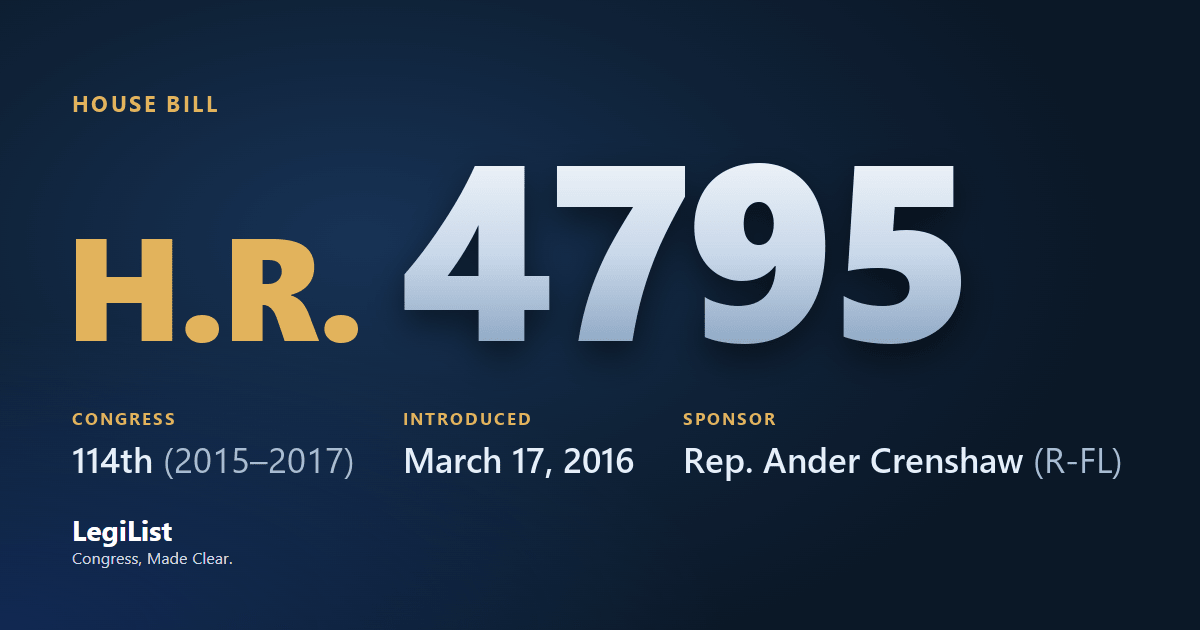
ABLE to Work Act of 2016
Latest action · Mar 17, 2016 Referred to the House Committee on Ways and Means.
Progress
Where this bill reached, and when. A stage with no date was not reached; one that failed a vote and later carried shows the date it carried.
- IntroducedMar 17, 2016
- Passed HouseNot reached
- Passed SenateNot reached
- To the PresidentNot reached
- Became lawNot reached
Summary
ABLE to Work Act of 2016
This bill amends the Internal Revenue Code, with respect to ABLE accounts (tax-exempt savings accounts for persons with a disability), to allow: (1) an ABLE account beneficiary to make contributions to an ABLE account equal to the lesser of such beneficiary's compensation or an amount equal to the federal poverty line for a one-person household, and (2) a retirement savings tax credit for contributions to an ABLE account.
Cosponsors 34
Members who signed on, in the order they did. Signatures ran from Mar 17, 2016 to Dec 7, 2016; 3 are original cosponsors, there from the day it was introduced.
| Seat | Cosponsor | Signed on | |
|---|---|---|---|
| R-WA | Cathy McMorris Rodgers | Original | Mar 17, 2016 |
| D-MD | Chris Van Hollen | Original | Mar 17, 2016 |
| R-TX | Pete Sessions | Original | Mar 17, 2016 |
| D-NE | Brad Ashford | Apr 15, 2016 | |
| R-OH | David P. Joyce | Apr 15, 2016 | |
| R-NV | Joseph J. Heck | Apr 15, 2016 | |
| D-MA | Joseph P. Kennedy III | Apr 15, 2016 | |
| R-KS | Kevin Yoder | Apr 15, 2016 | |
| R-OH | Michael R. Turner | Apr 15, 2016 | |
| R-IL | Rodney Davis | Apr 15, 2016 | |
| D-OH | Tim Ryan | Apr 15, 2016 | |
| R-NJ | Christopher H. Smith | Apr 19, 2016 | |
| R-PA | Ryan A. Costello | Apr 19, 2016 | |
| D-NJ | Donald Norcross | Apr 26, 2016 | |
| R-WI | F. James Sensenbrenner, Jr. | Apr 26, 2016 | |
| D-WI | Mark Pocan | Apr 26, 2016 | |
| D-NY | Sean Patrick Maloney | Apr 26, 2016 | |
| R-TX | Brian Babin | Apr 29, 2016 | |
| D-MA | Seth Moulton | Apr 29, 2016 | |
| R-PA | Mike Kelly | May 12, 2016 | |
| R-VA | Robert J. Wittman | May 12, 2016 | |
| R-NJ | Scott Garrett | May 12, 2016 | |
| R-KY | Thomas Massie | May 12, 2016 | |
| R-LA | Charles W. Boustany, Jr. | May 16, 2016 | |
| R-OH | Steve Chabot | May 16, 2016 | |
| R-MO | Blaine Luetkemeyer | May 18, 2016 | |
| D-WA | Denny Heck | Jun 8, 2016 | |
| R-OH | Brad R. Wenstrup | Jul 12, 2016 | |
| R-OH | James B. Renacci | Nov 15, 2016 | |
| D-CT | John B. Larson | Nov 15, 2016 | |
| R-OH | Patrick J. Tiberi | Nov 15, 2016 | |
| R-PA | Patrick Meehan | Nov 15, 2016 | |
| D-NH | Ann M. Kuster | Dec 7, 2016 | |
| D-NJ | Bill Pascrell, Jr. | Dec 7, 2016 |
Committees 1
Where it was sent and what each committee and subcommittee did with it, in order.
| Chamber | Committee | What it did |
|---|---|---|
| House | Ways and Means Committee | Referred Mar 17, 2016 |
Actions 2
Everything that happened, newest first.
- Mar 17, 2016Introduced in House
- Mar 17, 2016Referred to the House Committee on Ways and Means.
Research
What has been written about this bill: committee reports, cost estimates, the sponsor’s authority statement, printed hearings and the Congressional Research Service’s work.
Constitutional authority
The sponsor’s statement, as printed in the Congressional Record, vol. 162, no. 43, March 17, 2016, page H1463.
Related bills 1
Companion bills and other measures the record links to this one.
| Bill | Title | Relationship | Latest action |
|---|---|---|---|
| S 2702 | ABLE to Work Act of 2016 | Identical bill | Mar 17, 2016 |
Titles 2
Every title it has carried, official and short, at each stage.
- Official Title as Introduced
- To amend the Internal Revenue Code of 1986 to allow individuals with disabilities to save additional amounts in their ABLE accounts above the current annual maximum contribution if they work and earn income.
- Short Titles as Introduced
- ABLE to Work Act of 2016
Subjects
Assigned by the Library of Congress. Policy area: Taxation.
Text 1
Each version as it was printed, newest first.
- Mar 17, 2016Introduced in House
Support LegiList
This page is free, carries no paywall, and is built and maintained by one person. If the record here is useful to you, a few dollars keeps it going.
Everything here is as published by Congress: the summary is the Congressional Research Service's, the action wording is the clerks', and the subjects are the Library of Congress's. How far it got is read from the actions themselves, taking the most recent one of each kind, so a bill that failed a vote and later passed is shown as having passed. Records come from this bill on Congress.gov and govinfo.gov; cost estimates are the Congressional Budget Office's, and the hearings are the printed hearings GovInfo publishes, which can appear months after the hearing.