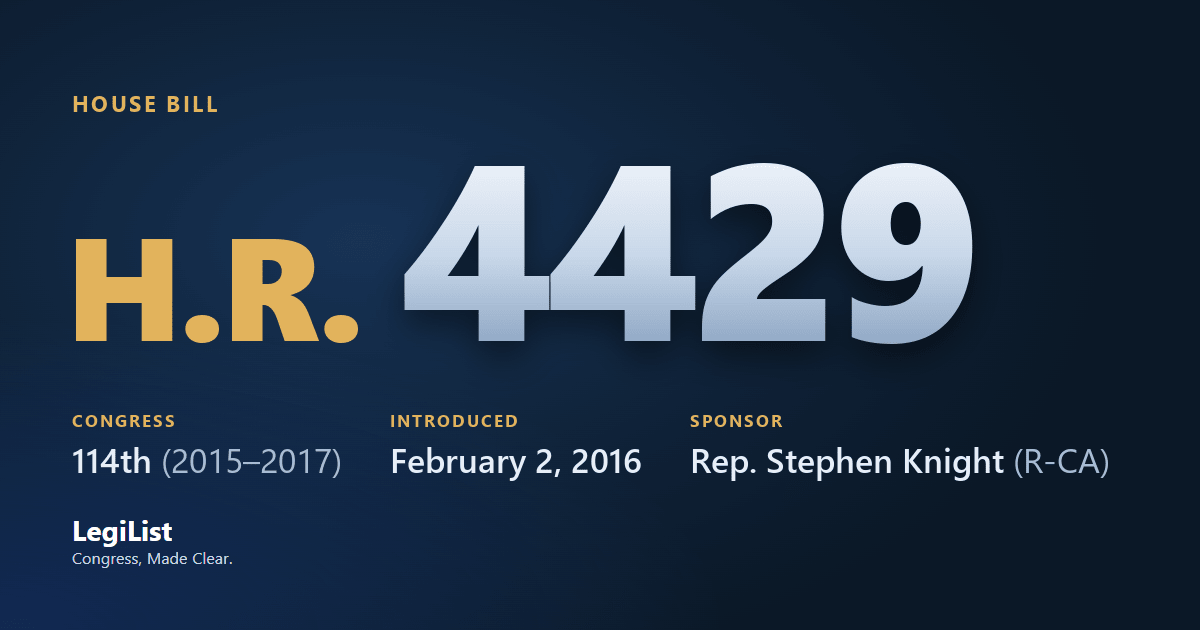
Natural Gas Leak Prevention Act of 2016
Latest action · Feb 5, 2016 Referred to the Subcommittee on Energy and Power.
Progress
Where this bill reached, and when. A stage with no date was not reached; one that failed a vote and later carried shows the date it carried.
- IntroducedFeb 2, 2016
- Passed HouseNot reached
- Passed SenateNot reached
- To the PresidentNot reached
- Became lawNot reached
Summary
Natural Gas Leak Prevention Act of 2016
This bill directs the Department of Transportation (DOT) to issue minimum uniform safety standards for the operation, environmental protection, and integrity management of underground natural gas storage facilities.
The bill defines an "underground natural gas storage facility" as a gas pipeline facility that stores gas in an underground facility, including:
- a depleted hydrocarbon reservoir,
- an aquifer reservoir, or
- a solution mined salt cavern reservoir.
DOT, in developing such standards, shall:
- consider the economic impacts of the regulations on individual gas customers,
- ensure that the regulations do not have a significant economic impact on end users, and
- consider existing consensus standards.
A user fee shall be imposed on an entity operating an underground natural gas storage facility. Collected fees shall be deposited in an underground natural gas storage facility safety account, which shall be established in the Pipeline Safety Fund and which shall be made available only for activities related to natural gas storage safety.
Cosponsors
Members who signed on, in the order they did.
Committees 2
Where it was sent and what each committee and subcommittee did with it, in order.
| Chamber | Committee | What it did |
|---|---|---|
| House | Transportation and Infrastructure Committee | Referred Feb 2, 2016 |
| Railroads, Pipelines, and Hazardous Materials Subcommittee | Referred Feb 3, 2016 | |
| House | Energy and Commerce Committee | Referred Feb 2, 2016 |
| Energy Subcommittee | Referred Feb 5, 2016 |
Actions 4
Everything that happened, newest first.
- Feb 5, 2016Referred to the Subcommittee on Energy and Power.
- Feb 3, 2016Referred to the Subcommittee on Railroads, Pipelines, and Hazardous Materials.
- Feb 2, 2016Introduced in House
- Feb 2, 2016Referred to the Committee on Transportation and Infrastructure, and in addition to the Committee on Energy and Commerce, for a period to be subsequently determined by the Speaker, in each case for consideration of such provisions as fall within the jurisdiction of the committee concerned.
Research
What has been written about this bill: committee reports, cost estimates, the sponsor’s authority statement, printed hearings and the Congressional Research Service’s work.
Constitutional authority
The sponsor’s statement, as printed in the Congressional Record, vol. 162, no. 19, February 2, 2016, page H496.
Related bills 2
Companion bills and other measures the record links to this one.
| Bill | Title | Relationship | Latest action |
|---|---|---|---|
| S 2276 | PIPES Act of 2016 | Related bill | Jun 22, 2016 |
| HR 4937 | PIPES Act of 2016 | Related bill | Nov 14, 2016 |
Titles 2
Every title it has carried, official and short, at each stage.
- Official Title as Introduced
- To amend title 49, United States Code, to direct the Secretary of Transportation to issue minimum uniform safety standards for underground natural gas storage facilities, and for other purposes.
- Short Titles as Introduced
- Natural Gas Leak Prevention Act of 2016
Subjects
Assigned by the Library of Congress. Policy area: Transportation and Public Works.
- Administrative law and regulatory procedures
- Department of Transportation
- Economic performance and conditions
- Energy storage, supplies, demand
- Government trust funds
- Oil and gas
- Pipelines
- Transportation and Public Works
- Transportation safety and security
- User charges and fees
- Water storage
- Water use and supply
Text 1
Each version as it was printed, newest first.
- Feb 2, 2016Introduced in House
Everything here is as published by Congress: the summary is the Congressional Research Service's, the action wording is the clerks', and the subjects are the Library of Congress's. How far it got is read from the actions themselves, taking the most recent one of each kind, so a bill that failed a vote and later passed is shown as having passed. Records come from this bill on Congress.gov and govinfo.gov; cost estimates are the Congressional Budget Office's, and the hearings are the printed hearings GovInfo publishes, which can appear months after the hearing.