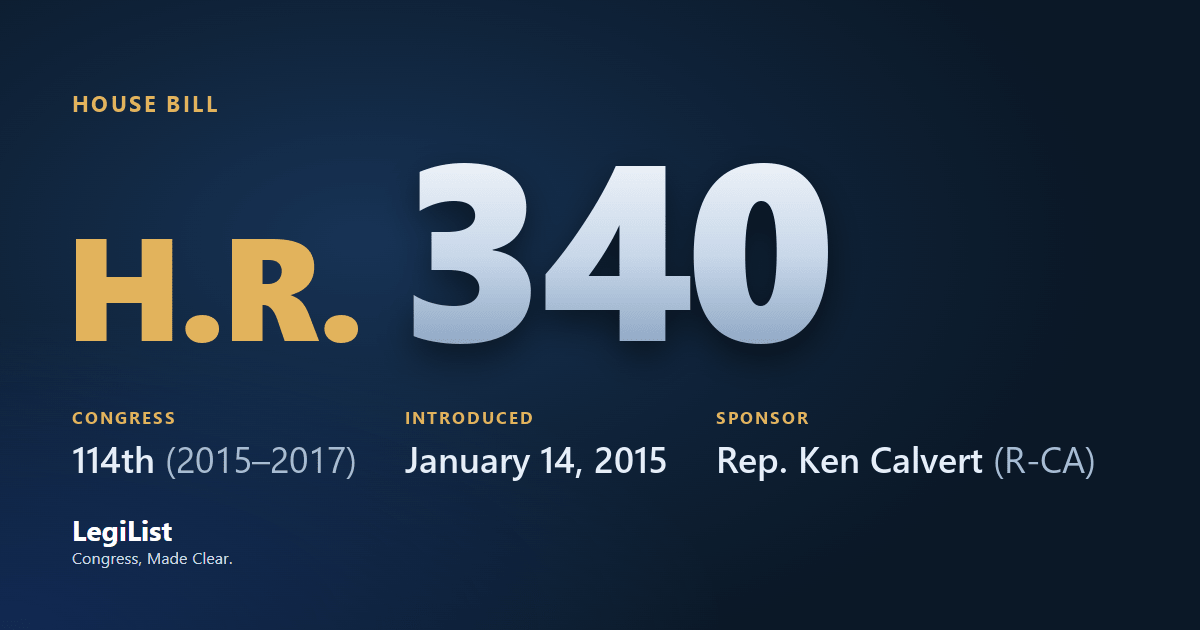
REDUCE Act
Latest action · Aug 13, 2015 Referred to the Subcommittee on Readiness.
Progress
Where this bill reached, and when. A stage with no date was not reached; one that failed a vote and later carried shows the date it carried.
- IntroducedJan 14, 2015
- Passed HouseNot reached
- Passed SenateNot reached
- To the PresidentNot reached
- Became lawNot reached
Summary
Rebalance for an Effective Defense Uniformed and Civilian Employees Act or the REDUCE Act
Limits full-time positions in the Department of Defense (DOD), in each of FY2022-FY2026, subject to specified adjustments to be made by the DOD Secretary, to a number not greater than 85% of the number of such positions at DOD as of September 30, 2016. Permits not more than 1,000 of such positions to be career appointees within the Senior Executive Service. Authorizes the DOD Secretary to offer voluntary separation incentive payments and voluntary early retirement payments to achieve the reductions required by this Act, but requires the Secretary to use involuntary measures, including reductions in force, beginning on October 1, 2016, to achieve required reductions in personnel levels if voluntary measures are inadequate.
Cosponsors 9
Members who signed on, in the order they did. Signatures ran from Jan 14, 2015 to Feb 4, 2015; 6 are original cosponsors, there from the day it was introduced.
| Seat | Cosponsor | Signed on | |
|---|---|---|---|
| R-CA | Darrell Issa | Original | Jan 14, 2015 |
| R-CA | Devin Nunes | Original | Jan 14, 2015 |
| R-CA | Duncan Hunter | Original | Jan 14, 2015 |
| R-AR | Eric A. "Rick" Crawford | Original | Jan 14, 2015 |
| R-WI | Reid J. Ribble | Original | Jan 14, 2015 |
| R-IN | Todd Rokita | Original | Jan 14, 2015 |
| R-TX | Kay Granger | Jan 28, 2015 | |
| R-WI | Paul D. Ryan | Jan 28, 2015 | |
| R-MT | Ryan K. Zinke | Feb 4, 2015 |
Committees 1
Where it was sent and what each committee and subcommittee did with it, in order.
| Chamber | Committee | What it did |
|---|---|---|
| House | Armed Services Committee | Referred Jan 14, 2015 |
| Readiness Subcommittee | Referred Aug 13, 2015 |
Actions 3
Everything that happened, newest first.
- Aug 13, 2015Referred to the Subcommittee on Readiness.
- Jan 14, 2015Introduced in House
- Jan 14, 2015Referred to the House Committee on Armed Services.
In the Congressional Record 1
Days the Record’s own index lists this bill, newest first, with the pages and the members it names. Pages starting H are the House, S the Senate, E Extensions of Remarks.
| Where | In the Record | Members | Date |
|---|---|---|---|
| House | Lists H406–H408H.R. 340–397 | — | Jan 14, 2015 |
Research
What has been written about this bill: committee reports, cost estimates, the sponsor’s authority statement, printed hearings and the Congressional Research Service’s work.
Constitutional authority
The sponsor’s statement, as printed in the Congressional Record, vol. 161, no. 7, January 14, 2015, page H406.
Related bills 1
Companion bills and other measures the record links to this one.
| Bill | Title | Relationship | Latest action |
|---|---|---|---|
| HR 295 | REDUCE Act | Reintroduced Bill | Feb 21, 2017 |
Titles 3
Every title it has carried, official and short, at each stage.
- Official Title as Introduced
- To provide for a limitation on the number of civilian employees at the Department of Defense, and for other purposes.
- Short Titles as Introduced
- REDUCE Act
- Rebalance for an Effective Defense Uniformed and Civilian Employees Act
Subjects
Assigned by the Library of Congress. Policy area: Armed Forces and National Security.
Text 1
Each version as it was printed, newest first.
- Jan 14, 2015Introduced in House
Support LegiList
This page is free, carries no paywall, and is built and maintained by one person. If the record here is useful to you, a few dollars keeps it going.
Everything here is as published by Congress: the summary is the Congressional Research Service's, the action wording is the clerks', and the subjects are the Library of Congress's. How far it got is read from the actions themselves, taking the most recent one of each kind, so a bill that failed a vote and later passed is shown as having passed. Records come from this bill on Congress.gov and govinfo.gov; cost estimates are the Congressional Budget Office's, and the hearings are the printed hearings GovInfo publishes, which can appear months after the hearing.