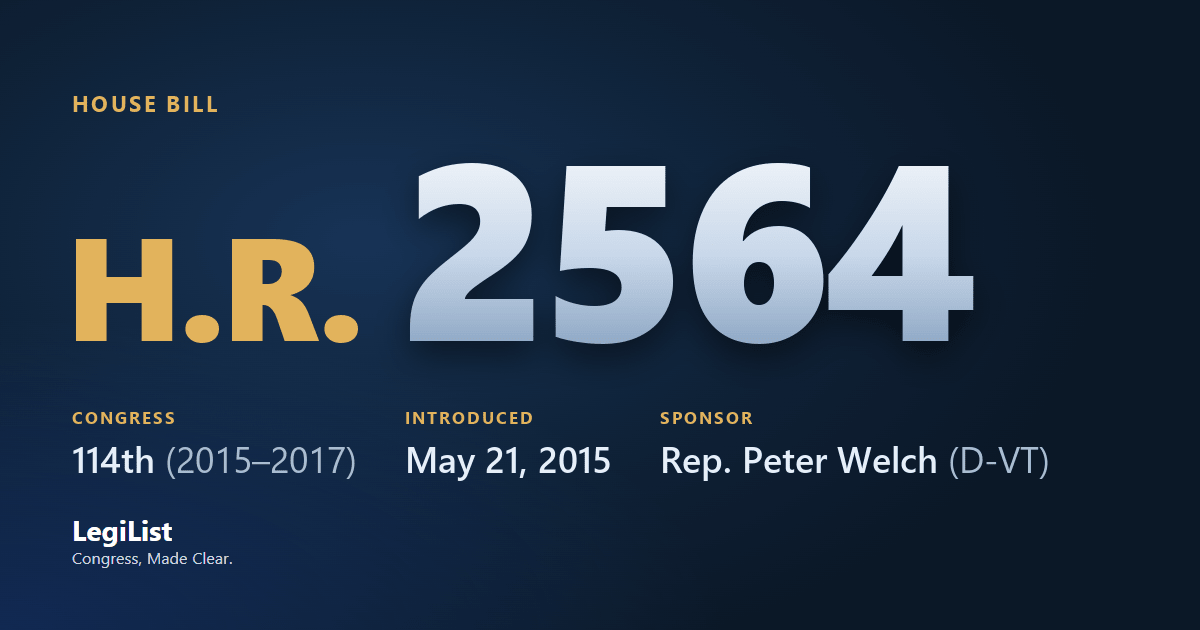
Smart Building Acceleration Act
Latest action · Aug 18, 2015 Referred to the Subcommittee on Research and Technology.
Progress
Where this bill reached, and when. A stage with no date was not reached; one that failed a vote and later carried shows the date it carried.
- IntroducedMay 21, 2015
- Passed HouseNot reached
- Passed SenateNot reached
- To the PresidentNot reached
- Became lawNot reached
Summary
Smart Building Acceleration Act
Directs the Department of Energy (DOE) to: (1) conduct a survey of privately owned smart buildings throughout the nation, select at least one building each from an appropriate range of building sizes and types, and evaluate the costs and benefits of such buildings using the guidelines of the Federal Energy Management Program relating to whole-building evaluation, measurement, and verification; and (2) establish a program to establish one or more smart buildings under the jurisdiction of the General Services Administration and the Departments of Defense, Energy, and Veterans Affairs to demonstrate and evaluate the costs and benefits of smart buildings. Requires such evaluations to include an identification of which advanced building technologies are most cost-effective and show the most promise for increasing building energy savings, increasing service performance to building occupants, and reducing environmental impacts.
Defines a "smart building" to mean a building with an energy system that:
- is flexible and automated;
- has extensive operational monitoring and communication connectivity, allowing remote monitoring and analysis of all building functions;
- is integrated with the overall building operations for control of energy generation, consumption, and storage; and
- communicates with utilities and other third party commercial entities.
Directs DOE: (1) as part of DOE's Better Building Challenge, to develop a smart building accelerator in consultation with major private sector property owners to demonstrate innovative policies and approaches that will accelerate the transition to smart buildings; and (2) to conduct research and development to address key barriers to the integration of advanced building technologies and to accelerate the transition to smart buildings.
Cosponsors 2
Members who signed on, in the order they did. Signatures ran from May 21, 2015 to Jul 16, 2015; 1 is an original cosponsor, there from the day it was introduced.
| Seat | Cosponsor | Signed on | |
|---|---|---|---|
| R-IL | Adam Kinzinger | Original | May 21, 2015 |
| D-FL | Kathy Castor | Jul 16, 2015 |
Committees 3
Where it was sent and what each committee and subcommittee did with it, in order.
| Chamber | Committee | What it did |
|---|---|---|
| House | Energy and Commerce Committee | Referred May 21, 2015 |
| Energy Subcommittee | Referred May 22, 2015 | |
| House | Transportation and Infrastructure Committee | Referred May 21, 2015 |
| Economic Development, Public Buildings, and Emergency Management Subcommittee | Referred May 22, 2015 | |
| House | Science, Space, and Technology Committee | Referred May 21, 2015 |
| Research and Technology Subcommittee | Referred Aug 18, 2015 |
Actions 5
Everything that happened, newest first.
- Aug 18, 2015Referred to the Subcommittee on Research and Technology.
- May 22, 2015Referred to the Subcommittee on Energy and Power.
- May 22, 2015Referred to the Subcommittee on Economic Development, Public Buildings and Emergency Management.
- May 21, 2015Introduced in House
- May 21, 2015Referred to the Committee on Energy and Commerce, and in addition to the Committees on Transportation and Infrastructure, and Science, Space, and Technology, for a period to be subsequently determined by the Speaker, in each case for consideration of such provisions as fall within the jurisdiction of the committee concerned.
Research
What has been written about this bill: committee reports, cost estimates, the sponsor’s authority statement, printed hearings and the Congressional Research Service’s work.
Constitutional authority
The sponsor’s statement, as printed in the Congressional Record, vol. 161, no. 79, May 21, 2015, page H3564.
Related bills 2
Companion bills and other measures the record links to this one.
| Bill | Title | Relationship | Latest action |
|---|---|---|---|
| S 1046 | Smart Building Acceleration Act | Identical bill | Apr 30, 2015 |
| S 2089 | American Energy Innovation Act | Related bill | Sep 29, 2015 |
Titles 2
Every title it has carried, official and short, at each stage.
- Official Title as Introduced
- To accelerate the adoption of smart building technologies in the private sector and key Federal agencies.
- Short Titles as Introduced
- Smart Building Acceleration Act
Subjects
Assigned by the Library of Congress. Policy area: Energy.
- Building construction
- Department of Defense
- Department of Energy
- Department of Veterans Affairs
- Electric power generation and transmission
- Energy
- Energy efficiency and conservation
- Energy research
- Energy storage, supplies, demand
- General Services Administration
- Government buildings, facilities, and property
- Government studies and investigations
- Public-private cooperation
- Research and development
Text 1
Each version as it was printed, newest first.
- May 21, 2015Introduced in House
Support LegiList
This page is free, carries no paywall, and is built and maintained by one person. If the record here is useful to you, a few dollars keeps it going.
Everything here is as published by Congress: the summary is the Congressional Research Service's, the action wording is the clerks', and the subjects are the Library of Congress's. How far it got is read from the actions themselves, taking the most recent one of each kind, so a bill that failed a vote and later passed is shown as having passed. Records come from this bill on Congress.gov and govinfo.gov; cost estimates are the Congressional Budget Office's, and the hearings are the printed hearings GovInfo publishes, which can appear months after the hearing.