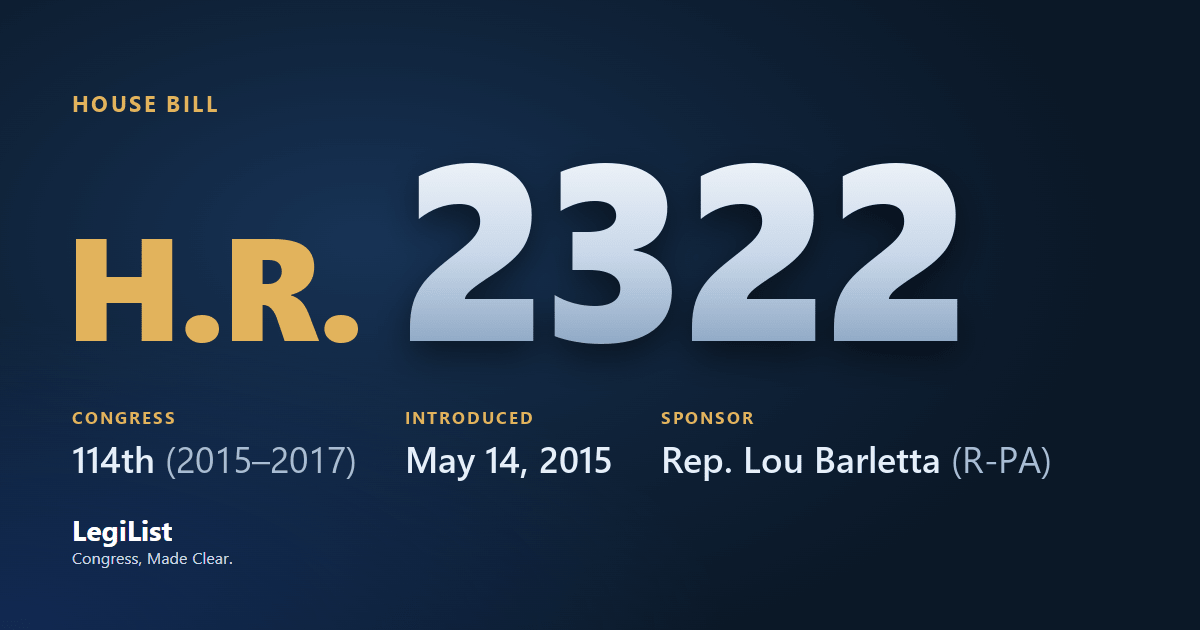
Public Buildings Reform and Savings Act of 2015
Latest action · May 20, 2015 Ordered to be Reported (Amended) by Voice Vote.
Progress
Where this bill reached, and when. A stage with no date was not reached; one that failed a vote and later carried shows the date it carried.
- IntroducedMay 14, 2015
- Passed HouseNot reached
- Passed SenateNot reached
- To the PresidentNot reached
- Became lawNot reached
Summary
Public Buildings Reform and Savings Act of 2015
Directs the General Services Administration (GSA) to establish and conduct a pilot program through 2020 to execute lease agreements using alternative procedures to reduce costs of leased space and significantly reduce or eliminate the backlog of expiring leases over the next five years. Authorizes the GSA to submit consolidated prospectuses for leases and projects to Congress for approval and to include in leases certain costs associated with agency relocation and buildout, including moving and equipment costs.
Provides for approval by congressional resolution of any costs and expenses associated with administering an acquisition by exchange involving real property or in-kind consideration, including services with a fair market value of $2.85 million or more.
Authorizes: (1) the Department of Homeland Security (DHS) to authorize contract security personnel to carry firearms, and (2) such personnel to detain individuals without a warrant. Directs DHS to establish minimum and uniform training standards for security personnel.
Directs DHS to report on: (1) the personnel needs of the Federal Protective Service (FPS), including recommendations on the numbers of FPS law enforcement officers needed to carry out the mission of FPS during the 10-year period after the enactment of this Act, and (2) the best method of funding for the FPS.
Requires the GSA to: (1) justify any need for new or replacement building space, including an explanation of why such space could not be consolidated or colocated into other owned or leased space; and (2) notify the House Committee on Transportation and Infrastructure and the Senate Committee on Environment and Public Works if the cost, scope, or size of any project changes by 5% or more.
Terminates the authority for any lease or project unless it is initiated not later than five years after congressional authorization.
Directs the GSA to sell portions of the Forrestal Complex in Washington, D.C. to generate funds necessary to construct a new Department of Energy headquarters on government-owned land in a manner consistent with the SW Ecodistrict Plan of the National Capital Planning Commission.
Directs the GSA, to the extent practicable and when cost effective, to consider the direct purchase of energy and other utilities in bulk or otherwise for leased facilities.
Exempts an individual acquisition for commercial leasing services from enhanced competition requirements for the purchase of property and services by executive agencies if such individual acquisition is made on a no cost basis and pursuant to a multiple award contract in accordance with requirements for full and open competition. Directs the Government Accountability Office to conduct biennial audits of the GSA National Broker Contract, conduct a review of the application of enhanced competition requirements, and report on such audits and reviews.
Cosponsors 4
Members who signed on, in the order they did. Signatures ran from May 14, 2015 to Oct 8, 2015; 3 are original cosponsors, there from the day it was introduced.
| Seat | Cosponsor | Signed on | |
|---|---|---|---|
| D-IN | André Carson | Original | May 14, 2015 |
| R-PA | Bill Shuster | Original | May 14, 2015 |
| D-OR | Peter A. DeFazio | Original | May 14, 2015 |
| D-NY | Jerrold Nadler | Oct 8, 2015 |
Committees 1
Where it was sent and what each committee and subcommittee did with it, in order.
| Chamber | Committee | What it did |
|---|---|---|
| House | Transportation and Infrastructure Committee | Referred May 14, 2015Markup May 20, 2015 |
| Economic Development, Public Buildings, and Emergency Management Subcommittee | Referred May 15, 2015Discharged May 20, 2015 |
Actions 6
Everything that happened, newest first.
- May 20, 2015Subcommittee on Economic Development, Public Buildings and Emergency Management Discharged.
- May 20, 2015Committee Consideration and Mark-up Session Held.
- May 20, 2015Ordered to be Reported (Amended) by Voice Vote.
- May 15, 2015Referred to the Subcommittee on Economic Development, Public Buildings and Emergency Management.
- May 14, 2015Introduced in House
- May 14, 2015Referred to the House Committee on Transportation and Infrastructure.
Research
What has been written about this bill: committee reports, cost estimates, the sponsor’s authority statement, printed hearings and the Congressional Research Service’s work.
Constitutional authority
The sponsor’s statement, as printed in the Congressional Record, vol. 161, no. 74, May 14, 2015, page H3213.
Related bills 1
Companion bills and other measures the record links to this one.
| Bill | Title | Relationship | Latest action |
|---|---|---|---|
| HR 4487 | Public Buildings Reform and Savings Act of 2016 | Related bill | Jul 14, 2016 |
Titles 2
Every title it has carried, official and short, at each stage.
- Official Title as Introduced
- To reduce costs of Federal real estate, improve building security, and for other purposes.
- Short Titles as Introduced
- Public Buildings Reform and Savings Act of 2015
Subjects
Assigned by the Library of Congress. Policy area: Government Operations and Politics.
- Accounting and auditing
- Congressional oversight
- Department of Energy
- Department of Homeland Security
- District of Columbia
- Energy storage, supplies, demand
- Firearms and explosives
- Government buildings, facilities, and property
- Government Operations and Politics
- Government studies and investigations
- Law enforcement officers
- Public contracts and procurement
Text 1
Each version as it was printed, newest first.
- May 14, 2015Introduced in House
Everything here is as published by Congress: the summary is the Congressional Research Service's, the action wording is the clerks', and the subjects are the Library of Congress's. How far it got is read from the actions themselves, taking the most recent one of each kind, so a bill that failed a vote and later passed is shown as having passed. Records come from this bill on Congress.gov and govinfo.gov; cost estimates are the Congressional Budget Office's, and the hearings are the printed hearings GovInfo publishes, which can appear months after the hearing.