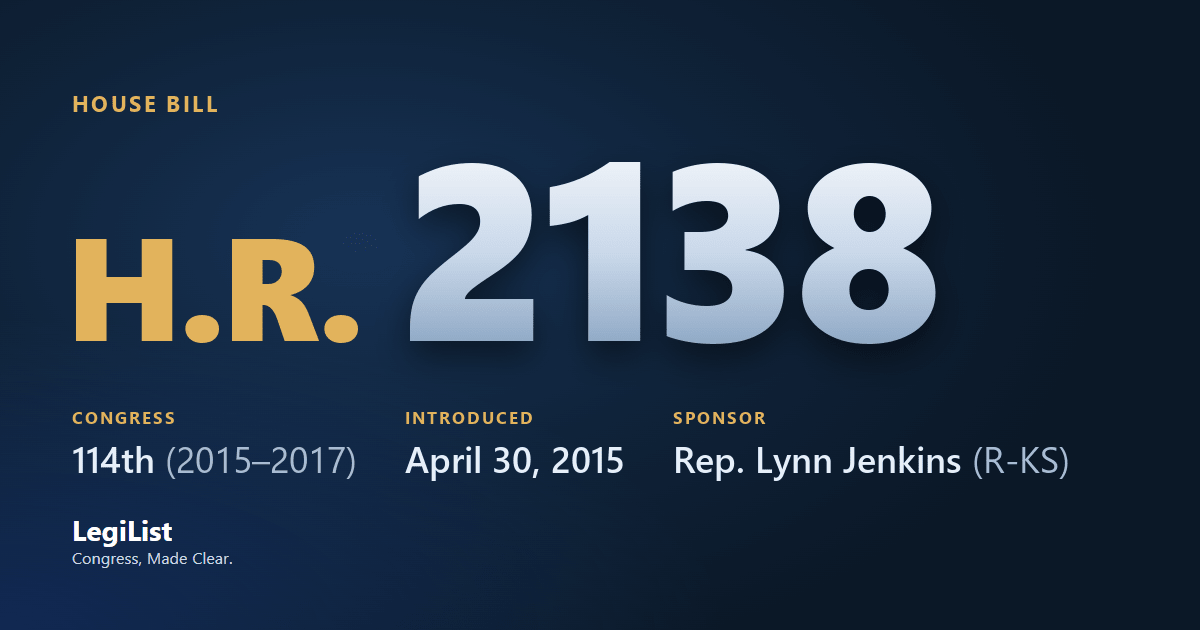
Medicare Access to Rural Anesthesiology Act of 2015
Latest action · May 14, 2015 Referred to the Subcommittee on Health.
Progress
Where this bill reached, and when. A stage with no date was not reached; one that failed a vote and later carried shows the date it carried.
- IntroducedApr 30, 2015
- Passed HouseNot reached
- Passed SenateNot reached
- To the PresidentNot reached
- Became lawNot reached
Summary
Medicare Access to Rural Anesthesiology Act of 2015
Amends title XVIII (Medicare) of the Social Security Act to provide payment under Medicare part A (Hospital Insurance) on a reasonable cost basis for anesthesia services furnished by a physician who is an anesthesiologist in certain rural hospitals in the same manner as payment is made for anesthesia services furnished by a certified registered nurse anesthetist in such hospitals.
Cosponsors 13
Members who signed on, in the order they did. Signatures ran from Apr 30, 2015 to Dec 8, 2016; 1 is an original cosponsor, there from the day it was introduced.
| Seat | Cosponsor | Signed on | |
|---|---|---|---|
| D-MO | Emanuel Cleaver | Original | Apr 30, 2015 |
| R-MO | Billy Long | May 14, 2015 | |
| R-MO | Blaine Luetkemeyer | May 14, 2015 | |
| R-MO | Jason Smith | May 14, 2015 | |
| D-CA | Julia Brownley | May 14, 2015 | |
| R-MO | Sam Graves | May 14, 2015 | |
| R-IL | Rodney Davis | Jun 4, 2015 | |
| R-MO | Ann Wagner | Jul 8, 2015 | |
| D-CA | Mike Thompson | Sep 11, 2015 | |
| D-CA | Jared Huffman | Dec 3, 2015 | |
| D-WI | Ron Kind | Dec 15, 2015 | |
| R-MI | John R. Moolenaar | May 3, 2016 | |
| D-NY | Grace Meng | Dec 8, 2016 |
Committees 1
Where it was sent and what each committee and subcommittee did with it, in order.
| Chamber | Committee | What it did |
|---|---|---|
| House | Ways and Means Committee | Referred Apr 30, 2015 |
| Health Subcommittee | Referred May 14, 2015 |
Actions 3
Everything that happened, newest first.
- May 14, 2015Referred to the Subcommittee on Health.
- Apr 30, 2015Introduced in House
- Apr 30, 2015Referred to the House Committee on Ways and Means.
Research
What has been written about this bill: committee reports, cost estimates, the sponsor’s authority statement, printed hearings and the Congressional Research Service’s work.
Constitutional authority
The sponsor’s statement, as printed in the Congressional Record, vol. 161, no. 64, April 30, 2015, page H2770.
Printed hearings 1
Hearings whose printed record names this bill, newest first: hearings on it, and wider hearings where it came up.
| Number | Hearing | Committee | Held |
|---|---|---|---|
| — | LEGISLATION TO IMPROVE AND SUSTAIN THE MEDICARE PROGRAM66 pages | Ways and Means Committee | Jun 8, 2016 |
Related bills 2
Companion bills and other measures the record links to this one.
| Bill | Title | Relationship | Latest action |
|---|---|---|---|
| HR 2881 | Medicare Access to Rural Anesthesiology Act of 2017 | Reintroduced Bill | Jun 21, 2017 |
| S 3435 | Craig Thomas Rural Hospital and Provider Equity Act of 2016 | Related bill | Sep 28, 2016 |
Titles 2
Every title it has carried, official and short, at each stage.
- Official Title as Introduced
- To amend title XVIII of the Social Security Act to provide payment under part A of the Medicare Program on a reasonable cost basis for anesthesia services furnished by an anesthesiologist in certain rural hospitals in the same manner as payments are provided for anesthesia services furnished by anesthesiologist assistants and certified registered nurse anesthetists in such hospitals, and for other purposes.
- Short Titles as Introduced
- Medicare Access to Rural Anesthesiology Act of 2015
Subjects
Assigned by the Library of Congress. Policy area: Health.
Text 1
Each version as it was printed, newest first.
- Apr 30, 2015Introduced in House
Everything here is as published by Congress: the summary is the Congressional Research Service's, the action wording is the clerks', and the subjects are the Library of Congress's. How far it got is read from the actions themselves, taking the most recent one of each kind, so a bill that failed a vote and later passed is shown as having passed. Records come from this bill on Congress.gov and govinfo.gov; cost estimates are the Congressional Budget Office's, and the hearings are the printed hearings GovInfo publishes, which can appear months after the hearing.