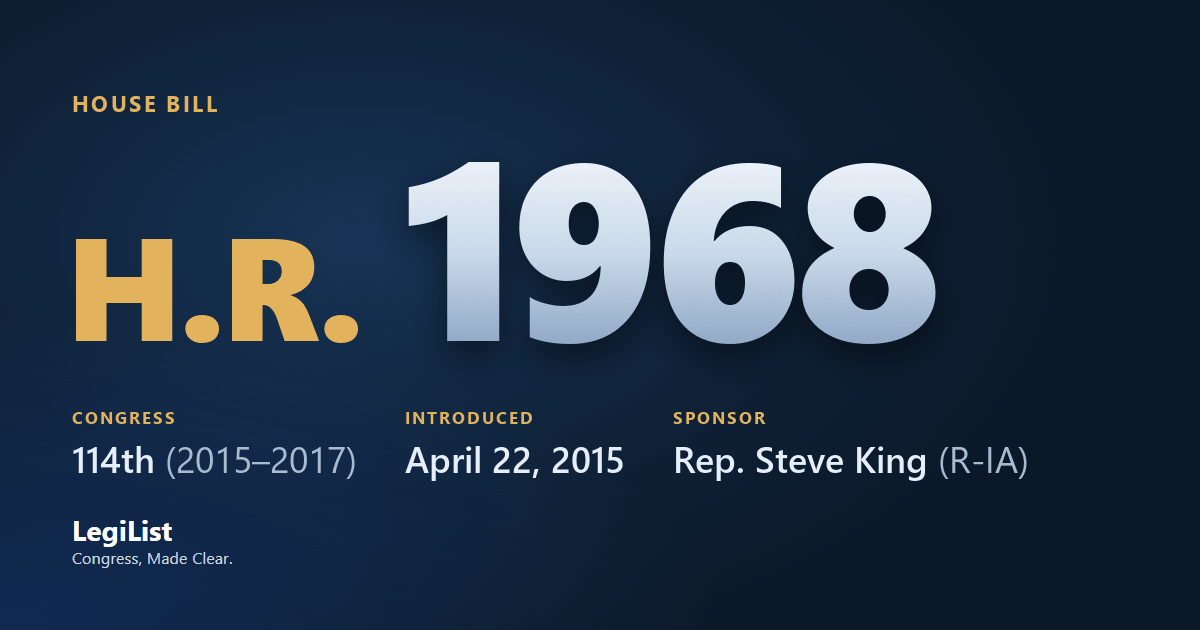
Restrain the Judges on Marriage Act of 2015
Latest action · May 15, 2015 Referred to the Subcommittee on the Constitution and Civil Justice.
Progress
Where this bill reached, and when. A stage with no date was not reached; one that failed a vote and later carried shows the date it carried.
- IntroducedApr 22, 2015
- Passed HouseNot reached
- Passed SenateNot reached
- To the PresidentNot reached
- Became lawNot reached
Summary
Restrain the Judges on Marriage Act of 2015
Amends the federal judicial code to deny federal courts jurisdiction to hear or decide any question pertaining to the interpretation, or the validity under the Constitution, of: (1) any type of marriage, (2) the provision of the Defense of Marriage Act declaring that no state shall be required to give effect to any marriage between persons of the same sex under the laws of any other state, or (3) this Act.
Prohibits federal funds from being used for: (1) litigation in federal courts on such questions, or (2) enforcement of federal court orders or judgments on such questions.
Cosponsors 10
Members who signed on, in the order they did. Signatures ran from Apr 22, 2015 to Jun 23, 2015; 7 are original cosponsors, there from the day it was introduced.
| Seat | Cosponsor | Signed on | |
|---|---|---|---|
| R-TX | Brian Babin | Original | Apr 22, 2015 |
| R-CA | Doug LaMalfa | Original | Apr 22, 2015 |
| R-PA | Glenn Thompson | Original | Apr 22, 2015 |
| R-SC | Jeff Duncan | Original | Apr 22, 2015 |
| R-TX | Louie Gohmert | Original | Apr 22, 2015 |
| R-FL | Ted S. Yoho | Original | Apr 22, 2015 |
| R-KY | Thomas Massie | Original | Apr 22, 2015 |
| R-MS | Steven M. Palazzo | Apr 23, 2015 | |
| R-MI | Tim Walberg | Apr 23, 2015 | |
| R-NC | Walter B. Jones | Jun 23, 2015 |
Committees 1
Where it was sent and what each committee and subcommittee did with it, in order.
| Chamber | Committee | What it did |
|---|---|---|
| House | Judiciary Committee | Referred Apr 22, 2015 |
| Constitution and Limited Government Subcommittee | Referred May 15, 2015 |
Actions 3
Everything that happened, newest first.
- May 15, 2015Referred to the Subcommittee on the Constitution and Civil Justice.
- Apr 22, 2015Introduced in House
- Apr 22, 2015Referred to the House Committee on the Judiciary.
Research
What has been written about this bill: committee reports, cost estimates, the sponsor’s authority statement, printed hearings and the Congressional Research Service’s work.
Constitutional authority
The sponsor’s statement, as printed in the Congressional Record, vol. 161, no. 59, April 22, 2015, page H2419.
Related bills 1
Companion bills and other measures the record links to this one.
| Bill | Title | Relationship | Latest action |
|---|---|---|---|
| S 1080 | Protect Marriage from the Courts Act of 2015 | Related bill | Apr 23, 2015 |
Titles 2
Every title it has carried, official and short, at each stage.
- Official Title as Introduced
- To amend title 28, United States Code, to limit Federal court jurisdiction and funding over questions concerning the issue of marriage with respect to the Defense of Marriage Act and the Constitution, and for other purposes.
- Short Titles as Introduced
- Restrain the Judges on Marriage Act of 2015
Subjects
Assigned by the Library of Congress. Policy area: Law.
- Civil actions and liability
- Constitution and constitutional amendments
- Federal appellate courts
- Federal district courts
- Intergovernmental relations
- Judicial review and appeals
- Jurisdiction and venue
- Law
- Marriage and family status
- Sex, gender, sexual orientation discrimination
- State and local government operations
- Supreme Court
Text 1
Each version as it was printed, newest first.
- Apr 22, 2015Introduced in House
Everything here is as published by Congress: the summary is the Congressional Research Service's, the action wording is the clerks', and the subjects are the Library of Congress's. How far it got is read from the actions themselves, taking the most recent one of each kind, so a bill that failed a vote and later passed is shown as having passed. Records come from this bill on Congress.gov and govinfo.gov; cost estimates are the Congressional Budget Office's, and the hearings are the printed hearings GovInfo publishes, which can appear months after the hearing.