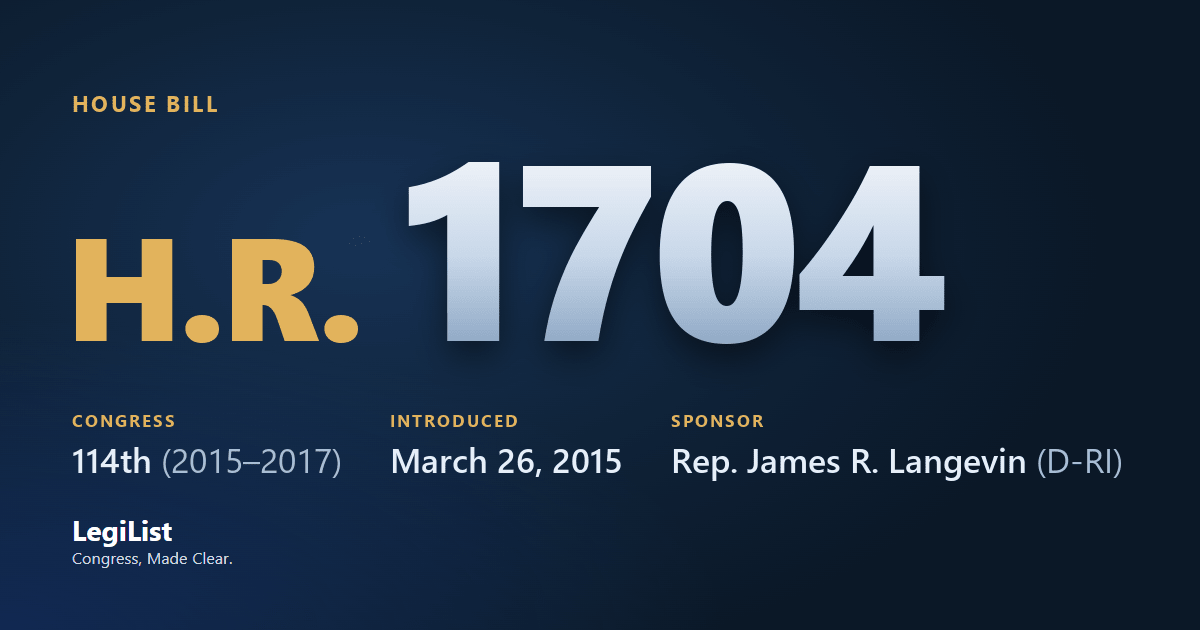
Personal Data Notification and Protection Act of 2015
Latest action · Apr 29, 2015 Referred to the Subcommittee on the Constitution and Civil Justice.
Progress
Where this bill reached, and when. A stage with no date was not reached; one that failed a vote and later carried shows the date it carried.
- IntroducedMar 26, 2015
- Passed HouseNot reached
- Passed SenateNot reached
- To the PresidentNot reached
- Became lawNot reached
Summary
Personal Data Notification and Protection Act of 2015
Requires certain businesses that use, access, transmit, store, dispose of, or collect sensitive personally identifiable information about more than 10,000 individuals during any 12-month period to notify individuals whose information is believed to have been accessed or acquired through a discovered security breach.
Directs businesses, within 30 days after discovery of a breach, to notify: (1) affected individuals by mail, telephone, or email; and (2) major media outlets if the number of affected residents of a state exceeds 5,000. Allows the Federal Trade Commission (FTC) to extend the notification period if a business seeks additional time.
Requires the Department of Homeland Security (DHS) to designate a federal government entity to receive notices about security incidents, threats, and vulnerabilities. Directs businesses to notify the DHS-designated entity, and requires the DHS-designated entity to then notify the U.S. Secret Service, the Federal Bureau of Investigation (FBI), and the FTC, if a security breach affects: (1) more than 5,000 individuals, (2) a database that contains the sensitive information of more than 500,000 individuals, (3) federal government databases, or (4) federal employees or contractors involved in national security or law enforcement. Requires the DHS-designated entity to also make the information available to other appropriate federal agencies for law enforcement, national security, or computer security purposes.
Authorizes the Secret Service or the FBI to require businesses to delay or exempt individuals from notifications for national security or law enforcement purposes.
Requires businesses to notify consumer reporting agencies if more than 5,000 individuals must be notified of a breach.
Exempts a business from individual notification requirements if the business: (1) conducts and notifies the FTC of a risk assessment finding no reasonable risk that a breach resulted in, or will result in, harm to the affected individuals, provided that the FTC is given 10 days to determine whether individual notification should be provided before the exemption automatically becomes effective; or (2) uses or participates in a security program that blocks the use of certain sensitive personal information to initiate financial transactions if the program also notifies affected individuals after a breach that results in fraud or unauthorized transactions.
Sets forth authority for the FTC and states to enforce against violations of this Act.
Amends the federal criminal code to extend extraterritorially the application of penalties for fraud offenses involving an access device issued, owned, managed, or controlled by a financial institution, credit card system member, or other entity organized under the laws of the United States or any U.S. state or territory. (An access device is any card, code, electronic serial number, telecommunications service, or other means of account access that can be used to initiate a transfer of funds or to obtain money, goods, or services.) Removes a condition under current law that subjects a person to such penalties only if the underlying articles, property, or proceeds are held within or have transferred through U.S. jurisdiction.
Cosponsors
Members who signed on, in the order they did.
Committees 2
Where it was sent and what each committee and subcommittee did with it, in order.
| Chamber | Committee | What it did |
|---|---|---|
| House | Energy and Commerce Committee | Referred Mar 26, 2015 |
| Commerce, Manufacturing, and Trade Subcommittee | Referred Mar 27, 2015 | |
| House | Judiciary Committee | Referred Mar 26, 2015 |
| Crime and Federal Government Surveillance Subcommittee | Referred Apr 29, 2015 | |
| Constitution and Limited Government Subcommittee | Referred Apr 29, 2015 |
Actions 5
Everything that happened, newest first.
- Apr 29, 2015Referred to the Subcommittee on Crime, Terrorism, Homeland Security, and Investigations.
- Apr 29, 2015Referred to the Subcommittee on the Constitution and Civil Justice.
- Mar 27, 2015Referred to the Subcommittee on Commerce, Manufacturing, and Trade.
- Mar 26, 2015Introduced in House
- Mar 26, 2015Referred to the Committee on Energy and Commerce, and in addition to the Committee on the Judiciary, for a period to be subsequently determined by the Speaker, in each case for consideration of such provisions as fall within the jurisdiction of the committee concerned.
Research
What has been written about this bill: committee reports, cost estimates, the sponsor’s authority statement, printed hearings and the Congressional Research Service’s work.
Constitutional authority
The sponsor’s statement, as printed in the Congressional Record, vol. 161, no. 51, March 26, 2015, page H2114.
Printed hearings 1
Hearings whose printed record names this bill, newest first: hearings on it, and wider hearings where it came up.
| Number | Hearing | Committee | Held |
|---|---|---|---|
| S. Hrg. 114-236 | CONFRONTING THE CHALLENGE OF CYBERSECURITY100 pages | Commerce, Science, and Transportation Committee | Sep 3, 2015 |
Related bills 1
Companion bills and other measures the record links to this one.
| Bill | Title | Relationship | Latest action |
|---|---|---|---|
| HR 1584 | CARDER Act of 2015 | Related bill | Dec 2, 2015 |
Titles 2
Every title it has carried, official and short, at each stage.
- Official Title as Introduced
- To establish a national data breach notification standard, and for other purposes.
- Short Titles as Introduced
- Personal Data Notification and Protection Act of 2015
Subjects
Assigned by the Library of Congress. Policy area: Commerce.
Text 1
Each version as it was printed, newest first.
- Mar 26, 2015Introduced in House
Support LegiList
This page is free, carries no paywall, and is built and maintained by one person. If the record here is useful to you, a few dollars keeps it going.
Everything here is as published by Congress: the summary is the Congressional Research Service's, the action wording is the clerks', and the subjects are the Library of Congress's. How far it got is read from the actions themselves, taking the most recent one of each kind, so a bill that failed a vote and later passed is shown as having passed. Records come from this bill on Congress.gov and govinfo.gov; cost estimates are the Congressional Budget Office's, and the hearings are the printed hearings GovInfo publishes, which can appear months after the hearing.