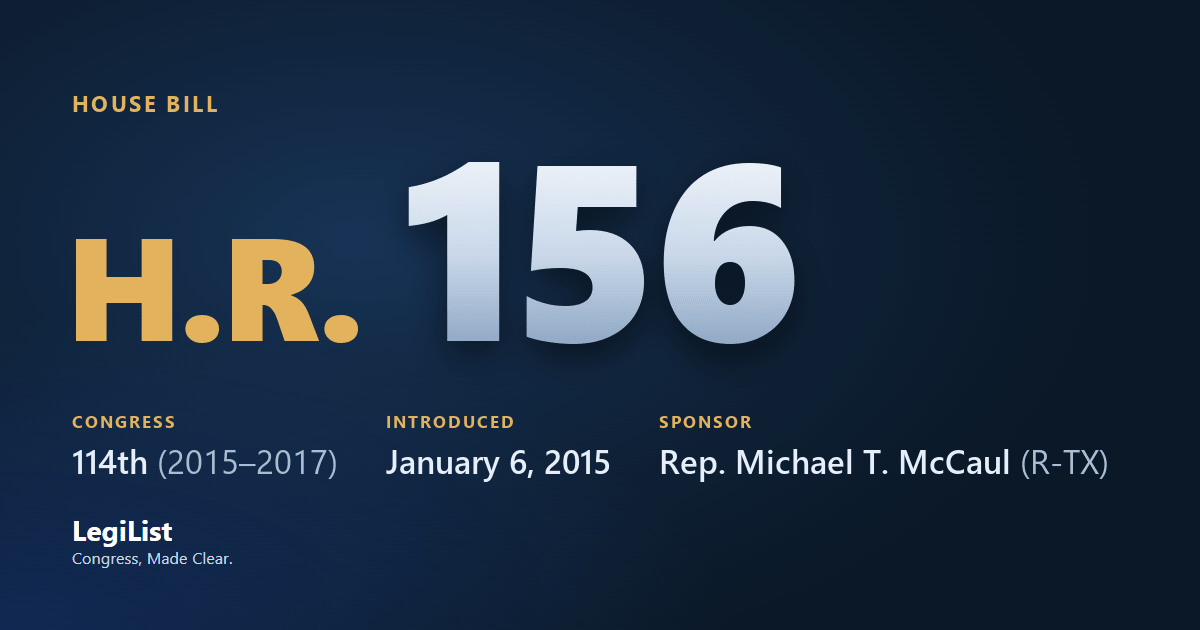
Crude Oil Export Act
Latest action · Mar 2, 2015 Referred to the Subcommittee on Energy and Mineral Resources.
Progress
Where this bill reached, and when. A stage with no date was not reached; one that failed a vote and later carried shows the date it carried.
- IntroducedJan 6, 2015
- Passed HouseNot reached
- Passed SenateNot reached
- To the PresidentNot reached
- Became lawNot reached
Summary
Crude Oil Export Act
Amends the Energy Policy and Conservation Act to repeal the authority of the President to restrict exports of: (1) coal, petroleum products, natural gas, or petrochemical feedstocks, and (2) materials or equipment which he determines necessary for either exploration, production, refining, or transportation of energy supplies, or for construction or maintenance of energy facilities within the United States.
Amends the Mineral Leasing Act to repeal limitations on exports of oil.
Amends the Outer Continental Shelf Lands Act to repeal limitations on export of Outer Continental Shelf oil or gas on the lands within its purview.
Declares without force or effect: (1) the limitation placed upon crude oil exports by the Export Administration Act of 1979, and (2) a specified regulation relating to crude oil.
Directs the Bureau of Industry and Security of the Department of Commerce to grant licenses to export crude oil to a country unless: (1) the country is subject to sanctions or trade restrictions imposed by the United States, or (2) either the President or Congress has designated the country as subject to exclusion for reasons of national security.
Authorizes the President, subject to a congressional resolution of disapproval, to ban the export of crude oil from the United States for a maximum period of 90 days during a national emergency. Permits renewal of such ban during periods of national emergency.
Subjects any act of imposing or renewing a ban to a resolution of disapproval under the Congressional Review Act.
Cosponsors 18
Members who signed on, in the order they did. Signatures ran from Jan 6, 2015 to Jul 7, 2015, with 3 there on the day it was introduced.
| Seat | Cosponsor | Signed on | |
|---|---|---|---|
| R-SC | Jeff Duncan | Original | Jan 6, 2015 |
| R-OK | Jim Bridenstine | Original | Jan 6, 2015 |
| R-TX | Ted Poe | Original | Jan 6, 2015 |
| R-TX | K. Michael Conaway | Jan 7, 2015 | |
| R-AR | Bruce Westerman | Jan 12, 2015 | |
| R-AZ | David Schweikert | Jan 12, 2015 | |
| R-ND | Kevin Cramer | Feb 4, 2015 | |
| R-OH | Steve Chabot | Feb 5, 2015 | |
| R-SC | Joe Wilson | Feb 9, 2015 | |
| R-CA | Tom McClintock | Feb 26, 2015 | |
| R-OK | Frank D. Lucas | Mar 3, 2015 | |
| R-AL | Gary J. Palmer | Mar 13, 2015 | |
| R-AZ | Matt Salmon | Mar 26, 2015 | |
| D-TX | Henry Cuellar | Apr 30, 2015 | |
| R-NC | George Holding | May 20, 2015 |
Actions 5
Everything that happened, newest first.
- Mar 2, 2015Referred to the Subcommittee on Energy and Mineral Resources.
- Feb 11, 2015Referred to the Subcommittee on Terrorism, Nonproliferation, and Trade.
- Jan 9, 2015Referred to the Subcommittee on Energy and Power.
- Jan 6, 2015Introduced in House
- Jan 6, 2015Referred to the Committee on Foreign Affairs, and in addition to the Committees on Natural Resources, Energy and Commerce, and Rules, for a period to be subsequently determined by the Speaker, in each case for consideration of such provisions as fall within the jurisdiction of the committee concerned.
Related bills 3
Companion bills and other measures the record links to this one.
| Bill | Title | Relationship | Latest action |
|---|---|---|---|
| S 791 | American Energy Renaissance Act of 2015 | Related bill | Mar 18, 2015 |
| S 1372 | American Crude Oil Export Equality Act | Related bill | May 19, 2015 |
| HR 1487 | American Energy Renaissance Act of 2015 | Related bill | Apr 8, 2015 |
Subjects
Assigned by the Library of Congress. Policy area: Foreign Trade and International Finance.
Text 1
Each version as it was printed, newest first.
- Jan 6, 2015Introduced in House
Everything here is as published by Congress: the summary is the Congressional Research Service's, the action wording is the clerks', and the subjects are the Library of Congress's. How far it got is read from the actions themselves, taking the most recent one of each kind, so a bill that failed a vote and later passed is shown as having passed. Records come from this bill on Congress.gov and govinfo.gov.