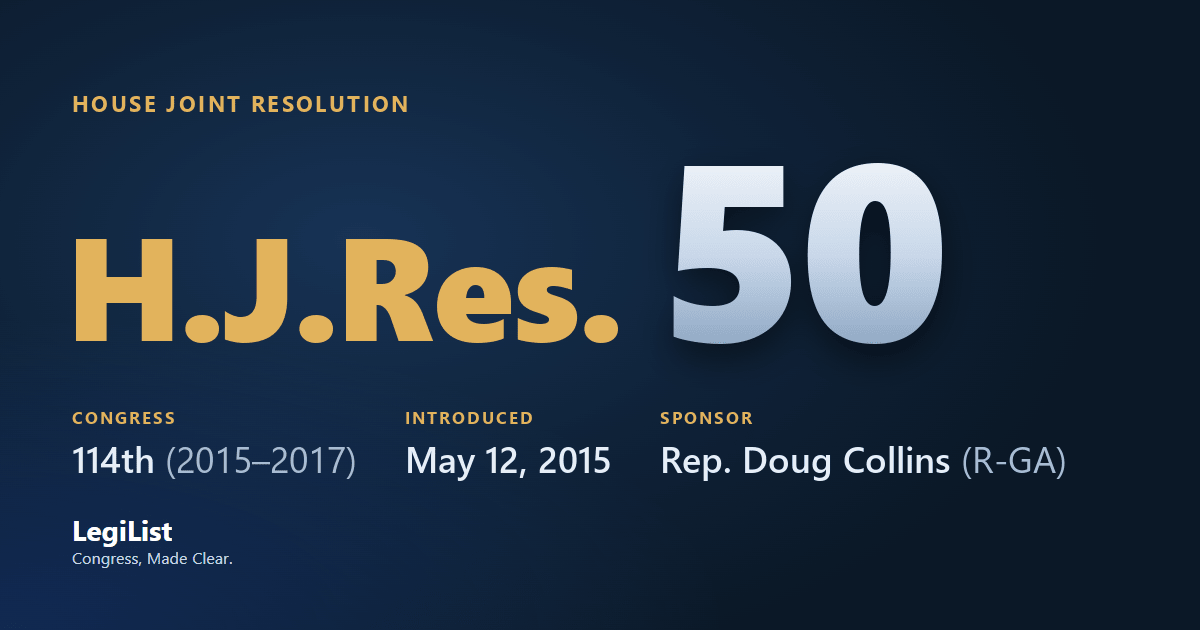
Granting the consent of Congress to the Health Care Compact.
Latest action · May 12, 2015 Referred to the House Committee on the Judiciary.
Progress
Where this resolution reached, and when. A stage with no date was not reached; one that failed a vote and later carried shows the date it carried.
- IntroducedMay 12, 2015
- Passed HouseNot reached
- Passed SenateNot reached
- To the PresidentNot reached
- Became lawNot reached
Summary
Grants congressional consent to the Health Care Compact. Exempts the National Institutes of Health, the Centers for Disease Control and Prevention, and the Food and Drug Administration from the Health Care Compact.
(In a member state, the Health Care Compact gives primary responsibility for regulation of health care to the state. Federal and state laws remain in effect in a member state until suspended by the state. A member state is responsible for federal funding obligations that remain in effect in the state. Each year, a member state is entitled to federal funds equal to the total federal spending on health care in the state during FY2010, adjusted for inflation and population. The compact establishes the Interstate Advisory Health Care Commission to collect information and data to assist member states in their regulation of health care. The commission may make non-binding recommendations to the member states.)Cosponsors 16
Members who signed on, in the order they did. Signatures ran from Jun 18, 2015 to Feb 23, 2016.
| Seat | Cosponsor | Signed on | |
|---|---|---|---|
| R-GA | Austin Scott | Jun 18, 2015 | |
| R-MO | Billy Long | Jun 18, 2015 | |
| R-TX | Blake Farenthold | Jun 18, 2015 | |
| R-OH | Jim Jordan | Jul 7, 2015 | |
| R-CO | Ken Buck | Jul 14, 2015 | |
| R-KS | Mike Pompeo | Jul 14, 2015 | |
| R-GA | Lynn A. Westmoreland | Sep 16, 2015 | |
| R-GA | Tom Graves | Sep 17, 2015 | |
| R-TX | Pete Olson | Sep 25, 2015 | |
| R-SC | Jeff Duncan | Sep 28, 2015 | |
| R-IN | Marlin A. Stutzman | Oct 26, 2015 | |
| R-SC | Mick Mulvaney | Oct 28, 2015 | |
| R-NC | Robert Pittenger | Nov 3, 2015 | |
| R-GA | Jody B. Hice | Nov 5, 2015 | |
| R-VA | Dave Brat | Dec 8, 2015 | |
| R-OH | Brad R. Wenstrup | Feb 23, 2016 |
Committees 1
Where it was sent and what each committee and subcommittee did with it, in order.
| Chamber | Committee | What it did |
|---|---|---|
| House | Judiciary Committee | Referred May 12, 2015 |
Actions 2
Everything that happened, newest first.
- May 12, 2015Introduced in House
- May 12, 2015Referred to the House Committee on the Judiciary.
In the Congressional Record 1
Days the Record’s own index lists this resolution, newest first, with the pages and the members it names. Pages starting H are the House, S the Senate, E Extensions of Remarks.
Research
What has been written about this resolution: committee reports, cost estimates, the sponsor’s authority statement, printed hearings and the Congressional Research Service’s work.
Constitutional authority
The sponsor’s statement, as printed in the Congressional Record, vol. 161, no. 72, May 12, 2015, page H2879.
Titles 1
Every title it has carried, official and short, at each stage.
- Official Title as Introduced
- Granting the consent of Congress to the Health Care Compact.
Subjects
Assigned by the Library of Congress. Policy area: Health.
Text 1
Each version as it was printed, newest first.
- May 12, 2015Introduced in House
Support LegiList
This page is free, carries no paywall, and is built and maintained by one person. If the record here is useful to you, a few dollars keeps it going.
Everything here is as published by Congress: the summary is the Congressional Research Service's, the action wording is the clerks', and the subjects are the Library of Congress's. How far it got is read from the actions themselves, taking the most recent one of each kind, so a bill that failed a vote and later passed is shown as having passed. Records come from this resolution on Congress.gov and govinfo.gov; cost estimates are the Congressional Budget Office's, and the hearings are the printed hearings GovInfo publishes, which can appear months after the hearing.