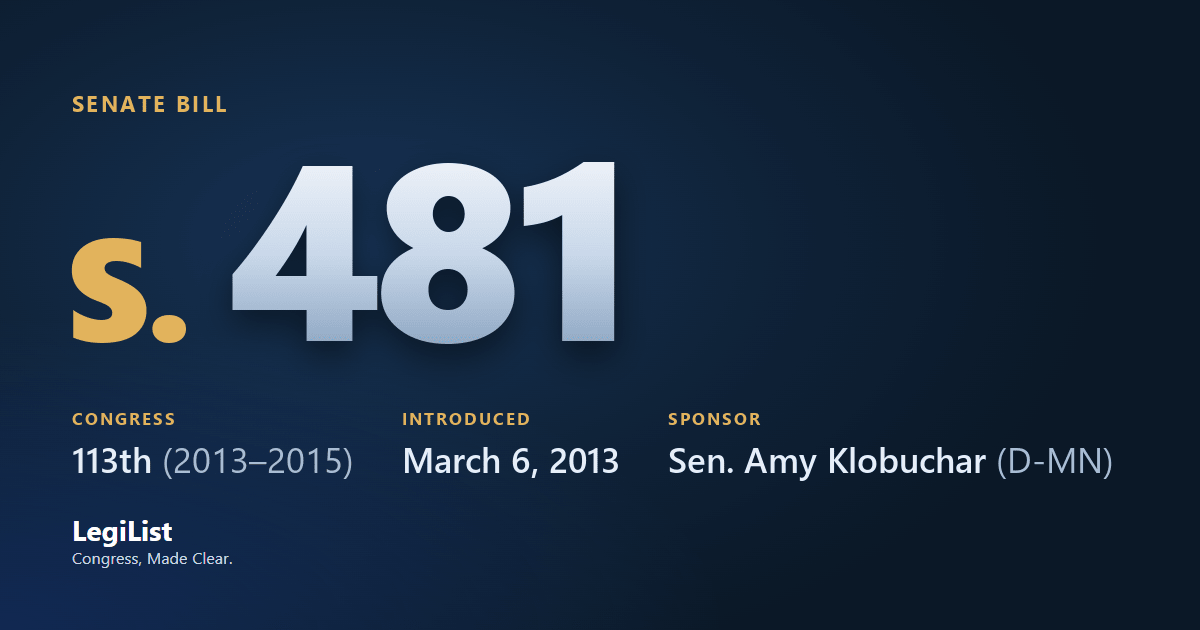
Wireless Consumer Choice Act
Latest action · Mar 6, 2013 Read twice and referred to the Committee on Commerce, Science, and Transportation.
Progress
Where this bill reached, and when. A stage with no date was not reached; one that failed a vote and later carried shows the date it carried.
- IntroducedMar 6, 2013
- Passed SenateNot reached
- Passed HouseNot reached
- To the PresidentNot reached
- Became lawNot reached
Summary
Wireless Consumer Choice Act - Requires the Federal Communications Commission (FCC) to direct providers of commercial mobile services and commercial mobile data services to permit their subscribers to unlock any type of wireless device used to access such services. (The "unlocking" of a mobile device enables the device to connect to different networks for the purpose of switching service providers.)
Prohibits this Act from being construed to alter the terms of any valid contract between a provider and a subscriber.
Cosponsors 2
Members who signed on, in the order they did. All signed on Mar 6, 2013.
| Seat | Cosponsor | Signed on | |
|---|---|---|---|
| R-UT | Mike Lee | Original | Mar 6, 2013 |
| D-CT | Richard Blumenthal | Original | Mar 6, 2013 |
Actions 2
Everything that happened, newest first.
- Mar 6, 2013Introduced in Senate
- Mar 6, 2013Read twice and referred to the Committee on Commerce, Science, and Transportation.
Subjects
Assigned by the Library of Congress. Policy area: Science, Technology, Communications.
Text 1
Each version as it was printed, newest first.
- Mar 6, 2013Introduced in Senate
Everything here is as published by Congress: the summary is the Congressional Research Service's, the action wording is the clerks', and the subjects are the Library of Congress's. How far it got is read from the actions themselves, taking the most recent one of each kind, so a bill that failed a vote and later passed is shown as having passed. Records come from this bill on Congress.gov and govinfo.gov.