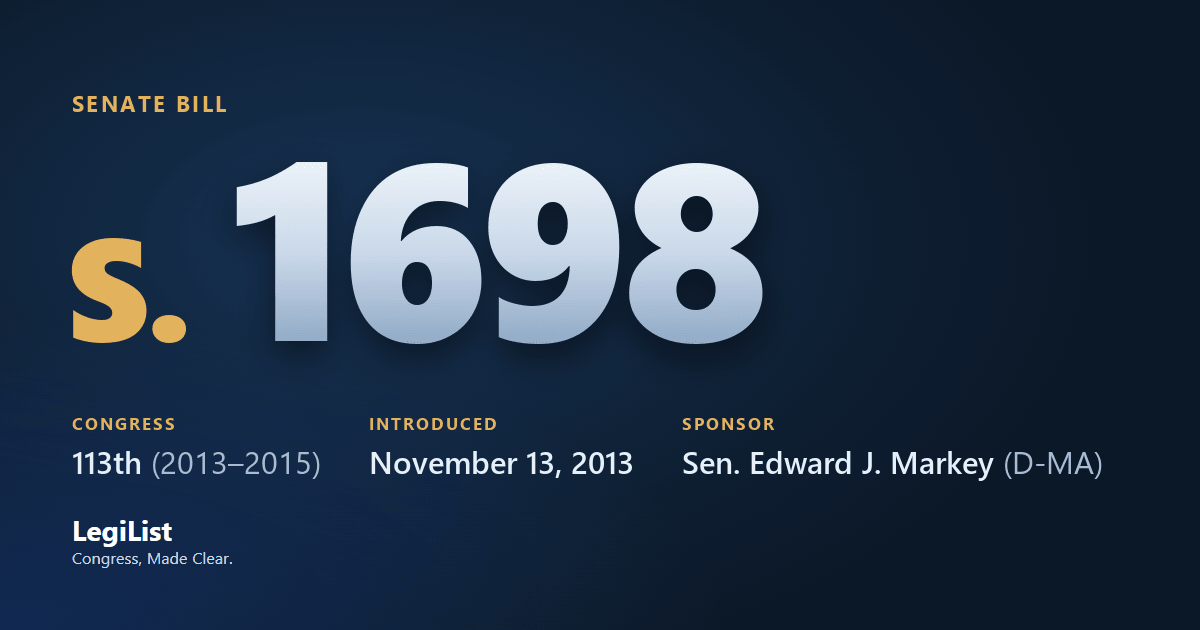
Consortia-Led Energy and Advanced Manufacturing Networks Act
Latest action · Nov 13, 2013 Read twice and referred to the Committee on Energy and Natural Resources.
Progress
Where this bill reached, and when. A stage with no date was not reached; one that failed a vote and later carried shows the date it carried.
- IntroducedNov 13, 2013
- Passed SenateNot reached
- Passed HouseNot reached
- To the PresidentNot reached
- Became lawNot reached
Summary
Consortia-Led Energy and Advanced Manufacturing Networks Act - Directs the Secretary of Commerce to establish a program of clean technology consortia by leveraging the expertise and resources of private research communities, higher education institutions, industry, venture capital, National Laboratories, and other participants in technology innovation. Describes such technology as a technology, production process, or methodology that, among other things, produces energy from renewable sources, produces an advanced or sustainable material with energy or energy efficiency applications, improves energy efficiency or water conservation and management, or addresses challenges in advanced manufacturing and supply chain integration.
Sets forth eligibility criteria for support under this Act, including regarding technology expertise, membership agreement policies, funding sources, and operation as a nonprofit organization or a public-private partnership under the leadership of a nonprofit organization.
Requires a consortium, in order to receive a grant, to establish an external advisory committee to review plans, programs, and projects and ensure that projects comply with the consortium's conflict of interest policy.
Provides the terms of grants, which shall not exceed five years initially. Limits grant amounts to $30 million per fiscal year or the collective contributions of non-federal entities. Requires grants to be used for support of translational research, technology development, manufacturing innovation, and commercialization activities relating to clean technology.
Sets forth audit and reporting requirements.Cosponsors
Members who signed on, in the order they did.
Committees 1
Where it was sent and what each committee and subcommittee did with it, in order.
| Chamber | Committee | What it did |
|---|---|---|
| Senate | Energy and Natural Resources Committee | Referred Nov 13, 2013 |
Actions 3
Everything that happened, newest first.
- Nov 13, 2013Introduced in Senate
- Nov 13, 2013Sponsor introductory remarks on measure. (CR S8006)
- Nov 13, 2013Read twice and referred to the Committee on Energy and Natural Resources.
In the Congressional Record 1
Days the Record’s own index lists this bill, newest first, with the pages and the members it names. Pages starting H are the House, S the Senate, E Extensions of Remarks.
| Where | In the Record | Members | Date |
|---|---|---|---|
| Senate | Debate and remarks S8006 | Edward J. Markey D-MA | Nov 13, 2013 |
Related bills 1
Companion bills and other measures the record links to this one.
| Bill | Title | Relationship | Latest action |
|---|---|---|---|
| HR 5548 | Consortia-Led Energy and Advanced Manufacturing Networks Act | Related bill | Dec 11, 2014 |
Titles 2
Every title it has carried, official and short, at each stage.
- Official Title as Introduced
- A bill to provide for the establishment of clean technology consortia to enhance the economic, environmental, and energy security of the United States by promoting domestic development, manufacture, and deployment of clean technologies.
- Short Titles as Introduced
- Consortia-Led Energy and Advanced Manufacturing Networks Act
Subjects
Assigned by the Library of Congress. Policy area: Energy.
- Advanced technology and technological innovations
- Advisory bodies
- Alternative and renewable resources
- Energy
- Energy efficiency and conservation
- Energy research
- Energy storage, supplies, demand
- Environmental technology
- Higher education
- Hybrid, electric, and advanced technology vehicles
- Lighting, heating, cooling
- Manufacturing
- Materials
- Public-private cooperation
- Research administration and funding
- Research and development
- Technology transfer and commercialization
- Water use and supply
Text 1
Each version as it was printed, newest first.
- Nov 13, 2013Introduced in Senate
Support LegiList
This page is free, carries no paywall, and is built and maintained by one person. If the record here is useful to you, a few dollars keeps it going.
Everything here is as published by Congress: the summary is the Congressional Research Service's, the action wording is the clerks', and the subjects are the Library of Congress's. How far it got is read from the actions themselves, taking the most recent one of each kind, so a bill that failed a vote and later passed is shown as having passed. Records come from this bill on Congress.gov and govinfo.gov; cost estimates are the Congressional Budget Office's, and the hearings are the printed hearings GovInfo publishes, which can appear months after the hearing.