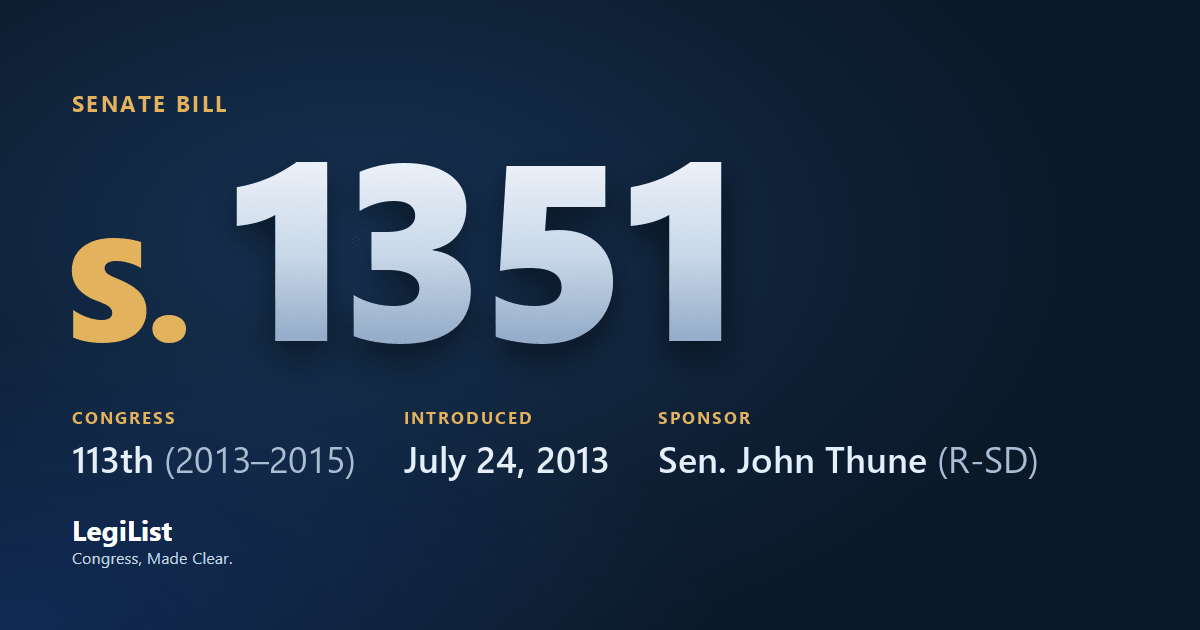
INFORM Act
Latest action · Jul 24, 2013 Read twice and referred to the Committee on the Budget.
Progress
Where this bill reached, and when. A stage with no date was not reached; one that failed a vote and later carried shows the date it carried.
- IntroducedJul 24, 2013
- Passed SenateNot reached
- Passed HouseNot reached
- To the PresidentNot reached
- Became lawNot reached
Summary
Intergenerational Financial Obligations Reform Act or INFORM Act - Amends the Congressional Budget Act of 1974 to require the Congressional Budget Office (CBO) to provide certain information on any legislation or resolution considered in either chamber which would impact revenues or mandatory spending by greater than 0.5% of gross domestic product (GDP) over the following 10-fiscal-year period, and upon request by the Chairmen or Ranking Members of the congressional budget committees.
Requires such information to comprise:
- a fiscal gap and generational accounting analysis, including any change in the analysis relative to the baseline; and
- the federal deficit, at current spending levels, in the fiscal year that is 75 years after the fiscal year in which the legislation is being considered, as well as the stock of the debt in that 75th year.
Requires: (1) CBO to produce an annual fiscal gap and generational accounting analysis within its annual "Long-Term Budget Outlook" and post it on the CBO public website, and (2) the Comptroller General to produce a separate similar analysis within its annual "Long-Term Fiscal Outlook" and post it on the General Accountability Office (GAO) public website.
Requires the President's budget submission to Congress to include:
- a fiscal gap and generational accounting analysis of the full budget proposal;
- the same kind of analysis of specific policy changes that would impact revenues or mandatory spending by greater than 0.5% of GDP over the following 10-fiscal year period; and
- the federal deficit, at current spending levels, in the fiscal year that is 75 years after the fiscal year in which the legislation is being considered, as well as the stock of the debt in that 75th year.
Cosponsors 8
Members who signed on, in the order they did. Signatures ran from Jul 24, 2013 to Nov 18, 2013; 3 are original cosponsors, there from the day it was introduced.
| Seat | Cosponsor | Signed on | |
|---|---|---|---|
| D-DE | Christopher A. Coons | Original | Jul 24, 2013 |
| R-OH | Rob Portman | Original | Jul 24, 2013 |
| D-VA | Tim Kaine | Original | Jul 24, 2013 |
| R-WY | Michael B. Enzi | Aug 1, 2013 | |
| D-WV | Joe Manchin III | Oct 29, 2013 | |
| R-GA | Johnny Isakson | Oct 29, 2013 | |
| R-GA | Saxby Chambliss | Oct 31, 2013 | |
| R-WI | Ron Johnson | Nov 18, 2013 |
Committees 1
Where it was sent and what each committee and subcommittee did with it, in order.
| Chamber | Committee | What it did |
|---|---|---|
| Senate | Budget Committee | Referred Jul 24, 2013 |
Actions 2
Everything that happened, newest first.
- Jul 24, 2013Introduced in Senate
- Jul 24, 2013Read twice and referred to the Committee on the Budget.
Related bills 1
Companion bills and other measures the record links to this one.
| Bill | Title | Relationship | Latest action |
|---|---|---|---|
| HR 2967 | INFORM Act | Identical bill | Aug 1, 2013 |
Titles 3
Every title it has carried, official and short, at each stage.
- Official Title as Introduced
- A bill to provide for fiscal gap and generational accounting analysis in the legislative process, the President's budget, and annual long-term fiscal outlook reports.
- Short Titles as Introduced
- INFORM Act
- Intergenerational Financial Obligations Reform Act
Subjects
Assigned by the Library of Congress. Policy area: Economics and Public Finance.
Text 1
Each version as it was printed, newest first.
- Jul 24, 2013Introduced in Senate
Everything here is as published by Congress: the summary is the Congressional Research Service's, the action wording is the clerks', and the subjects are the Library of Congress's. How far it got is read from the actions themselves, taking the most recent one of each kind, so a bill that failed a vote and later passed is shown as having passed. Records come from this bill on Congress.gov and govinfo.gov; cost estimates are the Congressional Budget Office's, and the hearings are the printed hearings GovInfo publishes, which can appear months after the hearing.