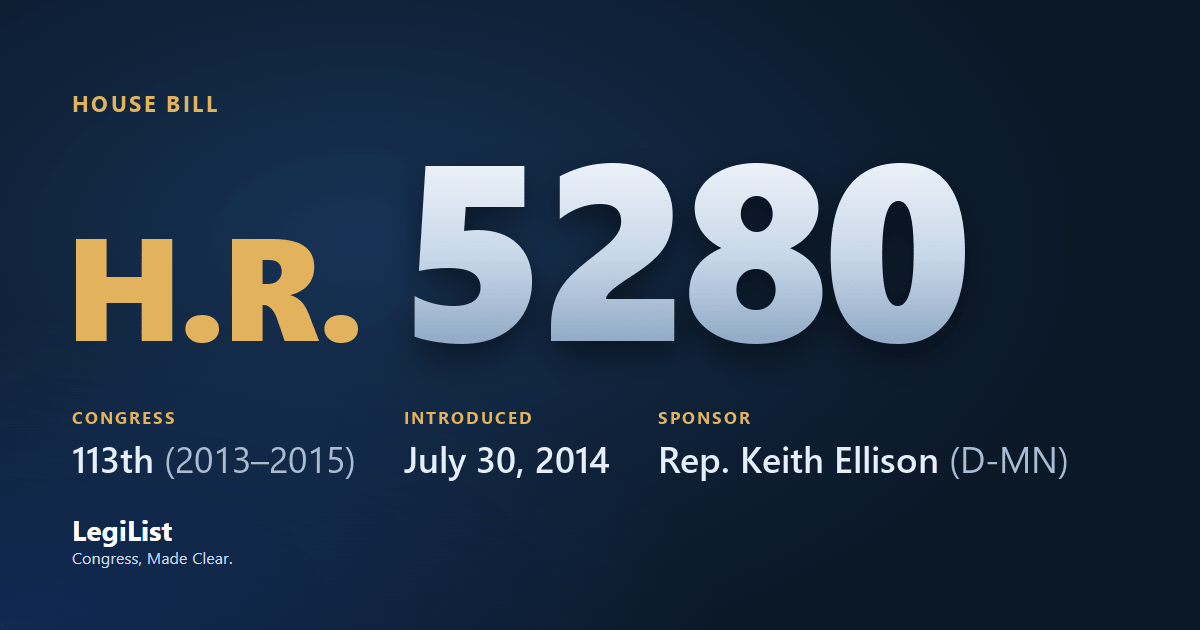
Employee Empowerment Act
Latest action · Sep 26, 2014 Referred to the Subcommittee on the Constitution and Civil Justice.
Progress
Where this bill reached, and when. A stage with no date was not reached; one that failed a vote and later carried shows the date it carried.
- IntroducedJul 30, 2014
- Passed HouseNot reached
- Passed SenateNot reached
- To the PresidentNot reached
- Became lawNot reached
Summary
Employee Empowerment Act - Amends the National Labor Relations Act to authorize a person alleging an unfair labor practice by an employer by discrimination regarding hiring or tenure of employment or any term or condition of employment to encourage or discourage membership in any labor organization, in addition to filing a charge alleging an unfair labor practice with the National Labor Relations Board, to bring a civil action against such employer in U.S. district court.
Authorizes the court to grant relief (including injunctive and equitable relief, back pay, and compensatory and punitive damages) and allow the prevailing party a reasonable attorney's fee (including expert witness fees) as part of the costs.
Cosponsors 18
Members who signed on, in the order they did. Signatures ran from Jul 30, 2014 to Dec 10, 2014; 16 are original cosponsors, there from the day it was introduced.
| Seat | Cosponsor | Signed on | |
|---|---|---|---|
| D-NJ | Albio Sires | Original | Jul 30, 2014 |
| D-CA | Barbara Lee | Original | Jul 30, 2014 |
| D-IL | Danny K. Davis | Original | Jul 30, 2014 |
| D-DC | Eleanor Holmes Norton | Original | Jul 30, 2014 |
| D-CA | George Miller | Original | Jul 30, 2014 |
| D-CA | Janice Hahn | Original | Jul 30, 2014 |
| D-NY | Jerrold Nadler | Original | Jul 30, 2014 |
| D-MI | John Conyers, Jr. | Original | Jul 30, 2014 |
| D-GA | John Lewis | Original | Jul 30, 2014 |
| D-CA | Karen Bass | Original | Jul 30, 2014 |
| D-OH | Marcia L. Fudge | Original | Jul 30, 2014 |
| D-CA | Mark Takano | Original | Jul 30, 2014 |
| D-AZ | Raúl M. Grijalva | Original | Jul 30, 2014 |
| D-NJ | Rush Holt | Original | Jul 30, 2014 |
| D-TX | Sheila Jackson Lee | Original | Jul 30, 2014 |
| D-OH | Tim Ryan | Original | Jul 30, 2014 |
| D-WA | Jim McDermott | Sep 11, 2014 | |
| D-FL | Frederica S. Wilson | Dec 10, 2014 |
Committees 2
Where it was sent and what each committee and subcommittee did with it, in order.
| Chamber | Committee | What it did |
|---|---|---|
| House | Education and Workforce Committee | Referred Jul 30, 2014 |
| House | Judiciary Committee | Referred Jul 30, 2014 |
| Constitution and Limited Government Subcommittee | Referred Sep 26, 2014 |
Actions 3
Everything that happened, newest first.
- Sep 26, 2014Referred to the Subcommittee on the Constitution and Civil Justice.
- Jul 30, 2014Introduced in House
- Jul 30, 2014Referred to the Committee on Education and the Workforce, and in addition to the Committee on the Judiciary, for a period to be subsequently determined by the Speaker, in each case for consideration of such provisions as fall within the jurisdiction of the committee concerned.
Research
What has been written about this bill: committee reports, cost estimates, the sponsor’s authority statement, printed hearings and the Congressional Research Service’s work.
Constitutional authority
The sponsor’s statement, as printed in the page H7127.
Titles 2
Every title it has carried, official and short, at each stage.
- Official Title as Introduced
- To strengthen the current protections available under the National Labor Relations Act by providing a private right of action for certain violations of such Act, and for other purposes.
- Short Titles as Introduced
- Employee Empowerment Act
Subjects
Assigned by the Library of Congress. Policy area: Labor and Employment.
Text 1
Each version as it was printed, newest first.
- Jul 30, 2014Introduced in House
Everything here is as published by Congress: the summary is the Congressional Research Service's, the action wording is the clerks', and the subjects are the Library of Congress's. How far it got is read from the actions themselves, taking the most recent one of each kind, so a bill that failed a vote and later passed is shown as having passed. Records come from this bill on Congress.gov and govinfo.gov; cost estimates are the Congressional Budget Office's, and the hearings are the printed hearings GovInfo publishes, which can appear months after the hearing.