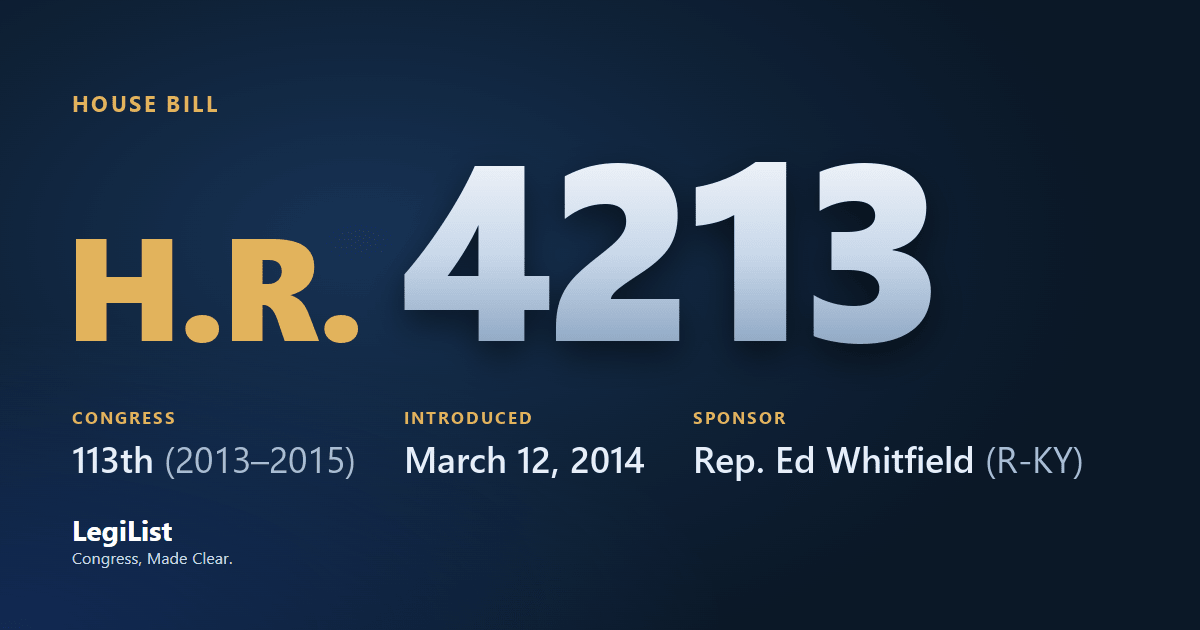
Funeral Rule Improvement Act of 2014
Latest action · Mar 14, 2014 Referred to the Subcommittee on Commerce, Manufacturing, and Trade.
Progress
Where this bill reached, and when. A stage with no date was not reached; one that failed a vote and later carried shows the date it carried.
- IntroducedMar 12, 2014
- Passed HouseNot reached
- Passed SenateNot reached
- To the PresidentNot reached
- Became lawNot reached
Summary
Funeral Rule Improvement Act of 2014 - Directs the Federal Trade Commission (FTC) to revise funeral industry regulations concerning funeral providers and services.
Revises the definition of "funeral provider" to: (1) include trusts (currently, only persons, partnerships, or corporations), and (2) apply to the sale of funeral or burial goods or services to the public (currently, such definition is limited to entities that sell both funeral goods and funeral services).
Excludes from such definition: (1) religious denominations, middle judicatories, houses of worship, or similar religious organizations; (2) states or political subdivisions; (3) cemeteries with 25 or fewer burials per year; and (4) certain non-profit cemetery companies and burial or cremation corporations exempt from taxation under the Internal Revenue Code.
Amends the definition of "funeral services" to define "funeral or burial services" as any services that are sold or offered for sale directly to the public for use in connection with: (1) the care and preparation of deceased human remains for burial, cremation, or other final disposition; or (2) the arrangement, supervision, or carrying out the funeral ceremony or final disposition of deceased human bodies.
Cosponsors 13
Members who signed on, in the order they did. Signatures ran from Mar 12, 2014 to Jul 9, 2014; 2 are original cosponsors, there from the day it was introduced.
| Seat | Cosponsor | Signed on | |
|---|---|---|---|
| D-MI | Gary C. Peters | Original | Mar 12, 2014 |
| R-MI | Tim Walberg | Original | Mar 12, 2014 |
| D-MN | Collin C. Peterson | Mar 13, 2014 | |
| D-ME | Michael H. Michaud | Mar 14, 2014 | |
| R-IA | Tom Latham | Mar 14, 2014 | |
| R-NY | Michael G. Grimm | Mar 24, 2014 | |
| R-IL | Randy Hultgren | Apr 8, 2014 | |
| R-OH | David P. Joyce | Apr 28, 2014 | |
| R-CA | Ken Calvert | May 7, 2014 | |
| D-TN | Steve Cohen | May 7, 2014 | |
| D-NH | Ann M. Kuster | May 22, 2014 | |
| R-KS | Mike Pompeo | May 30, 2014 | |
| D-IA | David Loebsack | Jul 9, 2014 |
Committees 1
Where it was sent and what each committee and subcommittee did with it, in order.
| Chamber | Committee | What it did |
|---|---|---|
| House | Energy and Commerce Committee | Referred Mar 12, 2014 |
| Commerce, Manufacturing, and Trade Subcommittee | Referred Mar 14, 2014 |
Actions 3
Everything that happened, newest first.
- Mar 14, 2014Referred to the Subcommittee on Commerce, Manufacturing, and Trade.
- Mar 12, 2014Introduced in House
- Mar 12, 2014Referred to the House Committee on Energy and Commerce.
Research
What has been written about this bill: committee reports, cost estimates, the sponsor’s authority statement, printed hearings and the Congressional Research Service’s work.
Constitutional authority
The sponsor’s statement, as printed in the page H2361.
Titles 2
Every title it has carried, official and short, at each stage.
- Official Title as Introduced
- To direct the Federal Trade Commission to revise the regulations regarding the definitions for funeral industry practices.
- Short Titles as Introduced
- Funeral Rule Improvement Act of 2014
Subjects
Assigned by the Library of Congress. Policy area: Commerce.
Text 1
Each version as it was printed, newest first.
- Mar 12, 2014Introduced in House
Support LegiList
This page is free, carries no paywall, and is built and maintained by one person. If the record here is useful to you, a few dollars keeps it going.
Everything here is as published by Congress: the summary is the Congressional Research Service's, the action wording is the clerks', and the subjects are the Library of Congress's. How far it got is read from the actions themselves, taking the most recent one of each kind, so a bill that failed a vote and later passed is shown as having passed. Records come from this bill on Congress.gov and govinfo.gov; cost estimates are the Congressional Budget Office's, and the hearings are the printed hearings GovInfo publishes, which can appear months after the hearing.