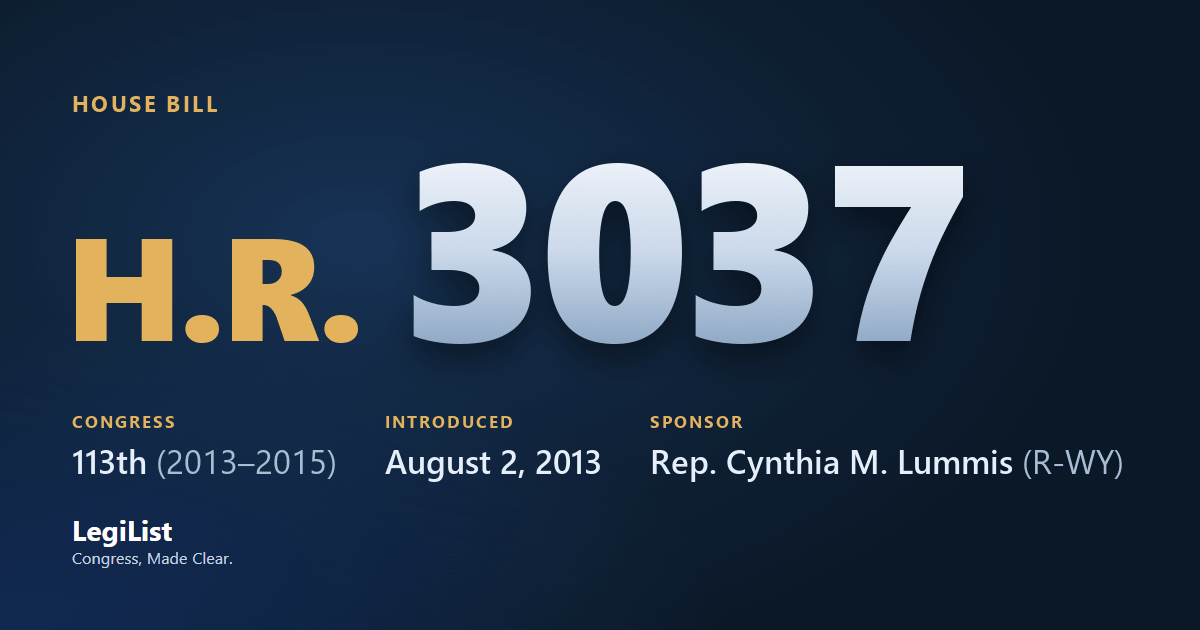
Government Litigation Savings Act
Latest action · Oct 15, 2013 Referred to the Subcommittee on the Constitution and Civil Justice.
Progress
Where this bill reached, and when. A stage with no date was not reached; one that failed a vote and later carried shows the date it carried.
- IntroducedAug 2, 2013
- Passed HouseNot reached
- Passed SenateNot reached
- To the PresidentNot reached
- Became lawNot reached
Summary
Government Litigation Savings Act - Revises provisions of the Equal Access to Justice Act (EAJA) and the federal judicial code relating to the fees and other expenses of parties in agency proceedings and court cases against the federal government.
Restricts awards of fees and other expenses under EAJA to prevailing parties with a direct and personal interest in an adjudication, including because of medical costs, property damage, determination of benefits, an unpaid disbursement, and other expenses of adjudication, or because of a policy interest.
Requires (currently, authorizes) the reduction or denial of an award if the party during the course of the proceedings engaged in conduct which unduly or unreasonably (currently, unduly and unreasonably) protracted the final resolution of the matter in controversy.
Increases to $200 per hour the cap on attorney fees awarded under EAJA and eliminates the cost-of-living and special factor considerations for allowing an increase in the hourly rate for such fees.
Eliminates the net worth exemption for determining eligibility for fees and expenses under EAJA for tax-exempt organizations and cooperative associations under the Agricultural Marketing Act.
Cosponsors 17
Members who signed on, in the order they did. Signatures ran from Aug 2, 2013 to Sep 17, 2013; 13 are original cosponsors, there from the day it was introduced.
| Seat | Cosponsor | Signed on | |
|---|---|---|---|
| R-NE | Adrian Smith | Original | Aug 2, 2013 |
| R-UT | Chris Stewart | Original | Aug 2, 2013 |
| R-CA | Devin Nunes | Original | Aug 2, 2013 |
| R-OR | Greg Walden | Original | Aug 2, 2013 |
| R-UT | Jason Chaffetz | Original | Aug 2, 2013 |
| R-SC | Jeff Duncan | Original | Aug 2, 2013 |
| R-TX | K. Michael Conaway | Original | Aug 2, 2013 |
| R-ID | Michael K. Simpson | Original | Aug 2, 2013 |
| R-CO | Mike Coffman | Original | Aug 2, 2013 |
| R-AZ | Paul A. Gosar | Original | Aug 2, 2013 |
| R-CO | Scott R. Tipton | Original | Aug 2, 2013 |
| R-NM | Stevan Pearce | Original | Aug 2, 2013 |
| R-AZ | Trent Franks | Original | Aug 2, 2013 |
| R-CO | Cory Gardner | Sep 12, 2013 | |
| R-UT | Rob Bishop | Sep 12, 2013 | |
| R-MT | Steve Daines | Sep 12, 2013 | |
| R-WA | Doc Hastings | Sep 17, 2013 |
Committees 1
Where it was sent and what each committee and subcommittee did with it, in order.
| Chamber | Committee | What it did |
|---|---|---|
| House | Judiciary Committee | Referred Aug 2, 2013 |
| Constitution and Limited Government Subcommittee | Referred Oct 15, 2013 |
Actions 3
Everything that happened, newest first.
- Oct 15, 2013Referred to the Subcommittee on the Constitution and Civil Justice.
- Aug 2, 2013Introduced in House
- Aug 2, 2013Referred to the House Committee on the Judiciary.
Research
What has been written about this bill: committee reports, cost estimates, the sponsor’s authority statement, printed hearings and the Congressional Research Service’s work.
Constitutional authority
The sponsor’s statement, as printed in the page H5402.
Titles 2
Every title it has carried, official and short, at each stage.
- Official Title as Introduced
- To amend titles 5 and 28, United States Code, with respect to the award of fees and other expenses in cases brought against agencies of the United States, and for other purposes.
- Short Titles as Introduced
- Government Litigation Savings Act
Subjects
Assigned by the Library of Congress. Policy area: Law.
Text 1
Each version as it was printed, newest first.
- Aug 2, 2013Introduced in House
Everything here is as published by Congress: the summary is the Congressional Research Service's, the action wording is the clerks', and the subjects are the Library of Congress's. How far it got is read from the actions themselves, taking the most recent one of each kind, so a bill that failed a vote and later passed is shown as having passed. Records come from this bill on Congress.gov and govinfo.gov; cost estimates are the Congressional Budget Office's, and the hearings are the printed hearings GovInfo publishes, which can appear months after the hearing.