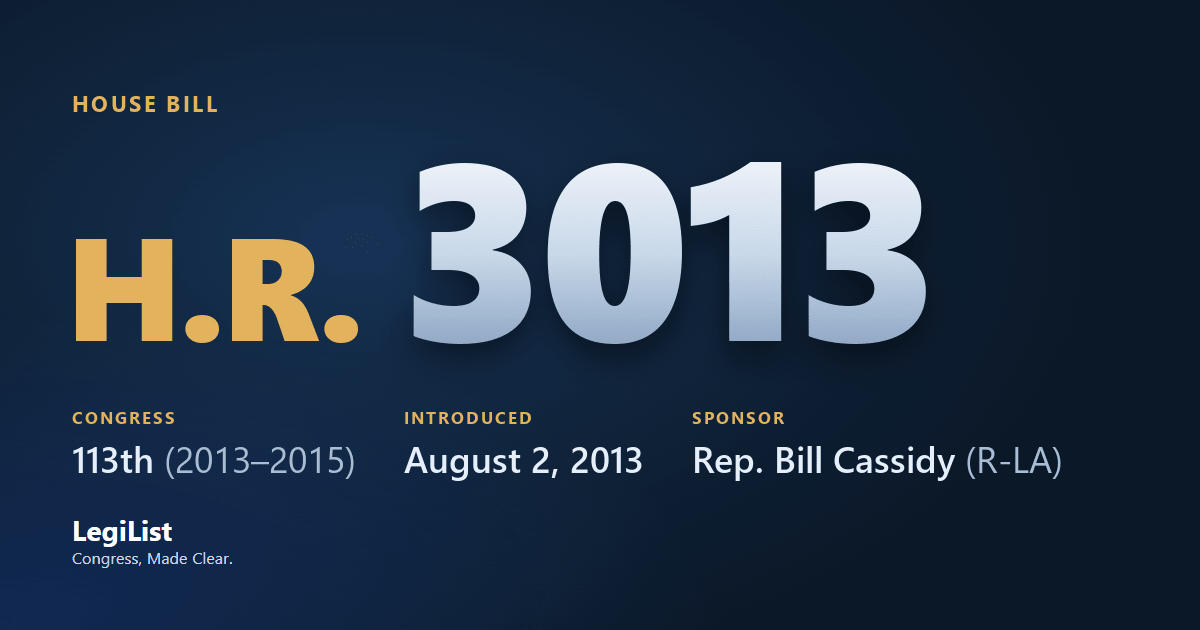
Home Protection Act of 2013
Latest action · Aug 2, 2013 Referred to the House Committee on Financial Services.
Progress
Where this bill reached, and when. A stage with no date was not reached; one that failed a vote and later carried shows the date it carried.
- IntroducedAug 2, 2013
- Passed HouseNot reached
- Passed SenateNot reached
- To the PresidentNot reached
- Became lawNot reached
Summary
Home Protection Act of 2013 - Amends the Biggert-Waters Flood Insurance Reform Act of 2012 to direct the Administrator of the Federal Emergency Management Agency (FEMA) to review, update, maintain, and publish National Flood Insurance Program rate maps under the National Flood Mapping Program with respect to areas protected by pumping stations, decertified levees, or non-federal or non-structural flood protection and mitigation measures, as well as the level of protection they provide.
Directs the Administrator to: (1) work with states, local communities, and property owners to identify such areas and measures; and (2) include in flood map updates any relevant information that leads to the appropriate use of circular wind models for the application of stillwater elevation calculations.
Amends the National Flood Insurance Act of 1968 to prohibit the Administrator from estimating flood insurance premium rates for property which, after July 6, 2012, has experienced or sustained substantial improvement exceeding 50% (currently 30%) of its fair market value.
Makes eligible for flood insurance coverage any communities that have made adequate progress, acceptable to the Administrator, on reconstruction of a flood protection system which will afford protection from the 100-year frequency flood.
Prohibits the Administrator, in determining whether adequate progress on construction or reconstruction has been made, from considering the level of federal funding involved in the enterprise.
Makes flood insurance available in communities restoring certain disaccredited flood protection systems, regardless of the level of either federal funding or participation in such restoration.
Directs the Administrator to issue regulations permitting a state or local government, either on its own accord or in conjunction with other state or local governments, to submit to FEMA payments necessary to cover part or all of the cost of any premium for any property within the government's jurisdiction.
Prohibits the Administrator from publishing either a flood insurance rate map or an update for an area unless: (1) it adequately reflects the level of protection provided by any flood protection system for the area, including a pumping station, decertified levee, or non-federal or non-structural flood mitigation measure, against the 100-year frequency flood, regardless of the system's accreditation status; or (2) the community for which a system provides protection elects not to give the data necessary for the Administrator to publish a rate map or update that adequately reflects such protection.
Nullifies the prohibition against extending premium rate subsidies to properties not insured before July 6, 2012, or to properties purchased after that date, until either of these two conditions applies.
Expresses the sense of the House of Representatives that a Bipartisan Task Force on Innovation in Financing Flood Risk should be established to: (1) compile data on innovative market-based solutions to make flood insurance more accessible and affordable, and (2) report on future flood-risk analysis and risk innovation in pricing.
Cosponsors 9
Members who signed on, in the order they did. Signatures ran from Aug 2, 2013 to Oct 16, 2013; 7 are original cosponsors, there from the day it was introduced.
| Seat | Cosponsor | Signed on | |
|---|---|---|---|
| R-MS | Alan Nunnelee | Original | Aug 2, 2013 |
| R-LA | Charles W. Boustany, Jr. | Original | Aug 2, 2013 |
| R-NY | Michael G. Grimm | Original | Aug 2, 2013 |
| R-LA | Rodney Alexander | Original | Aug 2, 2013 |
| R-LA | Steve Scalise | Original | Aug 2, 2013 |
| R-MS | Steven M. Palazzo | Original | Aug 2, 2013 |
| R-NC | Walter B. Jones | Original | Aug 2, 2013 |
| R-MS | Gregg Harper | Oct 16, 2013 | |
| R-TX | Pete Olson | Oct 16, 2013 |
Committees 1
Where it was sent and what each committee and subcommittee did with it, in order.
| Chamber | Committee | What it did |
|---|---|---|
| House | Financial Services Committee | Referred Aug 2, 2013 |
Actions 2
Everything that happened, newest first.
- Aug 2, 2013Introduced in House
- Aug 2, 2013Referred to the House Committee on Financial Services.
Research
What has been written about this bill: committee reports, cost estimates, the sponsor’s authority statement, printed hearings and the Congressional Research Service’s work.
Constitutional authority
The sponsor’s statement, as printed in the page H5401.
Titles 2
Every title it has carried, official and short, at each stage.
- Official Title as Introduced
- To reform the National Flood Insurance Program, and for other purposes.
- Short Titles as Introduced
- Home Protection Act of 2013
Subjects
Assigned by the Library of Congress. Policy area: Finance and Financial Sector.
- Administrative law and regulatory procedures
- Advisory bodies
- Congressional operations and organization
- Disaster relief and insurance
- Federal Emergency Management Agency (FEMA)
- Finance and Financial Sector
- Floods and storm protection
- Government information and archives
- Life, casualty, property insurance
- Residential rehabilitation and home repair
Text 1
Each version as it was printed, newest first.
- Aug 2, 2013Introduced in House
Everything here is as published by Congress: the summary is the Congressional Research Service's, the action wording is the clerks', and the subjects are the Library of Congress's. How far it got is read from the actions themselves, taking the most recent one of each kind, so a bill that failed a vote and later passed is shown as having passed. Records come from this bill on Congress.gov and govinfo.gov; cost estimates are the Congressional Budget Office's, and the hearings are the printed hearings GovInfo publishes, which can appear months after the hearing.