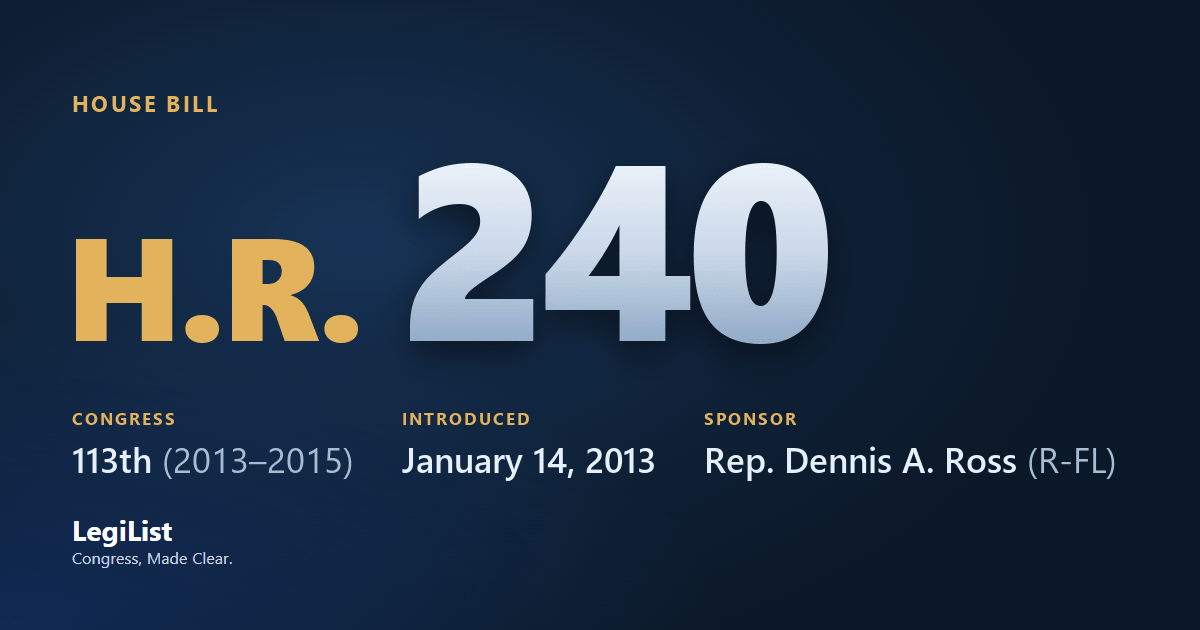
Homeowners Insurance Protection Act of 2013
Latest action · Jan 14, 2013 Referred to the House Committee on Financial Services.
Progress
Where this bill reached, and when. A stage with no date was not reached; one that failed a vote and later carried shows the date it carried.
- IntroducedJan 14, 2013
- Passed HouseNot reached
- Passed SenateNot reached
- To the PresidentNot reached
- Became lawNot reached
Summary
Homeowners Insurance Protection Act of 2013 - Instructs the Secretary of the Treasury to establish the National Commission on Catastrophe Preparation and Protection to advise the Secretary regarding estimated loss costs associated with contracts for reinsurance coverage.
Authorizes the Secretary to make homeowners protection coverage available through contracts for reinsurance coverage. Restricts purchase of such coverage to eligible state programs. Prescribes criteria for state eligibility.
Requires each contract for reinsurance coverage to provide insurance coverage against residential property losses to homes, including condominium and cooperative ownership, and the contents of apartment buildings. Cites covered perils.
Prescribes a minimum level of retained losses and maximum federal liability.
Authorizes any insurer who participates in an eligible state program to establish a Catastrophe Capital Reserve Fund to hold funds on the Secretary's behalf to offset reinsurance claims.
Establishes the Consumer Hurricane, Earthquake, Loss Protection (HELP) Fund to: (1) make payments to covered purchasers under contracts for reinsurance coverage for eligible losses; and (2) pay for Commission operating costs and reinsurance program administrative expenses.
Cosponsors
Members who signed on, in the order they did.
Committees 1
Where it was sent and what each committee and subcommittee did with it, in order.
| Chamber | Committee | What it did |
|---|---|---|
| House | Financial Services Committee | Referred Jan 14, 2013 |
Actions 2
Everything that happened, newest first.
- Jan 14, 2013Introduced in House
- Jan 14, 2013Referred to the House Committee on Financial Services.
Research
What has been written about this bill: committee reports, cost estimates, the sponsor’s authority statement, printed hearings and the Congressional Research Service’s work.
Constitutional authority
The sponsor’s statement, as printed in the page H86.
CRS reports 1
Congressional Research Service work that CRS links to this bill or the law it became, newest first.
Cite it 1
Products on other subjects that cite it, usually among other measures.
| Product | Title | Kind | Published |
|---|---|---|---|
| R43990 | FEMA’s Public Assistance Grant Program: Background and Considerations for Congress Archived | Report | Apr 16, 2015 |
Titles 2
Every title it has carried, official and short, at each stage.
- Official Title as Introduced
- To establish a program to provide reinsurance for State natural catastrophe insurance programs to help the United States better prepare for and protect its citizens against the ravages of natural catastrophes, to encourage and promote mitigation and prevention for, and recovery and rebuilding from such catastrophes, and to better assist in the financial recovery from such catastrophes.
- Short Titles as Introduced
- Homeowners Insurance Protection Act of 2013
Subjects
Assigned by the Library of Congress. Policy area: Finance and Financial Sector.
- Administrative law and regulatory procedures
- Advisory bodies
- Congressional oversight
- Department of the Treasury
- Disaster relief and insurance
- Finance and Financial Sector
- Floods and storm protection
- Government liability
- Government studies and investigations
- Government trust funds
- Housing finance and home ownership
- Housing industry and standards
- Insurance industry and regulation
- Natural disasters
- Public contracts and procurement
Text 1
Each version as it was printed, newest first.
- Jan 14, 2013Introduced in House
Support LegiList
This page is free, carries no paywall, and is built and maintained by one person. If the record here is useful to you, a few dollars keeps it going.
Everything here is as published by Congress: the summary is the Congressional Research Service's, the action wording is the clerks', and the subjects are the Library of Congress's. How far it got is read from the actions themselves, taking the most recent one of each kind, so a bill that failed a vote and later passed is shown as having passed. Records come from this bill on Congress.gov and govinfo.gov; cost estimates are the Congressional Budget Office's, and the hearings are the printed hearings GovInfo publishes, which can appear months after the hearing.