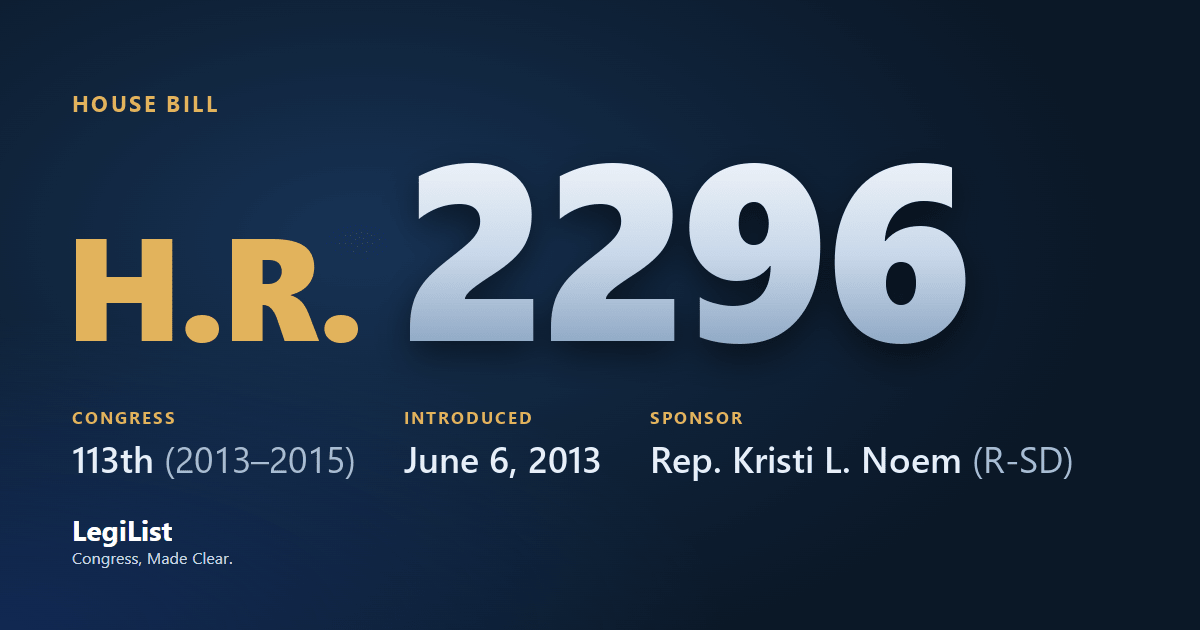
Local Taxpayer Relief Act
Latest action · Jul 8, 2013 Referred to the Subcommittee on Early Childhood, Elementary, and Secondary Education.
Progress
Where this bill reached, and when. A stage with no date was not reached; one that failed a vote and later carried shows the date it carried.
- IntroducedJun 6, 2013
- Passed HouseNot reached
- Passed SenateNot reached
- To the PresidentNot reached
- Became lawNot reached
Summary
Local Taxpayer Relief Act - Amends the Impact Aid Improvement Act of 2012 to make permanent amendments that Act made to the Impact Aid program (which compensates local educational agencies [LEAs] for the financial burden of federal activities affecting their school districts) that:
- require the valuation of the federal property located within the boundaries of an LEA by calculating the valuation, for property tax purposes, of all property within the LEA's boundaries and then multiplying that value by the proportion of that property that is federal property;
- alter the formula for determining the foundation payments due LEAs for federal ownership of property when appropriations for a fiscal year are insufficient to provide them with full compensation;
- alter the formula for determining the payments due LEAs for eligible federally-connected children who are displaced from federal property or Indian lands due to housing renovation or rebuilding; and
- direct the Secretary of Education to complete Impact Aid payments to eligible LEAs within three fiscal years of their appropriation.
Amends the Impact Aid program of the Elementary and Secondary Education Act of 1965 to alter the formula for determining the payments due LEAs for eligible federally-connected children. Includes not only children in average daily attendance but also those enrolled pursuant to a state open enrollment policy.
Continues an LEA's eligibility for such payments while activities associated with military base closures and realignments or force structure changes or relocations are ongoing.
Allows the calculation of such payments using current student counts instead of prior fiscal year data when LEAs experience a specified influx of new federally-connected students due to federal activities or the closure of an LEA that was receiving Impact Aid due to federally-connected children.
Requires the Secretary to allow LEAs to count their federally-connected children using the date they register their students for the fiscal year for which their application is filed.
Alters the formula for determining the construction payments due LEAs that are eligible for other Impact Aid payments. Divides 80% of the construction funds evenly between LEAs impacted by military dependent children and LEAs impacted by children residing on Indian lands, with the remainder reserved for emergency repair and modernization grants to LEAs serving Indian lands or experiencing a specified influx of new students due to federal activities.
Alters the formula for determining whether a state's plan for equalizing assistance to its LEAs will except it from the prohibition on state aid to LEAs being affected by Impact Aid payments.
Requires new LEAs applying for Impact Aid to have boundaries established by state law and the authority to tax or receive an imputed local tax.
Reauthorizes appropriations for the Impact Aid program.
Cosponsors 16
Members who signed on, in the order they did. Signatures ran from Jun 6, 2013 to Apr 2, 2014; 1 is an original cosponsor, there from the day it was introduced.
| Seat | Cosponsor | Signed on | |
|---|---|---|---|
| D-WA | Rick Larsen | Original | Jun 6, 2013 |
| D-AZ | Ann Kirkpatrick | Jun 11, 2013 | |
| R-NJ | Jon Runyan | Jun 11, 2013 | |
| D-CA | Alan S. Lowenthal | Jun 20, 2013 | |
| D-CO | Jared Polis | Jun 20, 2013 | |
| R-MO | Vicky Hartzler | Jun 28, 2013 | |
| D-NY | William L. Owens | Jun 28, 2013 | |
| D-HI | Colleen Hanabusa | Jul 11, 2013 | |
| D-WA | Denny Heck | Jul 31, 2013 | |
| D-CA | Jared Huffman | Jul 31, 2013 | |
| D-WA | Derek Kilmer | Sep 18, 2013 | |
| R-NE | Lee Terry | Sep 18, 2013 | |
| D-WA | Adam Smith | Oct 9, 2013 | |
| R-CA | David G. Valadao | Oct 9, 2013 | |
| D-WA | Suzan K. DelBene | Oct 9, 2013 |
Committees 1
Where it was sent and what each committee and subcommittee did with it, in order.
| Chamber | Committee | What it did |
|---|---|---|
| House | Education and Workforce Committee | Referred Jun 6, 2013 |
| Early Childhood, Elementary, and Secondary Education Subcommittee | Referred Jul 8, 2013 |
Actions 3
Everything that happened, newest first.
- Jul 8, 2013Referred to the Subcommittee on Early Childhood, Elementary, and Secondary Education.
- Jun 6, 2013Introduced in House
- Jun 6, 2013Referred to the House Committee on Education and the Workforce.
Research
What has been written about this bill: committee reports, cost estimates, the sponsor’s authority statement, printed hearings and the Congressional Research Service’s work.
Constitutional authority
The sponsor’s statement, as printed in the page H3252.
Related bills 2
Companion bills and other measures the record links to this one.
| Bill | Title | Relationship | Latest action |
|---|---|---|---|
| S 1108 | Local Taxpayer Relief Act | Related bill | Jun 6, 2013 |
| HR 2378 | Impact Aid Fairness and Equity Act of 2013 | Related bill | Jul 8, 2013 |
Titles 2
Every title it has carried, official and short, at each stage.
- Official Title as Introduced
- To reauthorize the impact aid program under the Elementary and Secondary Education Act of 1965.
- Short Titles as Introduced
- Local Taxpayer Relief Act
Subjects
Assigned by the Library of Congress. Policy area: Education.
- Education
- Education programs funding
- Elementary and secondary education
- Indian lands and resources rights
- Indian social and development programs
- Land transfers
- Military facilities and property
- Military personnel and dependents
- Minority education
- Property tax
- Residential rehabilitation and home repair
- State and local finance
Text 1
Each version as it was printed, newest first.
- Jun 6, 2013Introduced in House
Support LegiList
This page is free, carries no paywall, and is built and maintained by one person. If the record here is useful to you, a few dollars keeps it going.
Everything here is as published by Congress: the summary is the Congressional Research Service's, the action wording is the clerks', and the subjects are the Library of Congress's. How far it got is read from the actions themselves, taking the most recent one of each kind, so a bill that failed a vote and later passed is shown as having passed. Records come from this bill on Congress.gov and govinfo.gov; cost estimates are the Congressional Budget Office's, and the hearings are the printed hearings GovInfo publishes, which can appear months after the hearing.