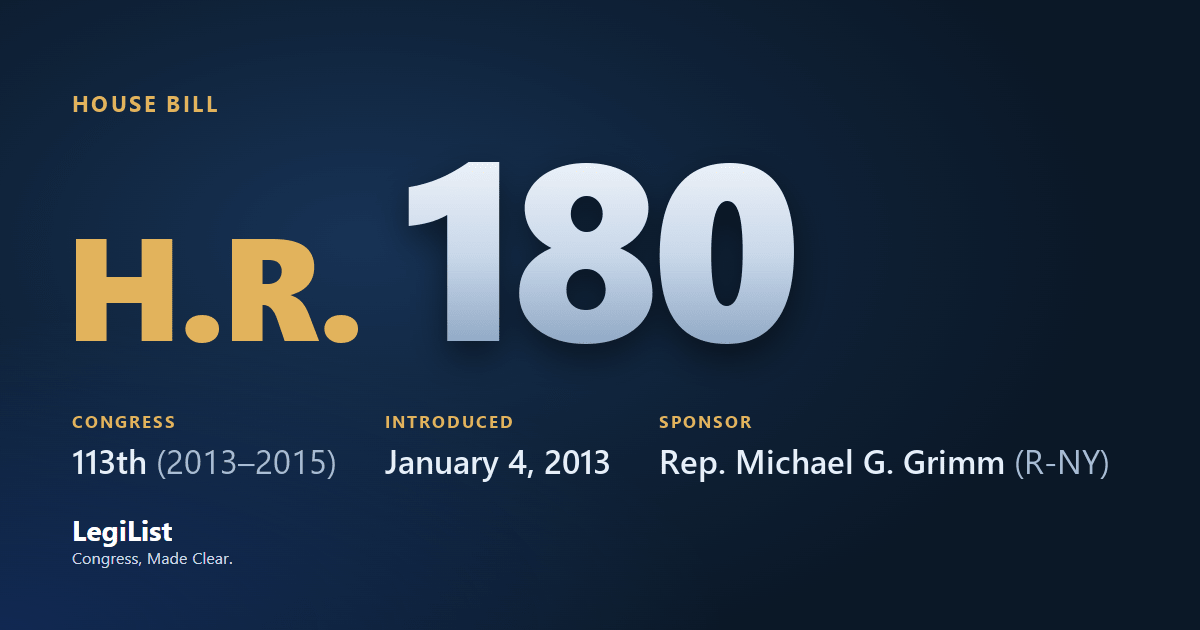
National Blue Alert Act of 2013
Latest action · Dec 20, 2013 Read twice. Placed on Senate Legislative Calendar under General Orders. Calendar No. 284.
Progress
Where this bill reached, and when. A stage with no date was not reached; one that failed a vote and later carried shows the date it carried.
- IntroducedJan 4, 2013
- Passed HouseMay 14, 2013
- Passed SenateNot reached
- To the PresidentNot reached
- Became lawNot reached
Summary
National Blue Alert Act of 2013 - Directs the Attorney General to: (1) establish a national Blue Alert communications network within the Department of Justice (DOJ) to disseminate information when a law enforcement officer is seriously injured or killed in the line of duty, in coordination with federal, state, and local Blue Alert plans; and (2) assign an existing DOJ officer to act as the national coordinator of the Blue Alert communications network.
Sets forth the duties of the national coordinator, including: (1) providing assistance to states and local governments that are using Blue Alert plans; (2) establishing voluntary guidelines for states and local governments to use in developing such plans; (3) developing protocols for efforts to apprehend suspects; (4) working with states to ensure appropriate regional coordination of various elements of the network; (5) establishing an advisory group to assist states, local governments, law enforcement agencies, and other entities in initiating, facilitating, and promoting Blue Alert plans; (6) acting as the nationwide point of contact for the development of the network and the regional coordination of Blue Alerts through the network; and (7) determining what procedures and practices are in use for notifying law enforcement and the public when a law enforcement officer is killed or seriously injured in the line of duty and which of the procedures and practices are effective and do not require the expenditure of additional resources to implement.
Requires the guidelines to: (1) provide that appropriate information relating to a Blue Alert is disseminated to officials of law enforcement, public health, and other agencies; and (2) provide mechanisms that ensure that Blue Alerts comply with all applicable federal, state, and local privacy laws and regulations and include standards that specifically provide for the protection of the civil liberties of law enforcement officers and their families.
Prohibits the coordinator from: (1) performing any official travel for the sole purpose of carrying out the duties of the coordinator, (2) lobbying any officer of a state regarding the funding or implementation of a Blue Alert plan, or (3) hosting a conference focused solely on the Blue Alert program that requires the expenditure of federal funds.
Directs the coordinator to annually submit a report on the coordinator's activities and the effectiveness and status of the Blue Alert plans that are in effect or being developed.
Recorded votes 1
Newest first. Open one to see how every member voted.
| Roll call | Question | Result | Date |
|---|---|---|---|
| House 144 | On Motion to Suspend the Rules and Pass, as Amended | Passed406–2 | May 14, 2013 |
Cosponsors 14
Members who signed on, in the order they did. Signatures ran from Jan 4, 2013 to May 6, 2013; 3 are original cosponsors, there from the day it was introduced.
| Seat | Cosponsor | Signed on | |
|---|---|---|---|
| D-NJ | Bill Pascrell, Jr. | Original | Jan 4, 2013 |
| R-WA | David G. Reichert | Original | Jan 4, 2013 |
| D-PR | Pedro R. Pierluisi | Original | Jan 4, 2013 |
| R-NJ | Frank A. LoBiondo | Feb 13, 2013 | |
| D-TN | Jim Cooper | Feb 27, 2013 | |
| D-NJ | Robert E. Andrews | Mar 4, 2013 | |
| R-NY | Peter T. King | Mar 14, 2013 | |
| R-OH | Bill Johnson | Mar 15, 2013 | |
| R-TN | John J. Duncan, Jr. | Apr 10, 2013 | |
| D-NY | Charles B. Rangel | Apr 25, 2013 | |
| D-NY | Daniel B. Maffei | Apr 25, 2013 | |
| D-HI | Tulsi Gabbard | Apr 26, 2013 | |
| D-MI | John Conyers, Jr. | May 6, 2013 | |
| R-TX | Ted Poe | May 6, 2013 |
Committees 1
Where it was sent and what each committee and subcommittee did with it, in order.
| Chamber | Committee | What it did |
|---|---|---|
| House | Judiciary Committee | Referred Jan 4, 2013Markup May 7, 2013Reported May 14, 2013 |
| Crime and Federal Government Surveillance Subcommittee | Referred Jan 25, 2013Discharged May 6, 2013 |
Actions 17
Everything that happened, newest first.
- Dec 20, 2013Read twice. Placed on Senate Legislative Calendar under General Orders. Calendar No. 284.
- May 15, 2013Received in the Senate.
- May 14, 2013Reported by the Committee on Judiciary. H. Rept. 113-54.
- May 14, 2013Placed on the Union Calendar, Calendar No. 32.
- May 14, 2013Mr. Goodlatte moved to suspend the rules and pass the bill, as amended.
- May 14, 2013Considered under suspension of the rules. (consideration: CR H2579-2582)
- May 14, 2013DEBATE - The House proceeded with forty minutes of debate on H.R. 180.
- May 14, 2013At the conclusion of debate, the Yeas and Nays were demanded and ordered. Pursuant to the provisions of clause 8, rule XX, the Chair announced that further proceedings on the motion would be postponed.
- May 14, 2013Considered as unfinished business. (consideration: CR H2586-2587)
- May 14, 2013Passed/agreed to in House: On motion to suspend the rules and pass the bill, as amended Agreed to by the Yeas and Nays: (2/3 required): 406 - 2 (Roll no. 144). (text: CR H2579-2580)
- May 14, 2013Motion to reconsider laid on the table Agreed to without objection.
- May 7, 2013Committee Consideration and Mark-up Session Held.
- May 7, 2013Ordered to be Reported by Voice Vote.
- May 6, 2013Subcommittee on Crime, Terrorism, Homeland Security, and Investigations Discharged.
- Jan 25, 2013Referred to the Subcommittee on Crime, Terrorism, Homeland Security, And Investigations.
- Jan 4, 2013Introduced in House
- Jan 4, 2013Referred to the House Committee on the Judiciary.
In the Congressional Record 1
Days the Record’s own index lists this bill, newest first, with the pages and the members it names. Pages starting H are the House, S the Senate, E Extensions of Remarks.
| Where | In the Record | Members | Date |
|---|---|---|---|
| House | Debate and remarks H2579–H2582Text printed H2579Recorded votes H2586enact | Bob Goodlatte R-VA, Michael G. Grimm R-NY, Robert C. "Bobby" Scott D-VA, Sheila Jackson Lee D-TX | May 14, 2013 |
Research
What has been written about this bill: committee reports, cost estimates, the sponsor’s authority statement, printed hearings and the Congressional Research Service’s work.
Committee report
Congressional Budget Office cost estimate
- May 9, 2013H.R. 180, National Blue Alert Act of 2013As ordered reported by the House Committee on the Judiciary on May 7, 2013
Constitutional authority
The sponsor’s statement, as printed in the page H54.
Related bills 1
Companion bills and other measures the record links to this one.
| Bill | Title | Relationship | Latest action |
|---|---|---|---|
| S 357 | National Blue Alert Act of 2013 | Identical bill | Sep 19, 2013 |
Titles 4
Every title it has carried, official and short, at each stage.
- Official Title as Introduced
- To encourage, enhance, and integrate Blue Alert plans throughout the United States in order to disseminate information when a law enforcement officer is seriously injured or killed in the line of duty.
- Short Titles as Introduced
- National Blue Alert Act of 2013
- Short Titles as Reported to House
- National Blue Alert Act of 2013
- Short Titles as Passed House
- National Blue Alert Act of 2013
Subjects
Assigned by the Library of Congress. Policy area: Crime and Law Enforcement.
Text 4
Each version as it was printed, newest first.
- Dec 20, 2013Placed on Calendar Senate
- May 14, 2013Engrossed in House
- May 14, 2013Reported in House
- Jan 4, 2013Introduced in House
Everything here is as published by Congress: the summary is the Congressional Research Service's, the action wording is the clerks', and the subjects are the Library of Congress's. How far it got is read from the actions themselves, taking the most recent one of each kind, so a bill that failed a vote and later passed is shown as having passed. Records come from this bill on Congress.gov and govinfo.gov; cost estimates are the Congressional Budget Office's, and the hearings are the printed hearings GovInfo publishes, which can appear months after the hearing.