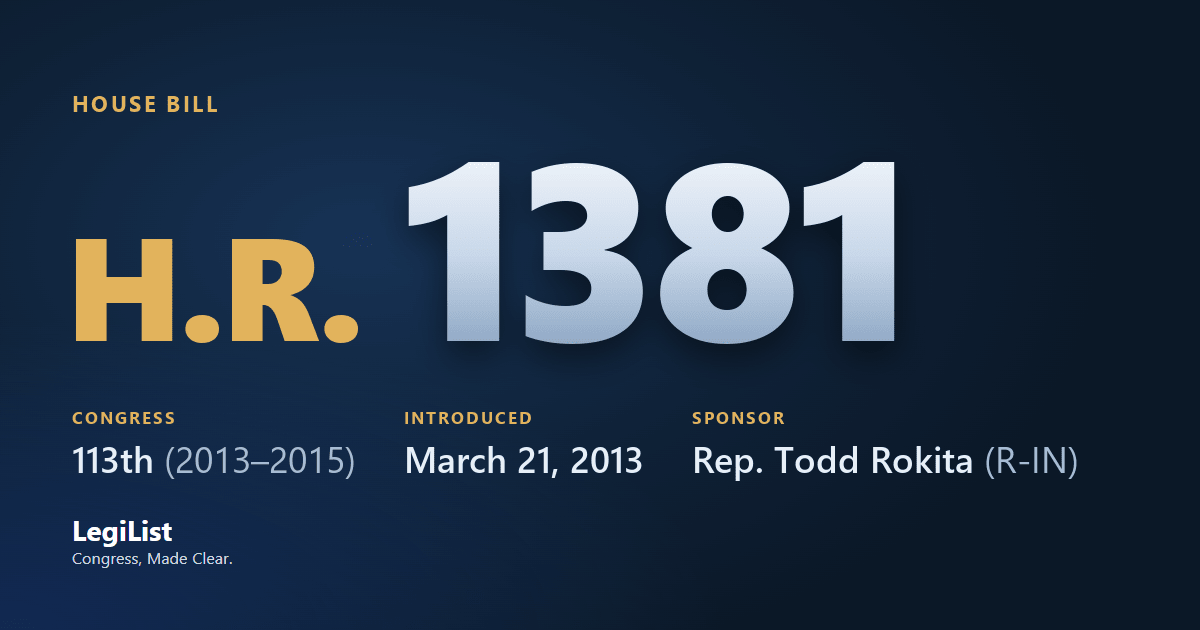
Educational Opportunities Act
Latest action · Jul 8, 2013 Referred to the Subcommittee on Early Childhood, Elementary, and Secondary Education.
Progress
Where this bill reached, and when. A stage with no date was not reached; one that failed a vote and later carried shows the date it carried.
- IntroducedMar 21, 2013
- Passed HouseNot reached
- Passed SenateNot reached
- To the PresidentNot reached
- Became lawNot reached
Summary
Educational Opportunities Act - Amends the Internal Revenue Code to allow individual taxpayers a tax credit for charitable contributions to a scholarship granting organization. Allows a maximum credit amount of $4,500 ($2,250 for a married individual filing a separate return). Defines "scholarship granting organization" as a tax-exempt entity whose exclusive purpose is to provide scholarships for the tuition and other expenses of elementary and secondary school students from low income households (i.e., household income not exceeding 250% of federal poverty guidelines).
Allows corporate taxpayers a tax credit, up to $100,000, for contributions to a scholarship granting organization.
Imposes a penalty on scholarship granting organizations that fail to distribute at least 90% of their total receipts for elementary and secondary school expenses in a taxable year.
Cosponsors 10
Members who signed on, in the order they did. Signatures ran from Mar 21, 2013 to Feb 4, 2014; 8 are original cosponsors, there from the day it was introduced.
| Seat | Cosponsor | Signed on | |
|---|---|---|---|
| R-MD | Andy Harris | Original | Mar 21, 2013 |
| R-CA | Doug LaMalfa | Original | Mar 21, 2013 |
| R-SC | Jeff Duncan | Original | Mar 21, 2013 |
| R-PA | Joseph R. Pitts | Original | Mar 21, 2013 |
| R-IN | Luke Messer | Original | Mar 21, 2013 |
| R-NC | Robert Pittenger | Original | Mar 21, 2013 |
| R-OK | Tom Cole | Original | Mar 21, 2013 |
| R-AZ | Trent Franks | Original | Mar 21, 2013 |
| R-SC | Trey Gowdy | Apr 9, 2013 | |
| R-OH | Steve Chabot | Feb 4, 2014 |
Committees 2
Where it was sent and what each committee and subcommittee did with it, in order.
| Chamber | Committee | What it did |
|---|---|---|
| House | Ways and Means Committee | Referred Mar 21, 2013 |
| House | Education and Workforce Committee | Referred Mar 21, 2013 |
| Early Childhood, Elementary, and Secondary Education Subcommittee | Referred Jul 8, 2013 |
Actions 3
Everything that happened, newest first.
- Jul 8, 2013Referred to the Subcommittee on Early Childhood, Elementary, and Secondary Education.
- Mar 21, 2013Introduced in House
- Mar 21, 2013Referred to the Committee on Ways and Means, and in addition to the Committee on Education and the Workforce, for a period to be subsequently determined by the Speaker, in each case for consideration of such provisions as fall within the jurisdiction of the committee concerned.
Research
What has been written about this bill: committee reports, cost estimates, the sponsor’s authority statement, printed hearings and the Congressional Research Service’s work.
Constitutional authority
The sponsor’s statement, as printed in the page H1828.
Related bills 1
Companion bills and other measures the record links to this one.
| Bill | Title | Relationship | Latest action |
|---|---|---|---|
| S 297 | Educational Opportunities Act | Identical bill | Feb 13, 2013 |
Titles 2
Every title it has carried, official and short, at each stage.
- Official Title as Introduced
- To amend the Internal Revenue Code of 1986 to allow a credit against tax for qualified elementary and secondary education tuition.
- Short Titles as Introduced
- Educational Opportunities Act
Subjects
Assigned by the Library of Congress. Policy area: Taxation.
Text 1
Each version as it was printed, newest first.
- Mar 21, 2013Introduced in House
Support LegiList
This page is free, carries no paywall, and is built and maintained by one person. If the record here is useful to you, a few dollars keeps it going.
Everything here is as published by Congress: the summary is the Congressional Research Service's, the action wording is the clerks', and the subjects are the Library of Congress's. How far it got is read from the actions themselves, taking the most recent one of each kind, so a bill that failed a vote and later passed is shown as having passed. Records come from this bill on Congress.gov and govinfo.gov; cost estimates are the Congressional Budget Office's, and the hearings are the printed hearings GovInfo publishes, which can appear months after the hearing.