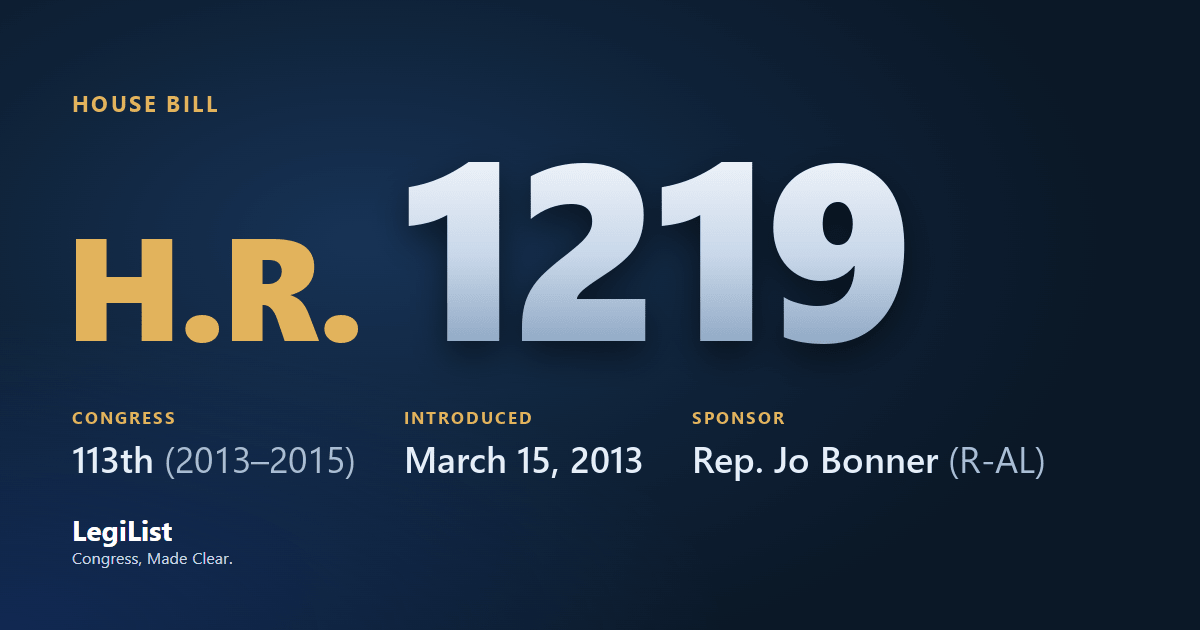
Gulf Fisheries Fairness Act
Latest action · Mar 15, 2013 Referred to the House Committee on Natural Resources.
Progress
Where this bill reached, and when. A stage with no date was not reached; one that failed a vote and later carried shows the date it carried.
- IntroducedMar 15, 2013
- Passed HouseNot reached
- Passed SenateNot reached
- To the PresidentNot reached
- Became lawNot reached
Summary
Gulf Fisheries Fairness Act - Amends the Magnuson-Stevens Fishery Conservation and Management Act to provide each of the states of Texas, Louisiana, Mississippi, Alabama, and Florida with exclusive fishery management authority over reef fish: (1) within the exclusive economic zone in the Gulf of Mexico in waters of a specified average depth on a continuous line within a minimum distance of nine nautical miles from the baseline from which the territorial sea of the United States is measured, and (2) between projected jurisdictional lines determined by the President under the Outer Continental Shelf Lands Act.
Directs the Secretary of Commerce to publish a description and map of the applicable line along the coasts of such states.
Prohibits the Secretary from suspending, revoking, terminating, or otherwise limiting the authority of any person under federal law to engage in fishing based on the person fishing for Gulf reef fish in waters subject to the exclusive authority of such states.
Exempts such waters from specified federal regulatory requirements addressing fishery permits.
Cosponsors 12
Members who signed on, in the order they did. Signatures ran from Mar 18, 2013 to May 8, 2013.
| Seat | Cosponsor | Signed on | |
|---|---|---|---|
| R-FL | Ander Crenshaw | Mar 18, 2013 | |
| R-GA | Austin Scott | Mar 18, 2013 | |
| R-LA | Charles W. Boustany, Jr. | Mar 18, 2013 | |
| R-FL | Jeff Miller | Mar 18, 2013 | |
| R-TX | Pete Olson | Mar 18, 2013 | |
| R-FL | Steve Southerland II | Mar 18, 2013 | |
| R-AL | Mike Rogers | Mar 20, 2013 | |
| R-AL | Robert B. Aderholt | Mar 20, 2013 | |
| R-AL | Martha Roby | Apr 12, 2013 | |
| R-AL | Mo Brooks | Apr 12, 2013 | |
| R-AL | Spencer Bachus | Apr 12, 2013 | |
| R-FL | Dennis A. Ross | May 8, 2013 |
Committees 1
Where it was sent and what each committee and subcommittee did with it, in order.
| Chamber | Committee | What it did |
|---|---|---|
| House | Natural Resources Committee | Referred Mar 15, 2013 |
Actions 2
Everything that happened, newest first.
- Mar 15, 2013Introduced in House
- Mar 15, 2013Referred to the House Committee on Natural Resources.
Research
What has been written about this bill: committee reports, cost estimates, the sponsor’s authority statement, printed hearings and the Congressional Research Service’s work.
Constitutional authority
The sponsor’s statement, as printed in the page H1549.
Printed hearings 1
Hearings whose printed record names this bill, newest first: hearings on it, and wider hearings where it came up.
| Number | Hearing | Committee | Held |
|---|---|---|---|
| Serial No. 113-27 | MANAGEMENT OF RED SNAPPER IN THE GULF OF MEXICO UNDER THE MAGNUSON- STEVENS FISHERY CONSERVATION AND MANAGEMENT ACT90 pages | Natural Resources Committee | Jun 27, 2013 |
Titles 2
Every title it has carried, official and short, at each stage.
- Official Title as Introduced
- To amend the Magnuson-Stevens Fishery Conservation and Management Act to provide that each of the States of Texas, Louisiana, Mississippi, Alabama, and Florida have exclusive fishery management authority over reef fish in the Gulf of Mexico in waters that, on average, are 20 fathoms or less in depth, and for other purposes.
- Short Titles as Introduced
- Gulf Fisheries Fairness Act
Subjects
Assigned by the Library of Congress. Policy area: Public Lands and Natural Resources.
Text 1
Each version as it was printed, newest first.
- Mar 15, 2013Introduced in House
Everything here is as published by Congress: the summary is the Congressional Research Service's, the action wording is the clerks', and the subjects are the Library of Congress's. How far it got is read from the actions themselves, taking the most recent one of each kind, so a bill that failed a vote and later passed is shown as having passed. Records come from this bill on Congress.gov and govinfo.gov; cost estimates are the Congressional Budget Office's, and the hearings are the printed hearings GovInfo publishes, which can appear months after the hearing.