SECURE IT
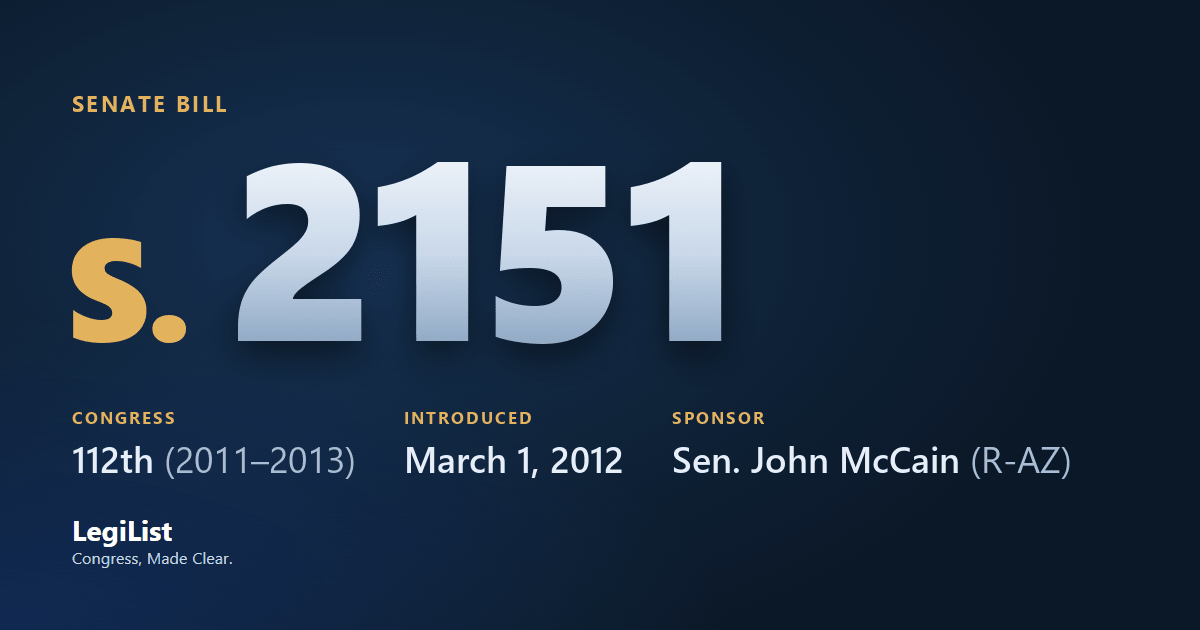
Latest action · Mar 1, 2012 Read twice and referred to the Committee on Commerce, Science, and Transportation.
Progress
Where this bill reached, and when. A stage with no date was not reached; one that failed a vote and later carried shows the date it carried.
- IntroducedMar 1, 2012
- Passed SenateNot reached
- Passed HouseNot reached
- To the PresidentNot reached
- Became lawNot reached
Summary
Strengthening and Enhancing Cybersecurity by Using Research, Education, Information, and Technology Act of 2012 or SECURE IT - Authorizes private entities to employ countermeasures and use cybersecurity systems to obtain, identify, or possess cyber threat information on its own networks or the networks of another entity with such entity's authorization.
Allows private entities, nonfederal government agencies, or state, tribal, or local governments to voluntarily disclose cyber threat information to designated cybersecurity centers or to each other to assist with preventing, investigating, or mitigating threats to information security.
Requires federal contractors of electronic communication, remote computing, or cybersecurity services to immediately provide the contracting agency with any cyber threat information directly related to the contract. Permits contractors to also provide such information to a cybersecurity center.
Directs federal agencies receiving such contractor-provided information to disclose it immediately to a cybersecurity center.
Permits cyber threat information provided to a cybersecurity center to be disclosed to, or used by, the federal government for a cybersecurity or national security purpose or to prevent, investigate, or prosecute various criminal offenses for which law enforcement officials are authorized, under existing law, to seek a court order authorizing an interception of wire, oral, or electronic communications.
Prohibits federal, state, tribal, or local agencies from directly using such information to regulate an entity's lawful activities.
Sets forth conditions with regard to information provided to a cybersecurity center including: (1) the disclosure of such information to state, tribal, or local governments; (2) the use, distribution, and any prerequisite consent necessary for sharing such information; and (3) the legal treatment of such information under specified privileges, exemptions, ex parte communications rules, and requirements for disclosing public information and records.
Provides legal protections to entities engaged in authorized cybersecurity activities.
Directs the Director of National Intelligence (DNI) and Secretary of Defense (DOD) to develop procedures for sharing classified and unclassified information.
Amends the Federal Information Security Management Act of 2002 to replace existing information security procedures for federal agencies with a new framework for coordinating and securing federal information.
Directs the Secretary of Commerce to issue compulsory and binding policies and directives governing agency information security operations. Requires that national security systems be overseen as directed by the President.
Requires each agency to comply with such policies and provide risk-commensurate information security protections for information systems used or operated by the agency or a contractor or other organization on an agency's behalf.
Requires each agency's Chief Information Officer to develop an agencywide information security program.
Directs the Secretary of Homeland Security (DHS) to: (1) designate a DHS entity to conduct an ongoing security analysis of agency information systems using automated processes, and (2) develop a timeline for each agency to adopt continuous monitoring systems. Sets forth separate requirements for national security systems.
Requires that federal information systems be based on National Institute of Standards and Technology (NIST) standards.
Amends the Computer Fraud and Abuse Act to increase and further delineate the criminal penalties for computer fraud and related activities.
Establishes an offense for aggravated damage to a public or private critical infrastructure computer that manages or controls systems or assets vital to national defense, national security, national economic security, or public health or safety.
Amends the High-Performance Computing Act of 1991 to re-designate the National High-Performance Computing Program as the Networking and Information Technology Research and Development Program.
Requires the Director of the Office of Science and Technology Policy (STP) to establish goals for inter-agency collaborative research and development with Program Component Areas, industry, institutions of higher education, federal laboratories, and international organizations. Directs agencies to develop a five-year strategic plan.
Requires that agencies be encouraged under the Program to address application areas with potential for contributions to national economic competitiveness and other societal benefits including technical solutions to cybersecurity, health care, energy management, transportation, cyber-physical systems, physical and behavioral phenomena, and privacy protection.
Defines "cyber-physical systems" as physical or engineered systems whose networking and information technology functions and physical elements are integrated and actively connected to the physical world through sensors, actuators, or other means to perform monitoring and control functions.
Requires the STP Director to convene a task force to report to Congress on options for the research, development, and organizational structure of cyber-physical systems.
Requires the National Science Foundation (NSF) to continue a Federal Cyber Scholarship-for-Service program.
Requires the NIST to coordinate federal agencies engaged in the development of international technical standards.
Amends the Cyber Security Research and Development Act to add research areas eligible for NSF computer and network security research grants. Authorizes: (1) various grant programs through FY2013, and (2) the cybersecurity faculty development traineeship program through FY2014.
Cosponsors 8
Members who signed on, in the order they did. Signatures ran from Mar 1, 2012 to Aug 2, 2012; 7 are original cosponsors, there from the day it was introduced.
| Seat | Cosponsor | Signed on | |
|---|---|---|---|
| R-IA | Chuck Grassley | Original | Mar 1, 2012 |
| R-IN | Daniel Coats | Original | Mar 1, 2012 |
| R-TX | Kay Bailey Hutchison | Original | Mar 1, 2012 |
| R-AK | Lisa Murkowski | Original | Mar 1, 2012 |
| R-NC | Richard Burr | Original | Mar 1, 2012 |
| R-WI | Ron Johnson | Original | Mar 1, 2012 |
| R-GA | Saxby Chambliss | Original | Mar 1, 2012 |
| R-KY | Mitch McConnell | Aug 2, 2012 |
Committees 1
Where it was sent and what each committee and subcommittee did with it, in order.
| Chamber | Committee | What it did |
|---|---|---|
| Senate | Commerce, Science, and Transportation Committee | Referred Mar 1, 2012 |
Actions 3
Everything that happened, newest first.
- Mar 1, 2012Introduced in Senate
- Mar 1, 2012Sponsor introductory remarks on measure. (CR S1201-1202)
- Mar 1, 2012Read twice and referred to the Committee on Commerce, Science, and Transportation.
In the Congressional Record 2
Days the Record’s own index lists this bill, newest first, with the pages and the members it names. Pages starting H are the House, S the Senate, E Extensions of Remarks.
| Where | In the Record | Members | Date |
|---|---|---|---|
| Senate | Debate and remarks S2458 | Sheldon Whitehouse D-RI | Apr 18, 2012 |
| Senate | Debate and remarks S1201–S1205 | John McCain R-AZ, Kay Bailey Hutchison R-TX, Lisa Murkowski R-AK, Saxby Chambliss R-GA | Mar 1, 2012 |
Research
What has been written about this bill: committee reports, cost estimates, the sponsor’s authority statement, printed hearings and the Congressional Research Service’s work.
CRS reports 1
Congressional Research Service work that CRS links to this bill or the law it became, newest first.
Cite it 1
Products on other subjects that cite it, usually among other measures.
| Product | Title | Kind | Published |
|---|---|---|---|
| R42114 | Federal Laws Relating to Cybersecurity: Overview of Major Issues, Current Laws, and Proposed Legislation Archived | Report | Dec 12, 2014 |
Related bills 4
Companion bills and other measures the record links to this one.
| Bill | Title | Relationship | Latest action |
|---|---|---|---|
| S 2105 | Cybersecurity Act of 2012 | Related bill | Feb 16, 2012 |
| S 2111 | Cyber Crime Protection Security Act | Related bill | Feb 16, 2012 |
| S 3342 | SECURE IT | Related bill | Jun 28, 2012 |
| HR 4263 | SECURE IT Act of 2012 | Related bill | Jul 10, 2012 |
Titles 3
Every title it has carried, official and short, at each stage.
- Official Title as Introduced
- A bill to improve information security, and for other purposes.
- Short Titles as Introduced
- SECURE IT
- Strengthening and Enhancing Cybersecurity by Using Research, Education, Information, and Technology Act of 2012
Subjects
Assigned by the Library of Congress. Policy area: Science, Technology, Communications.
- Administrative law and regulatory procedures
- Advisory bodies
- Civil actions and liability
- Computer security and identity theft
- Computers and information technology
- Congressional oversight
- Department of Commerce
- Department of Defense
- Department of Homeland Security
- Director of National Intelligence
- Education programs funding
- Executive agency funding and structure
- Fraud offenses and financial crimes
- Government information and archives
- Higher education
- Intelligence activities, surveillance, classified information
- Public-private cooperation
- Research administration and funding
- Research and development
- Right of privacy
- Science, Technology, Communications
- Student aid and college costs
- Teaching, teachers, curricula
Text 1
Each version as it was printed, newest first.
- Mar 1, 2012Introduced in Senate
Support LegiList
This page is free, carries no paywall, and is built and maintained by one person. If the record here is useful to you, a few dollars keeps it going.
Everything here is as published by Congress: the summary is the Congressional Research Service's, the action wording is the clerks', and the subjects are the Library of Congress's. How far it got is read from the actions themselves, taking the most recent one of each kind, so a bill that failed a vote and later passed is shown as having passed. Records come from this bill on Congress.gov and govinfo.gov; cost estimates are the Congressional Budget Office's, and the hearings are the printed hearings GovInfo publishes, which can appear months after the hearing.