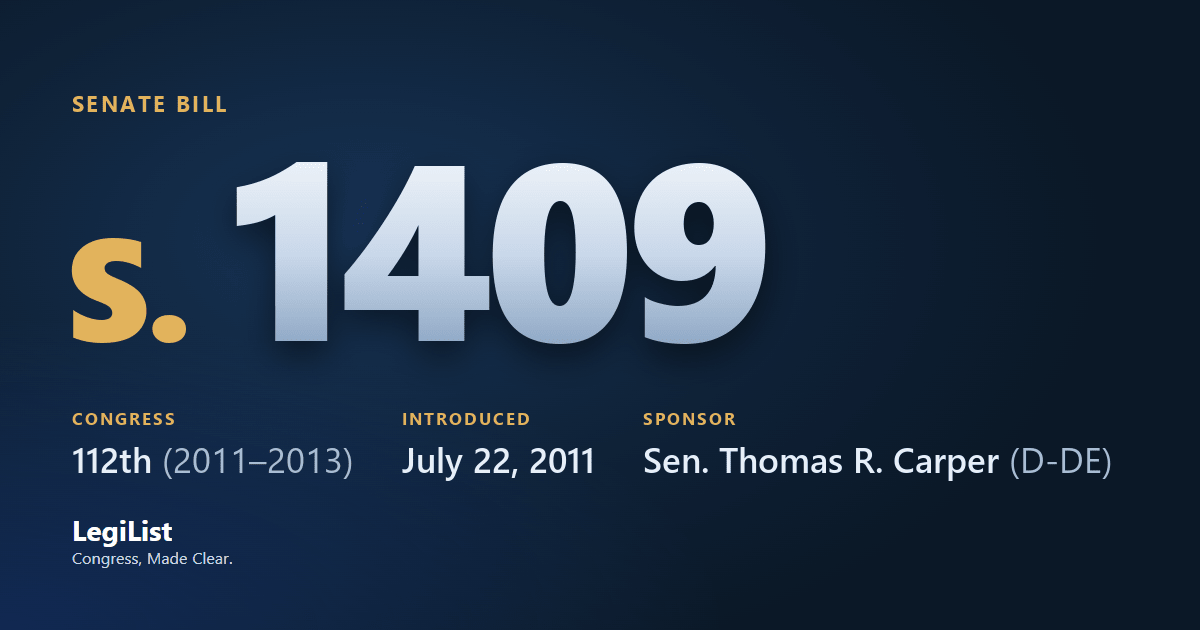
Improper Payments Elimination and Recovery Improvement Act of 2012
Latest action · Aug 2, 2012 Referred to the House Committee on Oversight and Government Reform.
Progress
Where this bill reached, and when. A stage with no date was not reached; one that failed a vote and later carried shows the date it carried.
- IntroducedJul 22, 2011
- Passed SenateAug 1, 2012
- Passed HouseNot reached
- To the PresidentNot reached
- Became lawNot reached
Summary
Improper Payments Elimination and Recovery Improvement Act of 2012 - (Sec. 3) Amends the Improper Payments Information Act of 2002 to require the Director of the Office of Management and Budget (OMB) to: (1) identify, on an annual basis, a list of high-priority federal programs for greater levels of oversight and review of improper payments; (2) coordinate with executive agencies responsible for administering high-priority programs to establish semi-annual or quarterly targets and actions for reducing improper payments; and (3) provide guidance to agencies for improving estimates of improper payments.
Requires agencies to report to their Inspectors General on an annual basis on any high-priority programs in which the highest dollar value or rate of improper payments occurs or for which there is a higher risk of improper payments. Requires OMB to make agency reports available on a central website.
(Sec. 5) Requires each agency to review prepayment and pre-award procedures and available databases to determine program or award eligibility and prevent improper payments before releasing any federal funds.
Establishes a Do Not Pay Initiative based on information from databases maintained by the federal government, including: (1) the Death Master File of the Social Security Administration (SSA), (2) the Excluded Parties List System of the General Services Administration (GSA), (3) the Debt Check Database of the Department of the Treasury, (4) the Credit Alert System or Credit Alert Interactive Voice Response System of the Department of Housing and Urban Development (HUD), (5) the List of Excluded Individuals/Entities of the Office of Inspector General of the Department of Health and Human Services (HHS), and (6) any other database designated by the Director of OMB that substantially assists in preventing improper payments.
Requires the Director to: (1) provide to Congress a plan for the inclusion of other databases in the Do Not Pay Initiative, for agency access to the Initiative, and for multilateral data use agreements for carrying out the Initiative; (2) establish a working system for prepayment and pre-award review that includes the Do Not Pay Initiative; (3) establish a plan for improving the quality, accuracy, and timeliness of death data maintained by SSA; and (4) submit annual reports to Congress on whether the Do Not Pay Initiative has reduced improper payments or awards. Requires each agency to review all payments and awards for all of its programs through the working system not later later than June 1, 2013.
Amends the Privacy Act to authorize each agency head and Inspector General to enter into computer matching agreements that allow ongoing data matching for detecting and preventing improper payments. Requires OMB to issue guidance: (1) for such agreements, including standards for reimbursement of costs, retention and timely destruction of records, and prohibitions on duplication and redisclosure of records; and (2) for Data Integrity Boards established under the Privacy Act to improve their effectiveness and responsiveness and ensure privacy protections.
Directs the Attorney General to submit recommendations for increasing the use of, access to, and the technical feasibility of using data on the federal, state, and local conviction and incarceration status of individuals to identify and prevent improper payments and fraud.
(Sec. 6) Requires the Director to determine the current and historical rates and amounts of recovery of improper payments and targets for recovering improper payments.
Cosponsors 4
Members who signed on, in the order they did. Signatures ran from Jul 22, 2011 to Mar 12, 2012; 3 are original cosponsors, there from the day it was introduced.
| Seat | Cosponsor | Signed on | |
|---|---|---|---|
| I-CT | Joseph I. Lieberman | Original | Jul 22, 2011 |
| R-MA | Scott P. Brown | Original | Jul 22, 2011 |
| R-ME | Susan M. Collins | Original | Jul 22, 2011 |
| D-PA | Robert P. Casey Jr. | Mar 12, 2012 |
Committees 2
Where it was sent and what each committee and subcommittee did with it, in order.
| Chamber | Committee | What it did |
|---|---|---|
| Senate | Homeland Security and Governmental Affairs Committee | Referred Jul 22, 2011Markup Oct 19, 2011Reported Jul 12, 2012 |
| House | Oversight and Government Reform Committee | Referred Aug 2, 2012 |
Actions 10
Everything that happened, newest first.
- Aug 2, 2012Received in the House.
- Aug 2, 2012Message on Senate action sent to the House.
- Aug 2, 2012Referred to the House Committee on Oversight and Government Reform.
- Aug 1, 2012Measure laid before Senate by unanimous consent. (consideration: CR S5894-5898; text of measure as reported in Senate: CR S5894-5896)
- Aug 1, 2012Passed/agreed to in Senate: Passed Senate with an amendment by Unanimous Consent.
In the Congressional Record 1
Days the Record’s own index lists this bill, newest first, with the pages and the members it names. Pages starting H are the House, S the Senate, E Extensions of Remarks.
| Where | In the Record | Members | Date |
|---|---|---|---|
| Senate | Debate and remarks S5894, S5896Text printed S5896–S5898Amendments S5891, S5894, S5896 | Harry Reid D-NV, Scott P. Brown R-MA (amendment), Susan M. Collins R-ME (amendment), Thomas R. Carper D-DE (amendment), Tom Coburn R-OK (amendment) | Aug 1, 2012 |
Research
What has been written about this bill: committee reports, cost estimates, the sponsor’s authority statement, printed hearings and the Congressional Research Service’s work.
Committee report
Congressional Budget Office cost estimate
- Apr 20, 2012S. 1409, Improper Payments Elimination and Recovery Improvement Act of 2011As ordered reported by the Senate Committee on Homeland Security and Governmental Affairs on October 19, 2011
Printed hearings 2
Hearings whose printed record names this bill, newest first: hearings on it, and wider hearings where it came up.
| Number | Hearing | Committee | Held |
|---|---|---|---|
| S. Hrg. 112-557 | ASSESSING EFFORTS TO COMBAT WASTE AND FRAUD IN FEDERAL PROGRAMS117 pages | Homeland Security and Governmental Affairs Committee | Mar 28, 2012 |
| Serial No. 112-130 | SOLUTIONS NEEDED: IMPROPER PAYMENTS TOTAL $115 BILLION IN FEDERAL MISSPENDING65 pages | Oversight and Government Reform Committee | Feb 7, 2012 |
Amendments 1
Amendments offered to this bill.
| Amendment | Description | Offered by | Status |
|---|---|---|---|
| SA 2770 | In the nature of a substitute. | Thomas R. Carper D-DE | Amendment SA 2770 agreed to in Senate by Unanimous Consent. |
Related bills 4
Companion bills and other measures the record links to this one.
| Bill | Title | Relationship | Latest action |
|---|---|---|---|
| S 2834 | Subsidized Stafford Loan Reduced Interest Rate Extension Act of 2012 | Related bill | May 7, 2012 |
| S 3254 | National Defense Authorization Act for Fiscal Year 2013 | Related bill | Dec 12, 2012 |
| HR 4053 | Improper Payments Elimination and Recovery Improvement Act of 2012 | Related bill | Jan 10, 2013 |
| HR 4310 | National Defense Authorization Act for Fiscal Year 2013 | Related bill | Jan 2, 2013 |
Titles 4
Every title it has carried, official and short, at each stage.
- Official Title as Introduced
- A bill to intensify efforts to identify, prevent, and recover payment error, waste, fraud, and abuse within Federal spending.
- Short Titles as Introduced
- Improper Payments Elimination and Recovery Improvement Act of 2011
- Short Titles as Reported to Senate
- Improper Payments Elimination and Recovery Improvement Act of 2012
- Short Titles as Passed Senate
- Improper Payments Elimination and Recovery Improvement Act of 2012
Subjects
Assigned by the Library of Congress. Policy area: Government Operations and Politics.
Text 4
Each version as it was printed, newest first.
- Aug 2, 2012Referred in House
- Aug 1, 2012Engrossed in Senate
- Jul 12, 2012Reported to Senate
- Jul 22, 2011Introduced in Senate
Support LegiList
This page is free, carries no paywall, and is built and maintained by one person. If the record here is useful to you, a few dollars keeps it going.
Everything here is as published by Congress: the summary is the Congressional Research Service's, the action wording is the clerks', and the subjects are the Library of Congress's. How far it got is read from the actions themselves, taking the most recent one of each kind, so a bill that failed a vote and later passed is shown as having passed. Records come from this bill on Congress.gov and govinfo.gov; cost estimates are the Congressional Budget Office's, and the hearings are the printed hearings GovInfo publishes, which can appear months after the hearing.