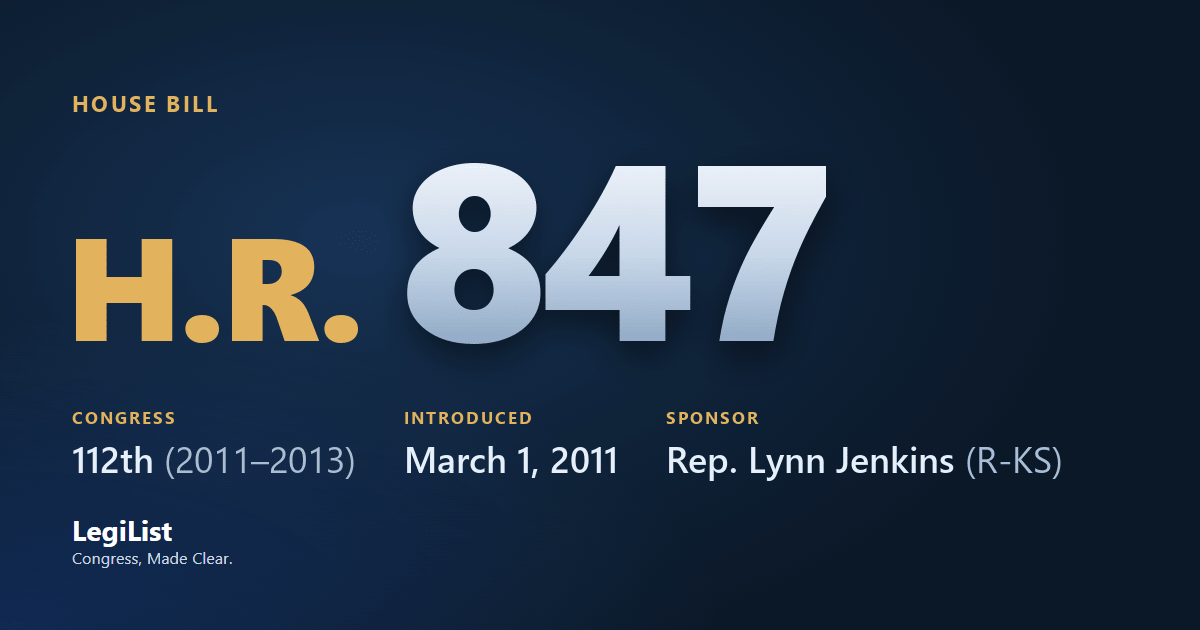
Kelsey Smith Act
Latest action · Mar 21, 2011 Referred to the Subcommittee on Crime, Terrorism, and Homeland Security.
Progress
Where this bill reached, and when. A stage with no date was not reached; one that failed a vote and later carried shows the date it carried.
- IntroducedMar 1, 2011
- Passed HouseNot reached
- Passed SenateNot reached
- To the PresidentNot reached
- Became lawNot reached
Summary
Kelsey Smith Act - Amends the Communications Act of 1934 to require telecommunication carriers to provide, at the request of a law enforcement agency, call location information of users of a commercial mobile service or an IP-enabled voice service (e.g., cell phones) to such agencies and other public safety agencies to respond to emergency situations.
Directs the Attorney General (DOJ), under the Byrne Law Enforcement Grant Program, to: (1) provide education and training to state and local law enforcement agencies and officials to collect and use call location information in emergency situations, and (2) develop and disseminate procedures to ensure that such agencies and officials have the necessary contact information to request and obtain call location information.
Cosponsors 8
Members who signed on, in the order they did. All signed on Mar 1, 2011.
| Seat | Cosponsor | Signed on | |
|---|---|---|---|
| D-CA | Adam B. Schiff | Original | Mar 1, 2011 |
| R-KS | Kevin Yoder | Original | Mar 1, 2011 |
| R-KS | Mike Pompeo | Original | Mar 1, 2011 |
| R-OH | Patrick J. Tiberi | Original | Mar 1, 2011 |
| R-IL | Peter J. Roskam | Original | Mar 1, 2011 |
| R-WV | Shelley Moore Capito | Original | Mar 1, 2011 |
| R-KS | Tim Huelskamp | Original | Mar 1, 2011 |
| R-PA | Todd Russell Platts | Original | Mar 1, 2011 |
Committees 2
Where it was sent and what each committee and subcommittee did with it, in order.
| Chamber | Committee | What it did |
|---|---|---|
| House | Energy and Commerce Committee | Referred Mar 1, 2011 |
| Communications and Technology Subcommittee | Referred Mar 8, 2011 | |
| House | Judiciary Committee | Referred Mar 1, 2011 |
| Crime and Federal Government Surveillance Subcommittee | Referred Mar 21, 2011 |
Actions 4
Everything that happened, newest first.
- Mar 21, 2011Referred to the Subcommittee on Crime, Terrorism, and Homeland Security.
- Mar 8, 2011Referred to the Subcommittee on Communications and Technology.
- Mar 1, 2011Introduced in House
- Mar 1, 2011Referred to the Committee on Energy and Commerce, and in addition to the Committee on the Judiciary, for a period to be subsequently determined by the Speaker, in each case for consideration of such provisions as fall within the jurisdiction of the committee concerned.
Research
What has been written about this bill: committee reports, cost estimates, the sponsor’s authority statement, printed hearings and the Congressional Research Service’s work.
Constitutional authority
The sponsor’s statement, as printed in the page H1455.
Titles 2
Every title it has carried, official and short, at each stage.
- Official Title as Introduced
- To amend the Communications Act of 1934 to require a provider of a commercial mobile service or an IP-enabled voice service to provide call location information concerning the user of such a service to law enforcement agencies in order to respond to a call for emergency services or in an emergency situation that involves risk of death or serious physical harm.
- Short Titles as Introduced
- Kelsey Smith Act
Subjects
Assigned by the Library of Congress. Policy area: Crime and Law Enforcement.
- Administrative law and regulatory procedures
- Business records
- Crime and Law Enforcement
- Department of Justice
- Emergency communications systems
- Emergency medical services and trauma care
- Fires
- Government information and archives
- Intergovernmental relations
- Internet and video services
- Internet, web applications, social media
- Law enforcement administration and funding
- Law enforcement officers
- State and local government operations
- Telephone and wireless communication
Text 1
Each version as it was printed, newest first.
- Mar 1, 2011Introduced in House
Everything here is as published by Congress: the summary is the Congressional Research Service's, the action wording is the clerks', and the subjects are the Library of Congress's. How far it got is read from the actions themselves, taking the most recent one of each kind, so a bill that failed a vote and later passed is shown as having passed. Records come from this bill on Congress.gov and govinfo.gov; cost estimates are the Congressional Budget Office's, and the hearings are the printed hearings GovInfo publishes, which can appear months after the hearing.