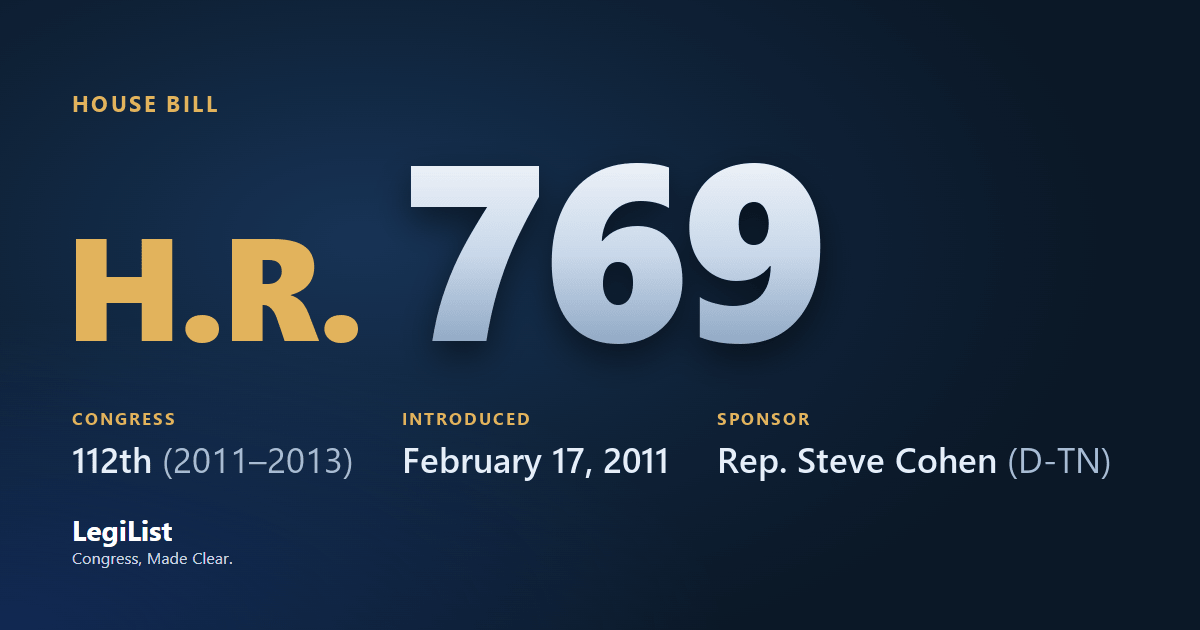
Fair Access to Credit Scores Act of 2011
Latest action · Apr 4, 2011 Referred to the Subcommittee on Financial Institutions and Consumer Credit.
Progress
Where this bill reached, and when. A stage with no date was not reached; one that failed a vote and later carried shows the date it carried.
- IntroducedFeb 17, 2011
- Passed HouseNot reached
- Passed SenateNot reached
- To the PresidentNot reached
- Became lawNot reached
Summary
Fair Access to Credit Scores Act of 2011 - Amends the Fair Credit Reporting Act to require consumer reporting agencies to disclose any information in the consumer's file concerning credit scores or other related risk scores or predictors when the consumer requests a free annual disclosure (credit report).
Requires all consumer reporting agencies to maintain information in the consumer's file concerning such scores or predictors for at least one year from the date on which such information is placed in the file.
Directs the Comptroller General to study bankruptcy risk scores used by consumer reporting agencies, including an analysis of: (1) the factors used to determine such scores; (2) how bankruptcy risk scores impact the ability of consumers to receive loans; and (3) actions that consumers can take to improve such scores.
Cosponsors 20
Members who signed on, in the order they did. Signatures ran from Feb 17, 2011 to May 18, 2012; 5 are original cosponsors, there from the day it was introduced.
| Seat | Cosponsor | Signed on | |
|---|---|---|---|
| D-NY | Charles B. Rangel | Original | Feb 17, 2011 |
| D-DC | Eleanor Holmes Norton | Original | Feb 17, 2011 |
| D-WA | Jim McDermott | Original | Feb 17, 2011 |
| D-CA | Laura Richardson | Original | Feb 17, 2011 |
| D-MA | Niki Tsongas | Original | Feb 17, 2011 |
| D-IL | Janice D. Schakowsky | Mar 1, 2011 | |
| D-IL | Jesse L. Jackson, Jr. | Mar 1, 2011 | |
| D-GU | Madeleine Z. Bordallo | Mar 1, 2011 | |
| D-NY | Nita M. Lowey | Mar 31, 2011 | |
| D-OH | Marcy Kaptur | Jul 19, 2011 | |
| D-NJ | Steven R. Rothman | Feb 7, 2012 | |
| D-GA | Henry C. "Hank" Johnson, Jr. | Feb 8, 2012 | |
| D-MA | John F. Tierney | Feb 8, 2012 | |
| D-NJ | Albio Sires | Feb 14, 2012 | |
| D-NJ | Bill Pascrell, Jr. | Feb 14, 2012 | |
| D-ME | Chellie Pingree | Feb 16, 2012 | |
| D-CA | Michael M. Honda | Feb 28, 2012 | |
| D-IN | Peter J. Visclosky | Feb 28, 2012 | |
| D-MD | Elijah E. Cummings | Apr 17, 2012 | |
| D-CA | Howard L. Berman | May 18, 2012 |
Committees 1
Where it was sent and what each committee and subcommittee did with it, in order.
| Chamber | Committee | What it did |
|---|---|---|
| House | Financial Services Committee | Referred Feb 17, 2011 |
| Consumer Protection and Financial Institutions Subcommittee | Referred Apr 4, 2011 |
Actions 3
Everything that happened, newest first.
- Apr 4, 2011Referred to the Subcommittee on Financial Institutions and Consumer Credit.
- Feb 17, 2011Introduced in House
- Feb 17, 2011Referred to the House Committee on Financial Services.
Research
What has been written about this bill: committee reports, cost estimates, the sponsor’s authority statement, printed hearings and the Congressional Research Service’s work.
Constitutional authority
The sponsor’s statement, as printed in the page H1179.
Titles 2
Every title it has carried, official and short, at each stage.
- Official Title as Introduced
- To amend the Fair Credit Reporting Act to require the inclusion of credit scores with free annual credit reports provided to consumers, and for other purposes.
- Short Titles as Introduced
- Fair Access to Credit Scores Act of 2011
Subjects
Assigned by the Library of Congress. Policy area: Finance and Financial Sector.
Text 1
Each version as it was printed, newest first.
- Feb 17, 2011Introduced in House
Support LegiList
This page is free, carries no paywall, and is built and maintained by one person. If the record here is useful to you, a few dollars keeps it going.
Everything here is as published by Congress: the summary is the Congressional Research Service's, the action wording is the clerks', and the subjects are the Library of Congress's. How far it got is read from the actions themselves, taking the most recent one of each kind, so a bill that failed a vote and later passed is shown as having passed. Records come from this bill on Congress.gov and govinfo.gov; cost estimates are the Congressional Budget Office's, and the hearings are the printed hearings GovInfo publishes, which can appear months after the hearing.