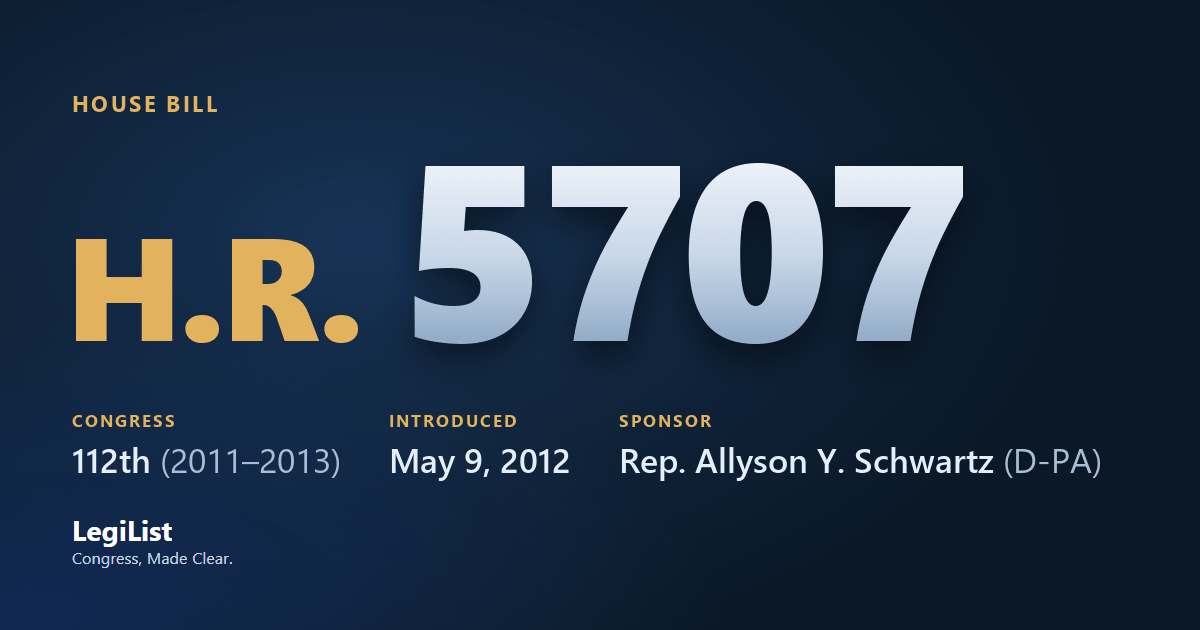
Medicare Physician Payment Innovation Act of 2012
Latest action · May 21, 2012 Referred to the Subcommittee on Health.
Progress
Where this bill reached, and when. A stage with no date was not reached; one that failed a vote and later carried shows the date it carried.
- IntroducedMay 9, 2012
- Passed HouseNot reached
- Passed SenateNot reached
- To the PresidentNot reached
- Became lawNot reached
Summary
Medicare Physician Payment Innovation Act of 2012 - Amends title XVIII (Medicare) of the Social Security Act (SSA) to revise requirements for payments for physician's services to eliminate the sustainable growth rate system from the formula for determination of the fee schedules for such services.
Sets at 0.0 the 2013 update to the single conversion factor in such formula.
Includes the program of Osteopathic Continuous Certification of the American Osteopathic Association as a Maintenance of Certification Program with respect to any plan of the Secretary of Health and Human Services (HHS) to integrate reporting on quality measures with reporting requirements relating to the meaningful use of electronic health records (EHR).
Establishes updates for separate primary care and other service categories beginning January 1, 2014, as well as separate conversion factors and separate updates through 2017 for each service category.
Directs the Secretary, through the Center for Medicare and Medicaid Innovation, to: (1) expand testing of each payment and service delivery model in at least three geographic regions; and (2) include analysis of average implementation costs, per physician, in evaluations of models in phase 1 testing.
Directs the Comptroller General to study the evaluations of each model tested.
Directs the Secretary to release to the public a comprehensive list of such health care delivery models identified as likely to: (1) reduce spending without reducing quality of care, or (2) improve the quality of patient care without increasing spending.
Requires the Secretary to inform physicians, nurse practitioners, group practices, and institutions employing Medicare part B (Supplementary Medical Insurance) providers on how best to transition to alternative health care delivery and payment models aimed at improving the coordination, quality, and efficiency of health care.
Freezes the physician fee schedule for 2018 by requiring 0.0 updates to the relevant conversion factors.
Directs the Secretary to: (1) contract and agree with regional extension centers to provide guidance and assistance on how physicians may transition to implementation of alternative health care delivery models identified as representating best practices; and (2) make certain funding available to the Office of the National Coordinator for Health Care Technology to award grants and incentive payments under a competitive process to regional extension centers and other qualified entities for such activities.
Requires the Office to: (1) establish a process for the competitive selection of regional extension centers (and other qualified entities) in the third quarter of 2014; and (2) authorize the initial distribution of funds to such centers and entities.
Prescribes updates to conversion factors for 2019-2022, but freezes them again beginning in 2023.
Requires the Secretary to consider certain factors in determining the growth rates to be recognized beginning with 2019 for alternative payment and delivery models.
Directs the Secretary to report to Congress on the impact on spending and on access to services under Medicare resulting from changes to the Medicare delivery and payments systems, including those made by this Act.
Amends the Balanced Budget and Emergency Deficit Control Act of 1985 (Graham-Rudman-Hollings Act), with respect to adjustments to discretionary spending limits in sequestration reports, to prescribe FY2013-FY2021 levels for overseas contingency and related activities for appropriations Acts. Requires any amount of budget authority for overseas contingency operations and related activities for such fiscal years in excess of such levels to be counted, in determining whether a breach has occurred in the security category and the nonsecurity category, on a proportional basis to the total spending for overseas contingency operations in those respective categories.
Cosponsors 28
Members who signed on, in the order they did. Signatures ran from May 9, 2012 to Jul 25, 2012; 3 are original cosponsors, there from the day it was introduced.
| Seat | Cosponsor | Signed on | |
|---|---|---|---|
| D-VI | Donna M. Christensen | Original | May 9, 2012 |
| D-CT | Joe Courtney | Original | May 9, 2012 |
| R-NV | Joseph J. Heck | Original | May 9, 2012 |
| D-MA | Barney Frank | May 16, 2012 | |
| D-CO | Jared Polis | May 16, 2012 | |
| D-FL | Kathy Castor | May 16, 2012 | |
| D-PA | Chaka Fattah | May 25, 2012 | |
| D-MA | John W. Olver | May 25, 2012 | |
| D-VT | Peter Welch | May 25, 2012 | |
| D-MA | James P. McGovern | Jun 5, 2012 | |
| D-PA | Robert A. Brady | Jun 5, 2012 | |
| D-DE | John C. Carney, Jr. | Jun 6, 2012 | |
| D-NM | Martin Heinrich | Jun 12, 2012 | |
| D-CA | Sam Farr | Jun 12, 2012 | |
| D-CO | Ed Perlmutter | Jun 15, 2012 |
Committees 3
Where it was sent and what each committee and subcommittee did with it, in order.
| Chamber | Committee | What it did |
|---|---|---|
| House | Energy and Commerce Committee | Referred May 9, 2012 |
| Health Subcommittee | Referred May 11, 2012 | |
| House | Ways and Means Committee | Referred May 9, 2012 |
| Health Subcommittee | Referred May 21, 2012 | |
| House | Budget Committee | Referred May 9, 2012 |
Actions 4
Everything that happened, newest first.
- May 21, 2012Referred to the Subcommittee on Health.
- May 11, 2012Referred to the Subcommittee on Health.
- May 9, 2012Introduced in House
- May 9, 2012Referred to the Committee on Energy and Commerce, and in addition to the Committees on Ways and Means, and the Budget, for a period to be subsequently determined by the Speaker, in each case for consideration of such provisions as fall within the jurisdiction of the committee concerned.
Research
What has been written about this bill: committee reports, cost estimates, the sponsor’s authority statement, printed hearings and the Congressional Research Service’s work.
Constitutional authority
The sponsor’s statement, as printed in the page H2569.
Printed hearings 1
Hearings whose printed record names this bill, newest first: hearings on it, and wider hearings where it came up.
| Number | Hearing | Committee | Held |
|---|---|---|---|
| S. Hrg. 112-799 | ROUNDTABLE DISCUSSION ON MEDICARE PHYSICIAN PAYMENT POLICY: PERSPECTIVES FROM PHYSICIANS126 pages | Finance Committee | Jul 11, 2012 |
Titles 2
Every title it has carried, official and short, at each stage.
- Official Title as Introduced
- To amend part B of title XVIII of the Social Security Act to reform Medicare payment for physicians' services by eliminating the sustainable growth rate system and providing incentives for the adoption of innovative payment and delivery models to improve quality and efficiency.
- Short Titles as Introduced
- Medicare Physician Payment Innovation Act of 2012
Subjects
Assigned by the Library of Congress. Policy area: Health.
Text 1
Each version as it was printed, newest first.
- May 9, 2012Introduced in House
Support LegiList
This page is free, carries no paywall, and is built and maintained by one person. If the record here is useful to you, a few dollars keeps it going.
Everything here is as published by Congress: the summary is the Congressional Research Service's, the action wording is the clerks', and the subjects are the Library of Congress's. How far it got is read from the actions themselves, taking the most recent one of each kind, so a bill that failed a vote and later passed is shown as having passed. Records come from this bill on Congress.gov and govinfo.gov; cost estimates are the Congressional Budget Office's, and the hearings are the printed hearings GovInfo publishes, which can appear months after the hearing.