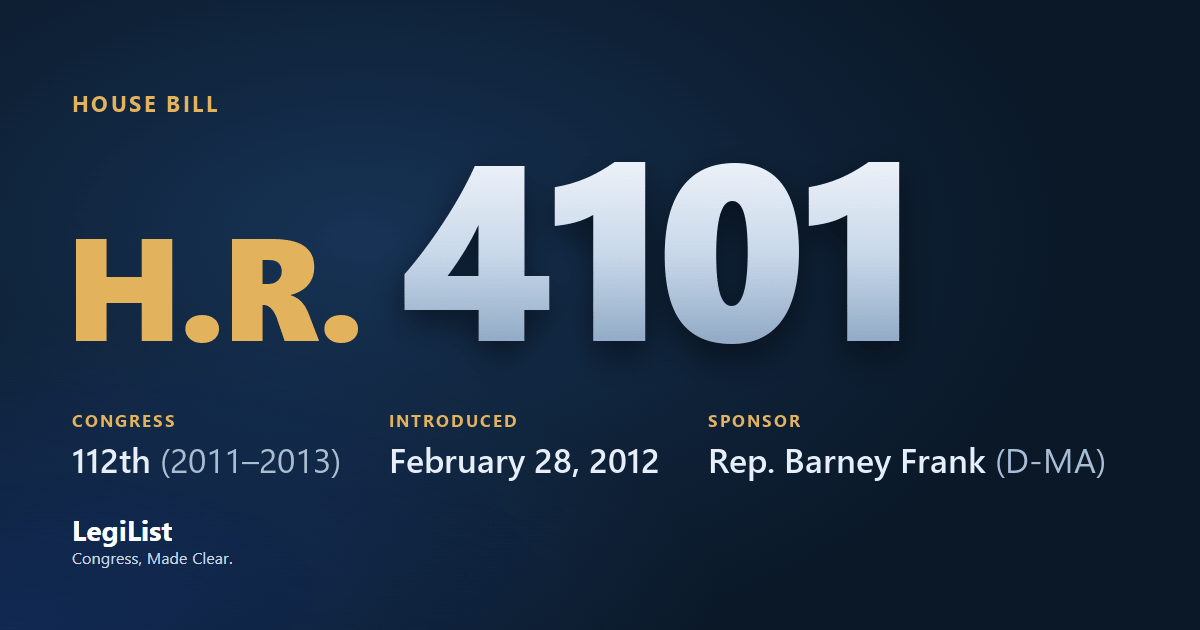
Fair Debt Collection Practices Clarification Act of 2012
Latest action · Apr 26, 2012 Referred to the Subcommittee on Financial Institutions and Consumer Credit.
Progress
Where this bill reached, and when. A stage with no date was not reached; one that failed a vote and later carried shows the date it carried.
- IntroducedFeb 28, 2012
- Passed HouseNot reached
- Passed SenateNot reached
- To the PresidentNot reached
- Became lawNot reached
Summary
Fair Debt Collection Practices Clarification Act of 2012 - Amends the Fair Debt Collection Practices Act to revise the disclaimer of liability for any act done or omitted in good faith in conformity with any advisory opinion of the Consumer Financial Protection Bureau (CFPB).
Exempts from liability, in addition, acts done or omitted in good faith in compliance with any rule, regulation, or interpretation of the CFPB, or in conformity with any interpretation or approval by a CFPB official or employee duly authorized to issue such interpretations or approvals.
Permits a debt collector to leave messages for a consumer regarding the collection of a debt on the consumer's answering machine, voice messaging system, or similar device, including in an initial communication with the consumer, so long as the message complies with regulations prescribed by the CFPB to ensure the preservation of consumer privacy and other rights, including restrictions on communications with third parties.
Prohibits a debt collector from initiating a legal action on a debt in an arbitration setting, or requiring the consumer to resolve by arbitration a collection-related dispute on the debt, unless the consumer has agreed in writing to resolution by arbitration after collections activities have been initiated and a legal action or dispute has arisen.
Cosponsors
Members who signed on, in the order they did.
Committees 1
Where it was sent and what each committee and subcommittee did with it, in order.
| Chamber | Committee | What it did |
|---|---|---|
| House | Financial Services Committee | Referred Feb 28, 2012 |
| Consumer Protection and Financial Institutions Subcommittee | Referred Apr 26, 2012 |
Actions 3
Everything that happened, newest first.
- Apr 26, 2012Referred to the Subcommittee on Financial Institutions and Consumer Credit.
- Feb 28, 2012Introduced in House
- Feb 28, 2012Referred to the House Committee on Financial Services.
Research
What has been written about this bill: committee reports, cost estimates, the sponsor’s authority statement, printed hearings and the Congressional Research Service’s work.
Constitutional authority
The sponsor’s statement, as printed in the page H1017.
Related bills 1
Companion bills and other measures the record links to this one.
| Bill | Title | Relationship | Latest action |
|---|---|---|---|
| HR 5794 | Fair Debt Collection Practices Clarification Act of 2012 | Related bill | Jul 11, 2012 |
Titles 2
Every title it has carried, official and short, at each stage.
- Official Title as Introduced
- To amend the Fair Debt Collection Practices Act to exempt a debt collector from liability when leaving certain voice mail messages for a consumer with respect to a debt as long as the debt collector follows regulations prescribed by the Bureau of Consumer Financial Protection on the appropriate manner in which to leave such a message, and for other purposes.
- Short Titles as Introduced
- Fair Debt Collection Practices Clarification Act of 2012
Subjects
Assigned by the Library of Congress. Policy area: Finance and Financial Sector.
Text 1
Each version as it was printed, newest first.
- Feb 28, 2012Introduced in House
Support LegiList
This page is free, carries no paywall, and is built and maintained by one person. If the record here is useful to you, a few dollars keeps it going.
Everything here is as published by Congress: the summary is the Congressional Research Service's, the action wording is the clerks', and the subjects are the Library of Congress's. How far it got is read from the actions themselves, taking the most recent one of each kind, so a bill that failed a vote and later passed is shown as having passed. Records come from this bill on Congress.gov and govinfo.gov; cost estimates are the Congressional Budget Office's, and the hearings are the printed hearings GovInfo publishes, which can appear months after the hearing.