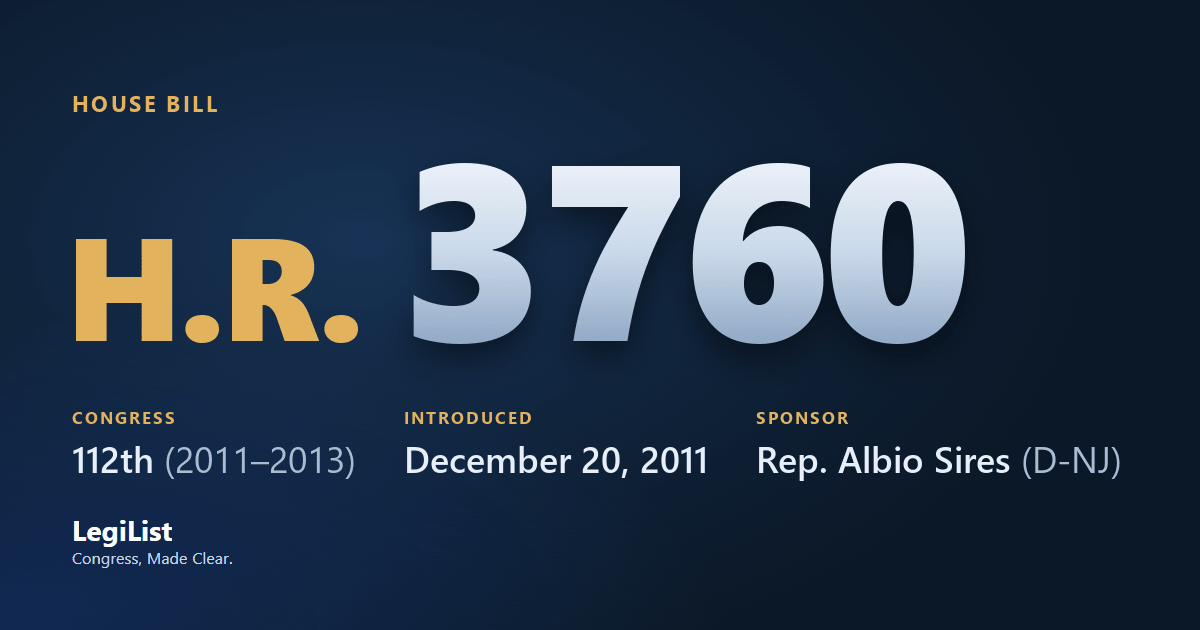
Collaborative Academic Research Efforts for Tourette Syndrome Act of 2011
Latest action · Dec 23, 2011 Referred to the Subcommittee on Health.
Progress
Where this bill reached, and when. A stage with no date was not reached; one that failed a vote and later carried shows the date it carried.
- IntroducedDec 20, 2011
- Passed HouseNot reached
- Passed SenateNot reached
- To the PresidentNot reached
- Became lawNot reached
Summary
Collaborative Academic Research Efforts for Tourette Syndrome Act of 2011 - Amends the Public Health Service Act to require the Director of the National Institutes of Health (NIH) to expand, intensify, and coordinate NIH programs and activities regarding Tourette syndrome.
Requires the Director to develop a system to collect data on Tourette syndrome, including epidemiological information regarding its incidence and prevalence in the United States, primary data, and data on the availability of medical and social services for individuals with Tourette syndrome and their families.
Requires the Director to award grants and contracts to public or nonprofit private entities to pay costs of planning, establishing, improving, and providing basic operating support for between four and six centers of excellence in different regions of the United States to conduct basic and clinical research on Tourette syndrome.
Requires the Secretary to designate a portion of the amounts made available to carry out NIH programs and activities for a fiscal year to carry out programs and activities with respect to Tourette syndrome.
Cosponsors 41
Members who signed on, in the order they did. Signatures ran from Jan 18, 2012 to Nov 27, 2012.
| Seat | Cosponsor | Signed on | |
|---|---|---|---|
| R-NJ | Leonard Lance | Jan 18, 2012 | |
| D-NM | Ben Ray Luján | Jan 24, 2012 | |
| D-TX | Charles A. Gonzalez | Jan 24, 2012 | |
| D-NC | David E. Price | Jan 24, 2012 | |
| D-AZ | Ed Pastor | Jan 24, 2012 | |
| D-CO | Ed Perlmutter | Jan 24, 2012 | |
| D-CA | Grace F. Napolitano | Jan 24, 2012 | |
| D-NY | Gregory W. Meeks | Jan 24, 2012 | |
| D-WI | Gwen Moore | Jan 24, 2012 | |
| D-TX | Henry Cuellar | Jan 24, 2012 | |
| D-PA | Jason Altmire | Jan 24, 2012 | |
| D-CA | Joe Baca | Jan 24, 2012 | |
| D-CT | Joe Courtney | Jan 24, 2012 | |
| D-IN | Joe Donnelly | Jan 24, 2012 | |
| D-KY | John A. Yarmuth | Jan 24, 2012 |
Committees 1
Where it was sent and what each committee and subcommittee did with it, in order.
| Chamber | Committee | What it did |
|---|---|---|
| House | Energy and Commerce Committee | Referred Dec 20, 2011 |
| Health Subcommittee | Referred Dec 23, 2011 |
Actions 3
Everything that happened, newest first.
- Dec 23, 2011Referred to the Subcommittee on Health.
- Dec 20, 2011Introduced in House
- Dec 20, 2011Referred to the House Committee on Energy and Commerce.
Research
What has been written about this bill: committee reports, cost estimates, the sponsor’s authority statement, printed hearings and the Congressional Research Service’s work.
Constitutional authority
The sponsor’s statement, as printed in the page H10016.
Related bills 1
Companion bills and other measures the record links to this one.
| Bill | Title | Relationship | Latest action |
|---|---|---|---|
| S 2321 | Collaborative Academic Research Efforts for Tourette Syndrome Act of 2012 | Related bill | Apr 19, 2012 |
Titles 2
Every title it has carried, official and short, at each stage.
- Official Title as Introduced
- To amend the Public Health Service Act to provide for the expansion, intensification, and coordination of the programs and activities of the National Institutes of Health with respect to Tourette syndrome.
- Short Titles as Introduced
- Collaborative Academic Research Efforts for Tourette Syndrome Act of 2011
Subjects
Assigned by the Library of Congress. Policy area: Health.
Text 1
Each version as it was printed, newest first.
- Dec 20, 2011Introduced in House
Support LegiList
This page is free, carries no paywall, and is built and maintained by one person. If the record here is useful to you, a few dollars keeps it going.
Everything here is as published by Congress: the summary is the Congressional Research Service's, the action wording is the clerks', and the subjects are the Library of Congress's. How far it got is read from the actions themselves, taking the most recent one of each kind, so a bill that failed a vote and later passed is shown as having passed. Records come from this bill on Congress.gov and govinfo.gov; cost estimates are the Congressional Budget Office's, and the hearings are the printed hearings GovInfo publishes, which can appear months after the hearing.