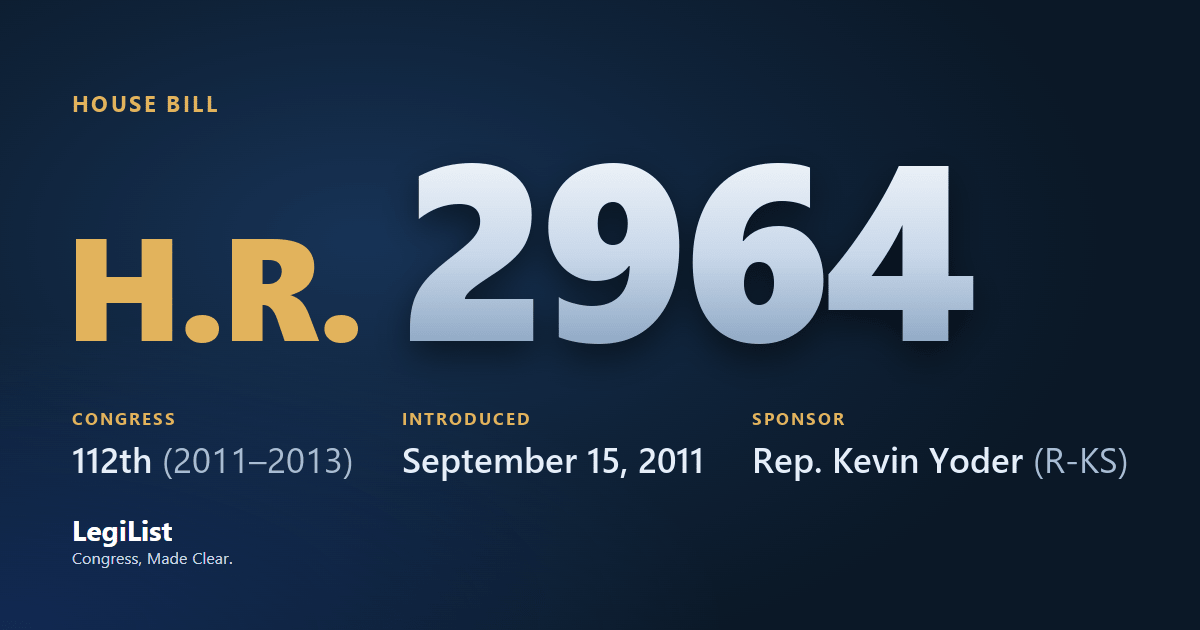
Unfunded Mandates Accountability Act of 2011
Latest action · Oct 3, 2011 Referred to the Subcommittee on Technology, Information Policy, Intergovernmental Relations and Procurement Reform .
Progress
Where this bill reached, and when. A stage with no date was not reached; one that failed a vote and later carried shows the date it carried.
- IntroducedSep 15, 2011
- Passed HouseNot reached
- Passed SenateNot reached
- To the PresidentNot reached
- Became lawNot reached
Summary
Unfunded Mandates Accountability Act of 2011 - Amends the Unfunded Mandates Reform Act of 1995 to: (1) require regulatory impact analyses for rules that do not involve a legislative mandate and for final rules that do not have a prior notice of proposed rulemaking; (2) require federal agencies to prepare and publish in the Federal Register an initial and final regulatory impact analysis prior to promulgating any proposed or final rule that may have an annual effect on the economy of $100 million or more or that may result in the expenditure of $100 million or more in any one year by state, local, and tribal governments; (3) require such agencies to identify and consider regulatory alternatives before promulgating any proposed or final rule and select the least costly, most cost-effective, or least burdensome alternative; (4) define "cost" as the cost of compliance and any reasonably foreseeable indirect cost resulting from agency rulemaking; (5) exempt rules concerning monetary policy proposed or implemented by the Board of Governors of the Federal Reserve System or the Federal Open Market Committee from provisions of such Act relating to regulatory accountability and reform, review of federal mandates, and judicial review; and (6) expand provisions relating to judicial review of regulatory impact analyses.
Amends the Congressional Budget and Impoundment Control Act of 1974 to require independent regulatory agencies to conduct regulatory impact analyses.
Cosponsors 24
Members who signed on, in the order they did. Signatures ran from Sep 15, 2011 to May 10, 2012; 17 are original cosponsors, there from the day it was introduced.
| Seat | Cosponsor | Signed on | |
|---|---|---|---|
| R-AZ | Benjamin Quayle | Original | Sep 15, 2011 |
| R-TX | Bill Flores | Original | Sep 15, 2011 |
| R-FL | Bill Posey | Original | Sep 15, 2011 |
| R-TN | David P. Roe | Original | Sep 15, 2011 |
| R-SC | Jeff Duncan | Original | Sep 15, 2011 |
| R-LA | Jeffrey M. Landry | Original | Sep 15, 2011 |
| R-LA | John Fleming | Original | Sep 15, 2011 |
| R-PA | Joseph R. Pitts | Original | Sep 15, 2011 |
| R-TX | Kevin Brady | Original | Sep 15, 2011 |
| R-KS | Mike Pompeo | Original | Sep 15, 2011 |
| R-NC | Patrick T. McHenry | Original | Sep 15, 2011 |
| R-ID | Raul R. Labrador | Original | Sep 15, 2011 |
| R-NC | Sue Wilkins Myrick | Original | Sep 15, 2011 |
| R-KS | Tim Huelskamp | Original | Sep 15, 2011 |
| R-IN | Todd Rokita | Original | Sep 15, 2011 |
| R-GA | Tom Price | Original | Sep 15, 2011 |
| R-CA | Wally Herger | Original | Sep 15, 2011 |
| R-MD | Andy Harris | Oct 13, 2011 | |
| R-TX | Francisco "Quico" Canseco | Oct 13, 2011 | |
| R-FL | Jeff Miller | Oct 13, 2011 | |
| R-GA | Lynn A. Westmoreland | Oct 13, 2011 | |
| R-KS | Lynn Jenkins | Oct 13, 2011 | |
| R-IL | Joe Walsh | Nov 18, 2011 | |
| R-TN | John J. Duncan, Jr. | May 10, 2012 |
Committees 4
Where it was sent and what each committee and subcommittee did with it, in order.
| Chamber | Committee | What it did |
|---|---|---|
| House | Oversight and Government Reform Committee | Referred Sep 15, 2011 |
| Technology, Information Policy, Intergovernmental Relations and Procurement Reform Subcommittee | Referred Oct 3, 2011 | |
| House | Judiciary Committee | Referred Sep 15, 2011 |
| Courts, Intellectual Property, Artificial Intelligence, and the Internet Subcommittee | Referred Sep 23, 2011 | |
| House | Rules Committee | Referred Sep 15, 2011 |
| House | Budget Committee | Referred Sep 15, 2011 |
Actions 5
Everything that happened, newest first.
- Oct 3, 2011Referred to the Subcommittee on Technology, Information Policy, Intergovernmental Relations and Procurement Reform .
- Sep 23, 2011Referred to the Subcommittee on Courts, Commercial and Administrative Law.
- Sep 15, 2011Introduced in House
- Sep 15, 2011Referred to the Committee on Oversight and Government Reform, and in addition to the Committees on the Judiciary, Rules, and the Budget, for a period to be subsequently determined by the Speaker, in each case for consideration of such provisions as fall within the jurisdiction of the committee concerned.
- Sep 14, 2011Sponsor introductory remarks on measure. (CR H6150-6151)
Research
What has been written about this bill: committee reports, cost estimates, the sponsor’s authority statement, printed hearings and the Congressional Research Service’s work.
Constitutional authority
The sponsor’s statement, as printed in the page H6233.
Related bills 2
Companion bills and other measures the record links to this one.
| Bill | Title | Relationship | Latest action |
|---|---|---|---|
| S 1189 | Unfunded Mandates Accountability Act of 2011 | Related bill | Jul 20, 2011 |
| S 1720 | Jobs Through Growth Act | Related bill | Oct 18, 2011 |
Titles 2
Every title it has carried, official and short, at each stage.
- Official Title as Introduced
- To amend the Unfunded Mandates Reform Act of 1995 to provide for regulatory impact analyses for certain rules, consideration of the least burdensome regulatory alternative, and for other purposes.
- Short Titles as Introduced
- Unfunded Mandates Accountability Act of 2011
Subjects
Assigned by the Library of Congress. Policy area: Government Operations and Politics.
Text 1
Each version as it was printed, newest first.
- Sep 15, 2011Introduced in House
Everything here is as published by Congress: the summary is the Congressional Research Service's, the action wording is the clerks', and the subjects are the Library of Congress's. How far it got is read from the actions themselves, taking the most recent one of each kind, so a bill that failed a vote and later passed is shown as having passed. Records come from this bill on Congress.gov and govinfo.gov; cost estimates are the Congressional Budget Office's, and the hearings are the printed hearings GovInfo publishes, which can appear months after the hearing.