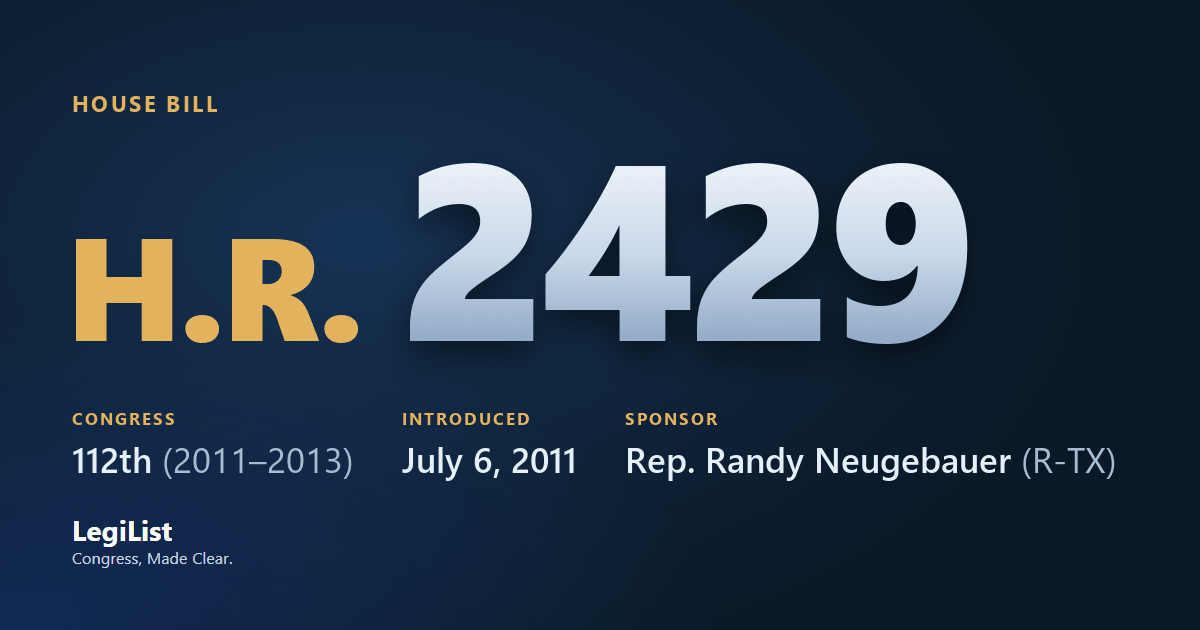
To exempt certain class A CDL drivers from the requirement to obtain a hazardous material endorsement while operating a service vehicle with a fuel tank containing 3,785 liters (1,000 gallons) or less of diesel fuel.
Latest action · Jul 7, 2011 Referred to the Subcommittee on Highways and Transit.
Progress
Where this bill reached, and when. A stage with no date was not reached; one that failed a vote and later carried shows the date it carried.
- IntroducedJul 6, 2011
- Passed HouseNot reached
- Passed SenateNot reached
- To the PresidentNot reached
- Became lawNot reached
Summary
Directs the Secretary of Transportation (DOT) to exempt from the requirement to obtain a hazardous material (hazmat) endorsement all class A commercial driver's license (CDL) holders who are custom harvesters, agricultural retailers, agricultural business employees, agricultural cooperative employees, or agricultural producers who operate a service vehicle with a fuel tank containing 3,785 liters (1,000) gallons or less of diesel fuel if the tank is clearly marked with a placard reading "Diesel Fuel."
Cosponsors 22
Members who signed on, in the order they did. Signatures ran from Jul 19, 2011 to Jul 18, 2012.
| Seat | Cosponsor | Signed on | |
|---|---|---|---|
| R-FL | Bill Posey | Jul 19, 2011 | |
| R-OH | Bob Gibbs | Jul 19, 2011 | |
| R-OH | Robert E. Latta | Jul 25, 2011 | |
| R-TX | Francisco "Quico" Canseco | Jul 26, 2011 | |
| R-OK | James Lankford | Jul 27, 2011 | |
| R-TX | Ted Poe | Sep 8, 2011 | |
| D-MN | Collin C. Peterson | Sep 12, 2011 | |
| R-NE | Jeff Fortenberry | Sep 12, 2011 | |
| R-KS | Tim Huelskamp | Sep 21, 2011 | |
| R-AZ | Paul A. Gosar | Oct 14, 2011 | |
| R-KS | Lynn Jenkins | Dec 15, 2011 | |
| R-ND | Rick Berg | Dec 16, 2011 | |
| R-TX | Ron Paul | Jan 31, 2012 | |
| R-TX | K. Michael Conaway | Feb 1, 2012 | |
| R-KS | Mike Pompeo | Feb 2, 2012 | |
| R-OH | Bill Johnson | Feb 3, 2012 | |
| R-IN | Marlin A. Stutzman | Feb 7, 2012 | |
| R-AR | Eric A. "Rick" Crawford | Feb 14, 2012 | |
| R-NE | Adrian Smith | Feb 28, 2012 | |
| R-IA | Tom Latham | Mar 7, 2012 | |
| R-KS | Kevin Yoder | Apr 26, 2012 | |
| R-IN | Todd Rokita | Jul 18, 2012 |
Committees 1
Where it was sent and what each committee and subcommittee did with it, in order.
| Chamber | Committee | What it did |
|---|---|---|
| House | Transportation and Infrastructure Committee | Referred Jul 6, 2011 |
| Highways and Transit Subcommittee | Referred Jul 7, 2011 |
Actions 3
Everything that happened, newest first.
- Jul 7, 2011Referred to the Subcommittee on Highways and Transit.
- Jul 6, 2011Introduced in House
- Jul 6, 2011Referred to the House Committee on Transportation and Infrastructure.
Research
What has been written about this bill: committee reports, cost estimates, the sponsor’s authority statement, printed hearings and the Congressional Research Service’s work.
Constitutional authority
The sponsor’s statement, as printed in the page H4672.
Related bills 1
Companion bills and other measures the record links to this one.
| Bill | Title | Relationship | Latest action |
|---|---|---|---|
| S 1288 | A bill to exempt certain class A CDL drivers from the requirement to obtain a hazardous material endorsement while operating a service vehicle with a fuel tank containing 3,785 liters (1,000 gallons) or less of diesel fuel. | Identical bill | Jun 28, 2011 |
Titles 1
Every title it has carried, official and short, at each stage.
- Official Title as Introduced
- To exempt certain class A CDL drivers from the requirement to obtain a hazardous material endorsement while operating a service vehicle with a fuel tank containing 3,785 liters (1,000 gallons) or less of diesel fuel.
Subjects
Assigned by the Library of Congress. Policy area: Transportation and Public Works.
Text 1
Each version as it was printed, newest first.
- Jul 6, 2011Introduced in House
Everything here is as published by Congress: the summary is the Congressional Research Service's, the action wording is the clerks', and the subjects are the Library of Congress's. How far it got is read from the actions themselves, taking the most recent one of each kind, so a bill that failed a vote and later passed is shown as having passed. Records come from this bill on Congress.gov and govinfo.gov; cost estimates are the Congressional Budget Office's, and the hearings are the printed hearings GovInfo publishes, which can appear months after the hearing.