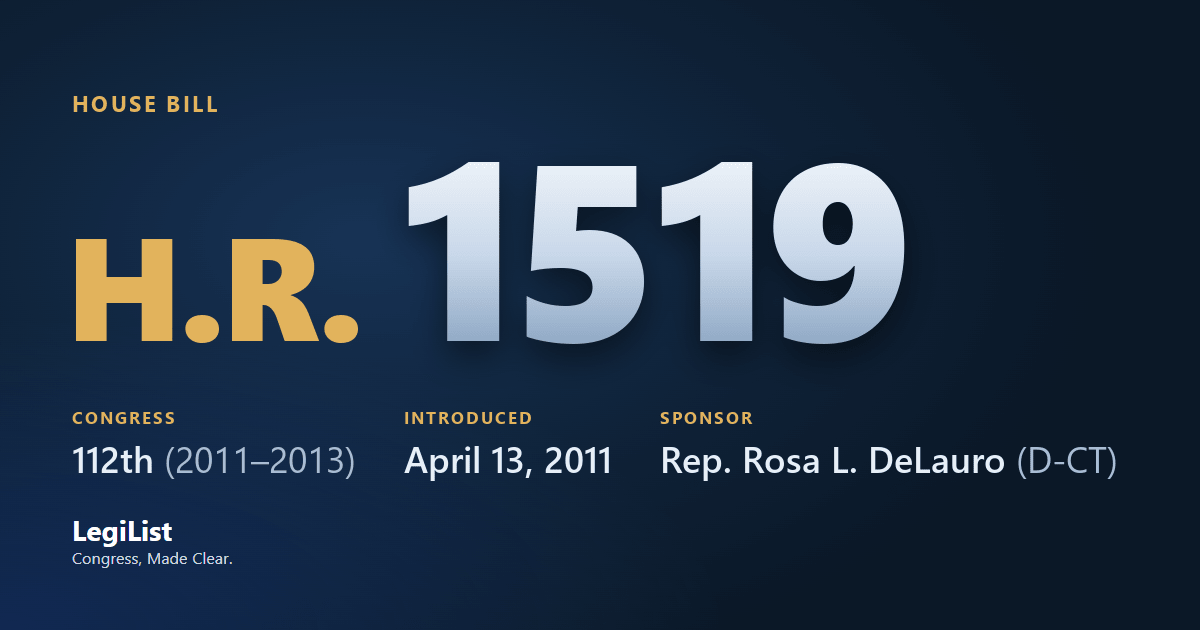
Paycheck Fairness Act
Latest action · May 20, 2011 Referred to the Subcommittee on Workforce Protections.
Progress
Where this bill reached, and when. A stage with no date was not reached; one that failed a vote and later carried shows the date it carried.
- IntroducedApr 13, 2011
- Passed HouseNot reached
- Passed SenateNot reached
- To the PresidentNot reached
- Became lawNot reached
Summary
Paycheck Fairness Act - Amends the portion of the Fair Labor Standards Act of 1938 (FLSA) known as the Equal Pay Act to revise remedies for, enforcement of, and exceptions to prohibitions against sex discrimination in the payment of wages.
Revises the exception to the prohibition for a wage rate differential based on any other factor other than sex. Limits such factors to bona fide factors, such as education, training, or experience.
States that the bona fide factor defense shall apply only if the employer demonstrates that such factor: (1) is not based upon or derived from a sex-based differential in compensation, (2) is job-related with respect to the position in question, and (3) is consistent with business necessity. Makes such defense inapplicable where the employee demonstrates that: (1) an alternative employment practice exists that would serve the same business purpose without producing such differential, and (2) the employer has refused to adopt such alternative practice.
Revises the prohibition against employer retaliation for employee complaints. Prohibits retaliation for inquiring about, discussing, or disclosing the wages of the employee or another employee in response to a complaint or charge, or in furtherance of a sex discrimination investigation, proceeding, hearing, or action, or an investigation conducted by the employer.
Makes employers who violate sex discrimination prohibitions liable in a civil action for either compensatory or (except for the federal government) punitive damages.
States that any action brought to enforce the prohibition against sex discrimination may be maintained as a class action in which individuals may be joined as party plaintiffs without their written consent.
Authorizes the Secretary of Labor (Secretary) to seek additional compensatory or punitive damages in a sex discrimination action.
Requires the Equal Employment Opportunity Commission (EEOC) and the Office of Federal Contract Compliance Programs to train EEOC employees and affected individuals and entities on matters involving wage discrimination.
Authorizes the Secretary to make grants to eligible entities for negotiation skills training programs for girls and women. Directs the Secretary and the Secretary of Education to issue regulations or policy guidance to integrate such training into certain programs under their Departments.
Directs the Secretary to conduct studies and provide information to employers, labor organizations, and the general public regarding the means available to eliminate pay disparities between men and women.
Establishes the Secretary of Labor's National Award for Pay Equity in the Workplace for an employer who has made a substantial effort to eliminate pay disparities between men and women.
Amends the Civil Rights Act of 1964 to require the EEOC to collect from employers pay information data regarding the sex, race, and national origin of employees for use in the enforcement of federal laws prohibiting pay discrimination.
Directs: (1) the Commissioner of Labor Statistics to continue to collect data on woman workers in the Current Employment Statistics survey, (2) the Office of Federal Contract Compliance Programs to use specified types of methods in investigating compensation discrimination and in enforcing pay equity, and (3) the Secretary to make accurate information on compensation discrimination readily available to the public.
Directs the Secretary and the Commissioner [sic] of the EEOC jointly to develop technical assistance material to assist small businesses to comply with the requirements of this Act.
Cosponsors 197
Members who signed on, in the order they did. Signatures ran from Apr 13, 2011 to Sep 10, 2012; 167 are original cosponsors, there from the day it was introduced.
| Seat | Cosponsor | Signed on | |
|---|---|---|---|
| D-CA | Adam B. Schiff | Original | Apr 13, 2011 |
| D-TX | Al Green | Original | Apr 13, 2011 |
| D-NJ | Albio Sires | Original | Apr 13, 2011 |
| D-FL | Alcee L. Hastings | Original | Apr 13, 2011 |
| D-PA | Allyson Y. Schwartz | Original | Apr 13, 2011 |
| D-IN | André Carson | Original | Apr 13, 2011 |
| D-CA | Anna G. Eshoo | Original | Apr 13, 2011 |
| D-NY | Anthony D. Weiner | Original | Apr 13, 2011 |
| D-CA | Barbara Lee | Original | Apr 13, 2011 |
| D-MA | Barney Frank | Original | Apr 13, 2011 |
| D-NM | Ben Ray Luján | Original | Apr 13, 2011 |
| D-MS | Bennie G. Thompson | Original | Apr 13, 2011 |
| D-MN | Betty McCollum | Original | Apr 13, 2011 |
| D-OH | Betty Sutton | Original | Apr 13, 2011 |
| D-NJ | Bill Pascrell, Jr. | Original | Apr 13, 2011 |
Committees 1
Where it was sent and what each committee and subcommittee did with it, in order.
| Chamber | Committee | What it did |
|---|---|---|
| House | Education and Workforce Committee | Referred Apr 13, 2011 |
| Workforce Protections Subcommittee | Referred May 20, 2011 |
Actions 3
Everything that happened, newest first.
- May 20, 2011Referred to the Subcommittee on Workforce Protections.
- Apr 13, 2011Introduced in House
- Apr 13, 2011Referred to the House Committee on Education and the Workforce.
In the Congressional Record 8
Days the Record’s own index lists this bill, newest first, with the pages and the members it names. Pages starting H are the House, S the Senate, E Extensions of Remarks.
| Where | In the Record | Members | Date |
|---|---|---|---|
| Extensions | Debate and remarks E1036 | Silvestre Reyes D-TX | Jun 8, 2012 |
| Extensions | Debate and remarks E976 | Eddie Bernice Johnson D-TX | Jun 5, 2012 |
| House | Debate and remarks H3278, H3280, H3285, H3286 | Alcee L. Hastings D-FL, Barbara Lee D-CA, George Miller D-CA, Janice D. Schakowsky D-IL, John F. Tierney D-MA, Lucille Roybal-Allard D-CA, Lynn C. Woolsey D-CA, Marcia L. Fudge D-OH, Rosa L. DeLauro D-CT | May 31, 2012 |
| House | Debate and remarks H3190 | Sam Farr D-CA | May 30, 2012 |
| House | Debate and remarks H2192 | Shelley Berkley D-NV | Apr 26, 2012 |
Research
What has been written about this bill: committee reports, cost estimates, the sponsor’s authority statement, printed hearings and the Congressional Research Service’s work.
Constitutional authority
The sponsor’s statement, as printed in the page H2666.
Related bills 3
Companion bills and other measures the record links to this one.
| Bill | Title | Relationship | Latest action |
|---|---|---|---|
| S 797 | Paycheck Fairness Act | Related bill | Apr 12, 2011 |
| S 3220 | Paycheck Fairness Act | Related bill | Jun 5, 2012 |
| S 3256 | End Pay Discrimination Through Information Act | Related bill | Jun 4, 2012 |
Titles 2
Every title it has carried, official and short, at each stage.
- Official Title as Introduced
- To amend the Fair Labor Standards Act of 1938 to provide more effective remedies to victims of discrimination in the payment of wages on the basis of sex, and for other purposes.
- Short Titles as Introduced
- Paycheck Fairness Act
Subjects
Assigned by the Library of Congress. Policy area: Labor and Employment.
- Civil actions and liability
- Employment discrimination and employee rights
- Government information and archives
- Government studies and investigations
- Labor and Employment
- Public contracts and procurement
- Racial and ethnic relations
- Sex, gender, sexual orientation discrimination
- Small business
- Wages and earnings
- Women's employment
Text 1
Each version as it was printed, newest first.
- Apr 13, 2011Introduced in House
Support LegiList
This page is free, carries no paywall, and is built and maintained by one person. If the record here is useful to you, a few dollars keeps it going.
Everything here is as published by Congress: the summary is the Congressional Research Service's, the action wording is the clerks', and the subjects are the Library of Congress's. How far it got is read from the actions themselves, taking the most recent one of each kind, so a bill that failed a vote and later passed is shown as having passed. Records come from this bill on Congress.gov and govinfo.gov; cost estimates are the Congressional Budget Office's, and the hearings are the printed hearings GovInfo publishes, which can appear months after the hearing.