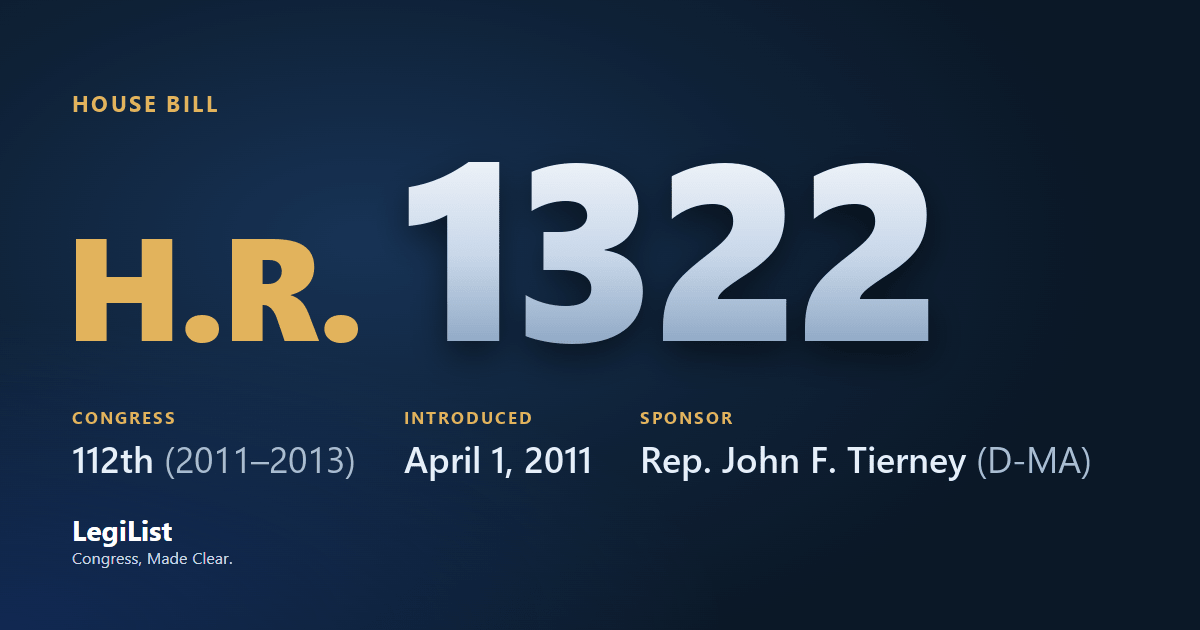
Earned Retiree Healthcare Benefits Protection Act of 2011
Latest action · Apr 15, 2011 Referred to the Subcommittee on Health, Employment, Labor, and Pensions.
Progress
Where this bill reached, and when. A stage with no date was not reached; one that failed a vote and later carried shows the date it carried.
- IntroducedApr 1, 2011
- Passed HouseNot reached
- Passed SenateNot reached
- To the PresidentNot reached
- Became lawNot reached
Summary
Earned Retiree Healthcare Benefits Protection Act of 2011 - Amends the Employee Retirement Income Security Act of 1974 (ERISA) to establish an enforceable obligation on sponsors of group health plans to restore health benefits previously taken away from plan participants to the extent such benefits were cancelled or altered after their retirement.
Prohibits group health plans from reducing retiree health benefits after the retirement of a plan beneficiary. Requires such plans to adopt provisions barring post-retirement reductions in retiree health benefits.
Requires group health plan sponsors to grant benefit restoration to retired plan participants. Authorizes the Secretary of Labor to waive or vary requirements for benefit restoration if compliance with such requirements would: (1) be adverse to the interests of plan participants in the aggregate, (2) not be administratively feasible, and (3) cause substantial business hardship to plan sponsors.
Authorizes the Secretary to assess civil penalties for violations of this Act.
Cosponsors 34
Members who signed on, in the order they did. Signatures ran from Apr 1, 2011 to Nov 27, 2012; 3 are original cosponsors, there from the day it was introduced.
| Seat | Cosponsor | Signed on | |
|---|---|---|---|
| D-CA | George Miller | Original | Apr 1, 2011 |
| D-NJ | Robert E. Andrews | Original | Apr 1, 2011 |
| R-NC | Walter B. Jones | Original | Apr 1, 2011 |
| D-MA | Barney Frank | Apr 15, 2011 | |
| D-NY | Gary L. Ackerman | May 24, 2011 | |
| D-MI | Dale E. Kildee | Jun 23, 2011 | |
| D-NY | Gregory W. Meeks | Jun 23, 2011 | |
| D-NJ | Steven R. Rothman | Jun 23, 2011 | |
| D-IA | Leonard L. Boswell | Jul 6, 2011 | |
| D-OH | Tim Ryan | Jul 18, 2011 | |
| D-OH | Dennis J. Kucinich | Sep 20, 2011 | |
| D-NY | Edolphus Towns | Sep 20, 2011 | |
| D-CA | Laura Richardson | Oct 12, 2011 | |
| D-OH | Marcy Kaptur | Feb 14, 2012 | |
| D-ME | Chellie Pingree | Jun 20, 2012 |
Committees 1
Where it was sent and what each committee and subcommittee did with it, in order.
| Chamber | Committee | What it did |
|---|---|---|
| House | Education and Workforce Committee | Referred Apr 1, 2011 |
| Health, Employment, Labor, and Pensions Subcommittee | Referred Apr 15, 2011 |
Actions 3
Everything that happened, newest first.
- Apr 15, 2011Referred to the Subcommittee on Health, Employment, Labor, and Pensions.
- Apr 1, 2011Introduced in House
- Apr 1, 2011Referred to the House Committee on Education and the Workforce.
Research
What has been written about this bill: committee reports, cost estimates, the sponsor’s authority statement, printed hearings and the Congressional Research Service’s work.
Constitutional authority
The sponsor’s statement, as printed in the page H2267.
Titles 2
Every title it has carried, official and short, at each stage.
- Official Title as Introduced
- To amend title I of the Employee Retirement Income Security Act of 1974 to provide protection for company-provided retiree health benefits.
- Short Titles as Introduced
- Earned Retiree Healthcare Benefits Protection Act of 2011
Subjects
Assigned by the Library of Congress. Policy area: Health.
Text 1
Each version as it was printed, newest first.
- Apr 1, 2011Introduced in House
Everything here is as published by Congress: the summary is the Congressional Research Service's, the action wording is the clerks', and the subjects are the Library of Congress's. How far it got is read from the actions themselves, taking the most recent one of each kind, so a bill that failed a vote and later passed is shown as having passed. Records come from this bill on Congress.gov and govinfo.gov; cost estimates are the Congressional Budget Office's, and the hearings are the printed hearings GovInfo publishes, which can appear months after the hearing.