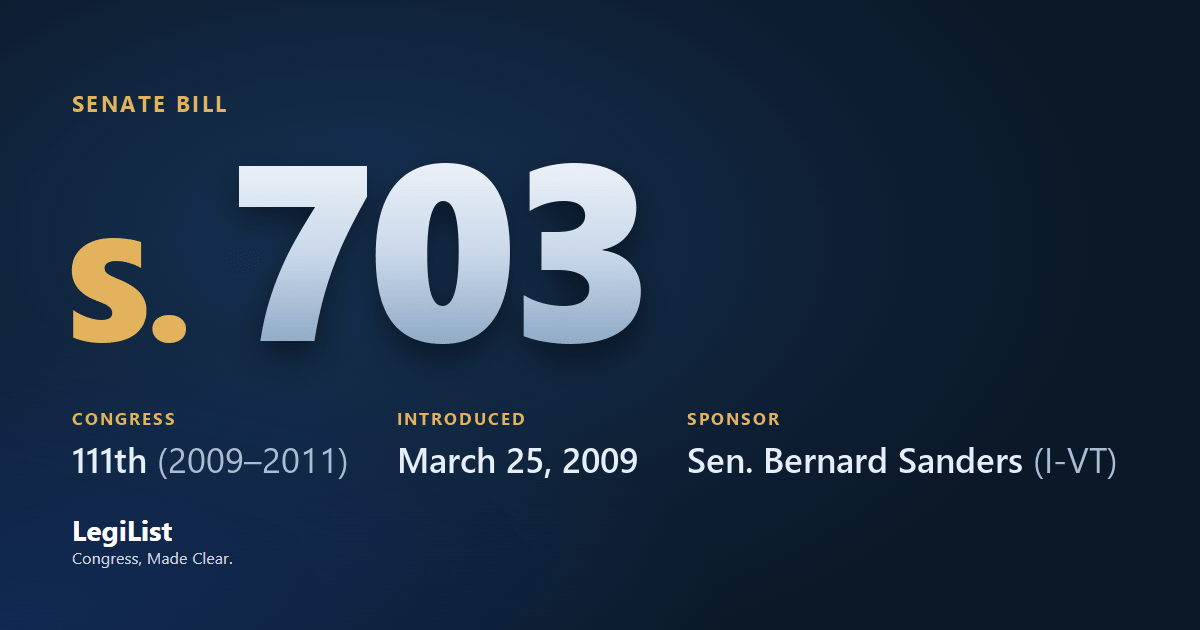
American Health Security Act of 2009
Latest action · Mar 25, 2009 Read twice and referred to the Committee on Finance.
Progress
Where this bill reached, and when. A stage with no date was not reached; one that failed a vote and later carried shows the date it carried.
- IntroducedMar 25, 2009
- Passed SenateNot reached
- Passed HouseNot reached
- To the PresidentNot reached
- Became lawNot reached
Summary
American Health Security Act of 2009 - Establishes the State-Based American Health Security Program to provide every U.S. resident who is a U.S. citizen, national, or lawful resident alien with health care services. Requires each participating state to establish a state health security program.
Eliminates benefits under: (1) titles XVIII (Medicare), XIX (Medicaid), and XXI (State Children's Health Insurance) (SCHIP) of the Social Security Act; (2) the Federal Employees Health Benefits Program; and (3) the Civilian Health and Medical Program of the Uniformed Services (CHAMPUS).
Requires each state health security program to prohibit the sale of health insurance in that state that duplicates benefits provided under the program.
Establishes the American Health Security Standards Board to: (1) develop policies, procedures, guidelines and requirements to carry out this Act; (2) establish uniform reporting requirements; (3) provide for an American Health Security Advisory Council and an Advisory Committee on Health Professional Education; and (4) establish a national health security budget specifying the total federal and state expenditures to be made for covered health care services.
Establishes the American Health Security Quality Council to: (1) review and evaluate practice guidelines, standards of quality, performance measures, and medical review criteria; and (2) develop minimum competence criteria.
Establishes the Office of Primary Care and Prevention Research within the Office of the Director of the National Institutes of Health (NIH).
Amends the Internal Revenue Code to create the American Health Security Trust Fund and appropriates to the Fund specified tax liabilities and current health program receipts.
Cosponsors
Members who signed on, in the order they did.
Committees 1
Where it was sent and what each committee and subcommittee did with it, in order.
| Chamber | Committee | What it did |
|---|---|---|
| Senate | Finance Committee | Referred Mar 25, 2009 |
Actions 2
Everything that happened, newest first.
- Mar 25, 2009Introduced in Senate
- Mar 25, 2009Read twice and referred to the Committee on Finance.
Research
What has been written about this bill: committee reports, cost estimates, the sponsor’s authority statement, printed hearings and the Congressional Research Service’s work.
Printed hearings 2
Hearings whose printed record names this bill, newest first: hearings on it, and wider hearings where it came up.
| Number | Hearing | Committee | Held |
|---|---|---|---|
| S. Hrg. 111-974 | HEALTHCARE REFORM ROUNDTABLE (PART I)116 pages | Health, Education, Labor, and Pensions Committee | Jun 11, 2009 |
| Serial No. 111-14 | HEALTH REFORM IN THE 21ST CENTURY: INSURANCE MARKET REFORMS134 pages | Ways and Means Committee | Apr 22, 2009 |
Related bills 1
Companion bills and other measures the record links to this one.
| Bill | Title | Relationship | Latest action |
|---|---|---|---|
| HR 1200 | American Health Security Act of 2009 | Related bill | Feb 26, 2009 |
Titles 2
Every title it has carried, official and short, at each stage.
- Official Title as Introduced
- A bill to provide for health care for every American and to control the cost and enhance the quality of the health care system.
- Short Titles as Introduced
- American Health Security Act of 2009
Subjects
Assigned by the Library of Congress. Policy area: Health.
- Advisory bodies
- Child health
- Comprehensive health care
- Criminal investigation, prosecution, interrogation
- Department of Health and Human Services
- Education programs funding
- Employee benefits and pensions
- Employment taxes
- Executive agency funding and structure
- Fraud offenses and financial crimes
- Government employee pay, benefits, personnel management
- Government information and archives
- Government trust funds
- Health
- Health care costs and insurance
- Health care coverage and access
- Health care quality
- Health facilities and institutions
- Health information and medical records
- Health programs administration and funding
- Health promotion and preventive care
- Intergovernmental relations
- Medicaid
- Medical education
- Medical research
- Medicare
- National Institutes of Health (NIH)
- Performance measurement
- Research administration and funding
- State and local finance
- State and local government operations
Text 1
Each version as it was printed, newest first.
- Mar 25, 2009Introduced in Senate
Support LegiList
This page is free, carries no paywall, and is built and maintained by one person. If the record here is useful to you, a few dollars keeps it going.
Everything here is as published by Congress: the summary is the Congressional Research Service's, the action wording is the clerks', and the subjects are the Library of Congress's. How far it got is read from the actions themselves, taking the most recent one of each kind, so a bill that failed a vote and later passed is shown as having passed. Records come from this bill on Congress.gov and govinfo.gov; cost estimates are the Congressional Budget Office's, and the hearings are the printed hearings GovInfo publishes, which can appear months after the hearing.