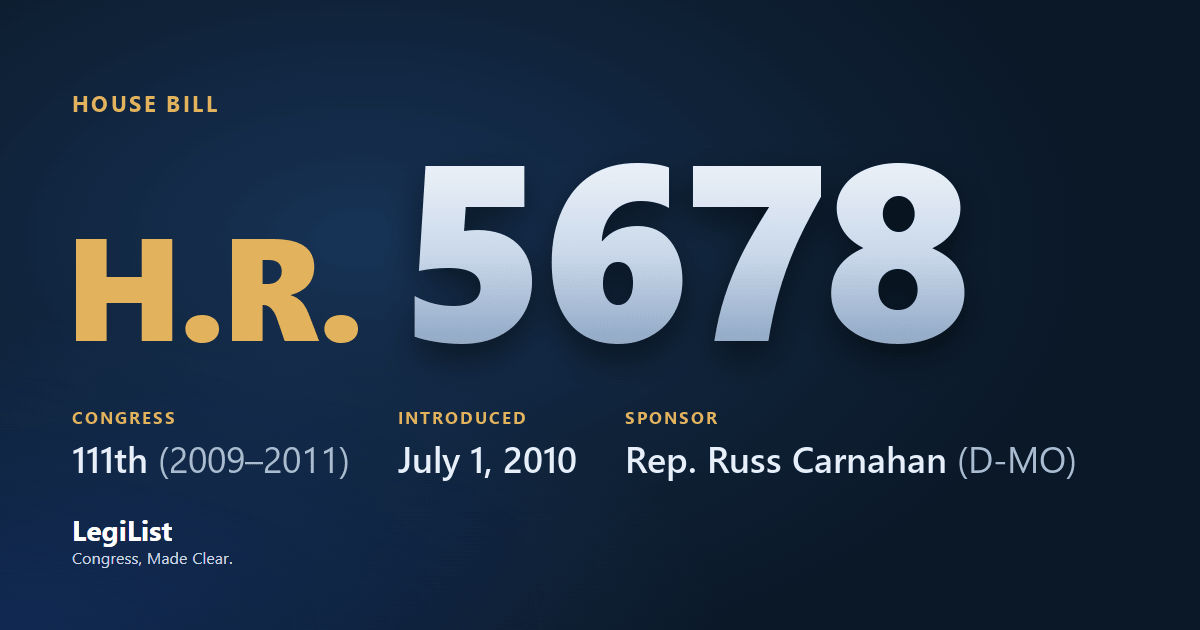
Universal Access to Methamphetamine Treatment Act of 2010
Latest action · Jul 1, 2010 Referred to the House Committee on Energy and Commerce.
Progress
Where this bill reached, and when. A stage with no date was not reached; one that failed a vote and later carried shows the date it carried.
- IntroducedJul 1, 2010
- Passed HouseNot reached
- Passed SenateNot reached
- To the PresidentNot reached
- Became lawNot reached
Summary
Universal Access to Methamphetamine Treatment Act of 2010 - Amends the Public Health Service Act to authorize the Secretary of Health and Human Services (HHS) to make grants to: (1) increase the availability of treatment for methamphetamine abuse; (2) provide vouchers to individuals in underserved populations for authorized services related to such treatment; and (3) establish programs to provide for and coordinate the provision of wrap-around services, such as medical services, job training services, and housing assistance, to methamphetamine-affected individuals.
Revises the grant program to provide residential substance abuse treatment to pregnant and postpartum women to: (1) make caregiver parents eligible for such program; (2) make Indian tribes and tribal organizations eligible for grants; and (3) set forth the priority for allocation of grants.
Requires the Director of the National Institute on Drug Abuse to conduct research on the effectiveness of the use of agonist and antagonist drugs to reduce the problems associated with stimulant abuse, including methamphetamine abuse.
Requires the Secretary to seek to enter into a contract with the Institute of Medicine to complete a literature review on the effectiveness of agonist and antagonist drugs for the treatment of stimulant abuse, including methamphetamine abuse.
Requires the Comptroller General to study: (1) the impact of the programs authorized by this Act on the effectiveness and availability of treatment for methamphetamine abuse; (2) how the level of federal funding available for such treatment compares to the amount necessary to provide adequate treatment; and (3) the impact of effective treatment of methamphetamine abuse on cost savings due to the reduced need for criminal justice and other services.
Cosponsors 10
Members who signed on, in the order they did. Signatures ran from Jul 1, 2010 to Aug 10, 2010; 9 are original cosponsors, there from the day it was introduced.
| Seat | Cosponsor | Signed on | |
|---|---|---|---|
| D-IL | Bill Foster | Original | Jul 1, 2010 |
| D-OK | Dan Boren | Original | Jul 1, 2010 |
| D-KS | Dennis Moore | Original | Jul 1, 2010 |
| R-CA | George Radanovich | Original | Jul 1, 2010 |
| D-TN | Lincoln Davis | Original | Jul 1, 2010 |
| D-HI | Mazie K. Hirono | Original | Jul 1, 2010 |
| D-ME | Michael H. Michaud | Original | Jul 1, 2010 |
| D-NV | Shelley Berkley | Original | Jul 1, 2010 |
| D-NJ | Steven R. Rothman | Original | Jul 1, 2010 |
| D-TN | Steve Cohen | Aug 10, 2010 |
Committees 1
Where it was sent and what each committee and subcommittee did with it, in order.
| Chamber | Committee | What it did |
|---|---|---|
| House | Energy and Commerce Committee | Referred Jul 1, 2010 |
Actions 2
Everything that happened, newest first.
- Jul 1, 2010Introduced in House
- Jul 1, 2010Referred to the House Committee on Energy and Commerce.
Titles 2
Every title it has carried, official and short, at each stage.
- Official Title as Introduced
- To amend the Public Health Service Act to provide grants for treatment of methamphetamine abuse, and for other purposes.
- Short Titles as Introduced
- Universal Access to Methamphetamine Treatment Act of 2010
Subjects
Assigned by the Library of Congress. Policy area: Health.
Text 1
Each version as it was printed, newest first.
- Jul 1, 2010Introduced in House
Support LegiList
This page is free, carries no paywall, and is built and maintained by one person. If the record here is useful to you, a few dollars keeps it going.
Everything here is as published by Congress: the summary is the Congressional Research Service's, the action wording is the clerks', and the subjects are the Library of Congress's. How far it got is read from the actions themselves, taking the most recent one of each kind, so a bill that failed a vote and later passed is shown as having passed. Records come from this bill on Congress.gov and govinfo.gov; cost estimates are the Congressional Budget Office's, and the hearings are the printed hearings GovInfo publishes, which can appear months after the hearing.