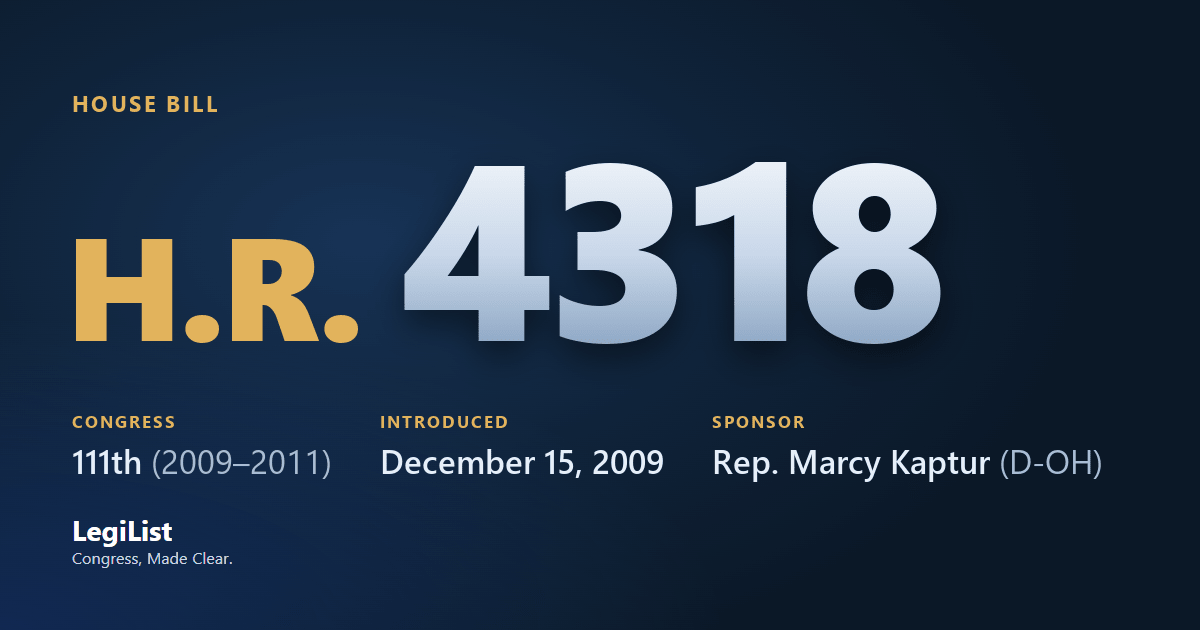
21st Century Civilian Conservation Corps Act
Latest action · Feb 23, 2010 Referred to the Subcommittee on Workforce Protections.
Progress
Where this bill reached, and when. A stage with no date was not reached; one that failed a vote and later carried shows the date it carried.
- IntroducedDec 15, 2009
- Passed HouseNot reached
- Passed SenateNot reached
- To the PresidentNot reached
- Became lawNot reached
Summary
21st Century Civilian Conservation Corps Act - Authorizes the President, in order to relieve widespread unemployment, restore depleted natural resources in the United States, and advance public works programs, to establish a Civilian Conservation Corps to employ unemployed or underemployed U.S. citizens in the construction, maintenance, and carrying on of works of a public nature, such as forestation of U.S. and state lands, prevention of forest fires, floods, and soil erosion, and construction and repair of National Park System paths and trails.
Authorizes the President to extend Corps activities to state- and private- owned lands to prevent and control forest fires and floods and attacks of forest tree pests and diseases.
Authorizes the President to provide housing and transportation for Corps employees. Prohibits discrimination in the hiring of Corps employees.
Cosponsors 9
Members who signed on, in the order they did. Signatures ran from Mar 3, 2010 to Sep 29, 2010.
| Seat | Cosponsor | Signed on | |
|---|---|---|---|
| D-DC | Eleanor Holmes Norton | Mar 3, 2010 | |
| D-CA | Fortney Pete Stark | Apr 20, 2010 | |
| D-CA | Lynn C. Woolsey | May 4, 2010 | |
| D-IN | Peter J. Visclosky | May 4, 2010 | |
| D-HI | Mazie K. Hirono | May 6, 2010 | |
| D-MI | John Conyers, Jr. | May 24, 2010 | |
| D-FL | Kathy Castor | May 24, 2010 | |
| D-AZ | Raúl M. Grijalva | Sep 14, 2010 | |
| D-WI | Tammy Baldwin | Sep 29, 2010 |
Committees 1
Where it was sent and what each committee and subcommittee did with it, in order.
| Chamber | Committee | What it did |
|---|---|---|
| House | Education and Workforce Committee | Referred Dec 15, 2009 |
| Workforce Protections Subcommittee | Referred Feb 23, 2010 |
Actions 3
Everything that happened, newest first.
- Feb 23, 2010Referred to the Subcommittee on Workforce Protections.
- Dec 15, 2009Introduced in House
- Dec 15, 2009Referred to the House Committee on Education and Labor.
Research
What has been written about this bill: committee reports, cost estimates, the sponsor’s authority statement, printed hearings and the Congressional Research Service’s work.
Printed hearings 1
Hearings whose printed record names this bill, newest first: hearings on it, and wider hearings where it came up.
| Number | Hearing | Committee | Held |
|---|---|---|---|
| Serial No. 111-71 | STATUS OF VETERANS EMPLOYMENT137 pages | Veterans' Affairs Committee | Apr 15, 2010 |
Related bills 1
Companion bills and other measures the record links to this one.
| Bill | Title | Relationship | Latest action |
|---|---|---|---|
| HR 6456 | 21st Century Civilian Conservation Corps Act | Related bill | Nov 29, 2010 |
Titles 2
Every title it has carried, official and short, at each stage.
- Official Title as Introduced
- To authorize the President to reestablish the Civilian Conservation Corps as a means of providing gainful employment to unemployed and underemployed citizens of the United States through the performance of useful public work, and for other purposes.
- Short Titles as Introduced
- 21st Century Civilian Conservation Corps Act
Subjects
Assigned by the Library of Congress. Policy area: Labor and Employment.
Text 1
Each version as it was printed, newest first.
- Dec 15, 2009Introduced in House
Support LegiList
This page is free, carries no paywall, and is built and maintained by one person. If the record here is useful to you, a few dollars keeps it going.
Everything here is as published by Congress: the summary is the Congressional Research Service's, the action wording is the clerks', and the subjects are the Library of Congress's. How far it got is read from the actions themselves, taking the most recent one of each kind, so a bill that failed a vote and later passed is shown as having passed. Records come from this bill on Congress.gov and govinfo.gov; cost estimates are the Congressional Budget Office's, and the hearings are the printed hearings GovInfo publishes, which can appear months after the hearing.